Pampers and Paklava

  • Home
  • Photography
  • Travel
  • Food
  • Garden
  • Contact

Marshmallow moments

July 9, 2010 by Beth Shepherd

Big Papa and I climb to the top of the observation tower at Riefel Bird Sanctuary in Ladner, British Columbia to see what we can see.  From every direction marsh and mountain reach out to greet us. Ducks escort their brood through tiny estuaries that wind their way through miles upon miles of Canadian marshland. Yellow-leg Sandpipers skirt along the surface and appear be walking on water. Great Blue Herons drop their landing gear on the aqua blue runway.

Fraser River and mountainsWe hike up three flights of metal stairs to reach the viewing platform. When we are a couple steps away, a little voice calls down to us: “Can you see it?” “See what?” I reply to the pint-sized tow-headed boy who appears just a few feet above me. “The island.”

He might have been four or five years old and has his dad tow. Dad points off in the distance toward a speck of a hump, Bowen Island, and tells they’d visited this island some time ago.

And then, in an instant the little guy moves on to his next observation: “Can you see the cracks in the dirt down there? “ he asks us as he points downward to the bottom of the observation tower. “Yeah” Big Papa and I answer in tandem. “Do you know what those are?” his dad asks him. “No.” “It’s because the ground is dry” Dad informs all of us.

I continue on about the mud, “Hey, look at the thousands of bird tracks” I say as I wave my hand toward the mud flats with bird hieroglyphics crisscrossing every which way. Flat-footed ducks and three-toed Sandpipers leave weaving trails of prints. The kid doesn’t seem all that interested. He’s got a truckload of questions on his mind that he rattles off one by one.

After a few minutes I say to him, “Hey, you know that guy you’re talking to (motioning in Big Papa’s direction), well it’s his birthday today. “Oh” he whispers with a bit of awe and turns toward Big Papa: “Do you want a marshmallow? “Dad, can we give him a marshmallow?” Dad tells the kid there are four marshmallows left and that if he gives Big Papa and me two of those, there will be two left. “Ok.”

Dad reaches into his pocket and pulls out a visibly worn Kraft marshmallow bag and Big Papa and I are each handed a Marshmallow. We accept gratefully as the towheaded kid and his dad disappear down the stairway. Three Sandhill Cranes

The marshmallow softens and sugar fills my mouth. My heart melts just a little bit and lets sweet emotions seep in.

There are days when I wonder if we will ever become parents. Waiting feels like forever, we bump up against unexpected walls and there have been a number of significant challenges…some that I am not able to write about just now. Sometimes I feel dejected, beaten even. Then, when I least expect it, out of the blue comes an instant like this one that touches my very core and reminds me why we’ve traveled this far and why we endure all that we have endured.

Heron taking flightThis journey we’re on is both wondrous and heartbreaking. Simple moments like this get me through, a gesture that starts as something so small and then unfolds its wings to soar as the dream of something so much bigger.

Filed Under: Adoption, Food Tagged With: Bowen Island, British Columbia, Ladner, marshmallow, Reifel Bird Sanctuary

But a Bing

June 23, 2010 by Beth Shepherd

It’s unbelievable! It’s a miracle! It’s a TV dinner! It’s Wonkavision. It could change the world!
~Willy Wonka and the Chocolate Factory

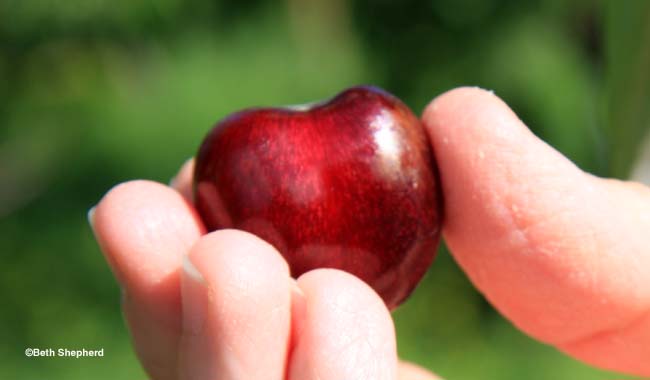
Cherries of every size and hue hung like the queen’s jewels along the branches. Ruby-red Kionas, marigold yellow Rainiers with blushing hints of rose and deep burgundy Santinas. And that was just the beginning. There were Skeenas and Reginas, Tieton and Benton, Chinook and Cowiche, not to mention one of my favorites, the yet-to-be-named 71-43-3. I think I saw every variety of cherry known to man in this scrumdiddlyumptous orchard, except Bing, because this orchard was about so much more. I had definitely landed in the everlasting gobstopper world of cherries.

heart-shaped cherry

Heart-shaped cherry

Cherries that would grow to be the size of a ping pong ball drank in the 75-degree rays of Yakima sunshine and puffed up their round shoulders. Heart-shaped cherries, that practically begged to  float on a bed of Chantilly cream and be nibbled by young lovers, cuddled en mass between emerald green leaves.  That’s right, heart-shaped cherries.

Snozzberries? Who ever heard of a snozzberry?

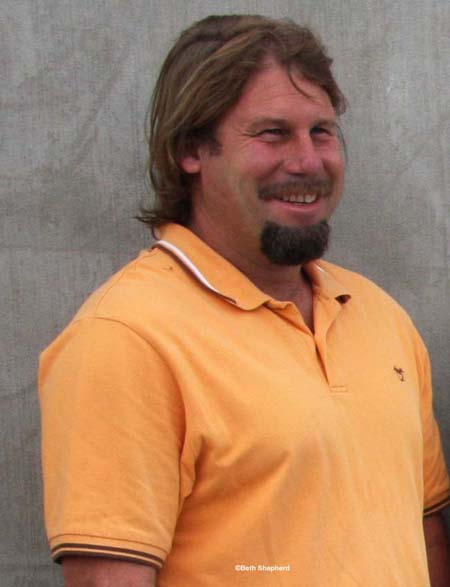
Mark HanrahanIn the middle of this entire splendor is Mark Hanrahan, of Knight Hill Farms, the delightful master of a very impressive cherry kingdom. He shepherded his flock of eager tasters (on a “learn about cherries from tree to table” tour) up one lane of trees and down the other calling out to us as we passed variety after variety like a revved up Willy Wonka guiding his cast of characters through the wonders of the chocolate factory. “Come over here and look at this one. It’s my favorite!” he tells us and off we trot, grabbing a handful of this and stuffing one or two of that into our bags and our mouths as we traipse along acres and acres of cherry heaven.

Practically prancing from row to row like a kid visiting Disneyland for the first time, it’s obvious that Mark is both extremely passionate and knowledgeable about growing cherries. “Do you grow apples too,” asked one naïve soul. “No. I don’t like apples. I like cherries” was his salt-of-the-earth response.

During our time in his orchard, I learned more about cherries – specifically growing cherries – than I ever could have possibly imagined. For example, who knew UFOs weren’t those unidentified flying objects in the sky but rather “upright fruiting offshoots,” a cherry training system born in the research orchards at the WSU Irrigated Agriculture Research & Extension Center in Prosser. Cherry trees are planted at an angle of 20 to 30 degrees, and tied to a trellis wire, like espaliered apple trees.

Mark is one of a handful of growers who’ve been experimenting with UFO-type systems over the past few years. He estimates that UFO trees yield about three times as much fruit, though he is quick to tell us that that the real pay-off is in the in the quality, not the yields.

Aside from UFOs, Mark sees the future of cherries in more varieties of cherries to suit diverse palates; mechanical picking, where trees are shaken by a machine, not a person, with the fruit falling into a basket; and,”stemless cherries,” varieties coaxed through genetic research to a point where the cherries “will easily dislodge from their stems. Mark’s ideas aren’t just lofty [cherry] pie in the sky fantasies. Cherry research (much of it at Washington State’s own WSU) supports a wide-range of cherry developments from new rootstocks to innovative growing and harvesting methods.

So much time and so little to do. Wait a minute. Strike that. Reverse it.

Oodles of cherriesOf course one can’t walk past cherry tree after cherry tree without so much as a nibble. And lucky us, because we’d been given a quart-sized baggie and clear instructions to sample to our heart’s content. In fact, Mark urged us to taste, taste, taste…and report back to him. Did we fancy the crunch of this cherry or the acidity of that cherry? Which variety did we like best?

So taste away we did. If Mark was Willy Wonka then I was most definitely Violet (or more aptly Cherry) Beauregarde: “Oh-my-god-this-cherry-is-so-amazing-I-must-have-MORE!” Certainly at any moment, someone was going to turn in my direction and say: “She’s swelling up! Like a blueberry!” Except in my case it would be like a cherry.

Ruby redAlong with twenty other happy campers, I spent a delicious hour or two stuffing myself silly with red roly-poly stone fruit. We ambled along picking willy-nilly from this tree and that, sweet cherry juice dripping from our lips, staining our fingertips and filling our bellies to the brim.

I want you to roll Miss Beauregarde into the boat and take her along to the Juicing Room at once. ‘Kay?

It was glorious afternoon indeed enjoying the fruits of Mark’s labor. His dedication to the genus Prunus is admirable. If ever cherries can be considered cutting edge, the cherries in this orchard can. And, if anyone has the vision and ability to make it so, it’s Mark Hanrahan.

We are the music makers… and we are the dreamers of dreams.

Hungry for more? Check out all the deliciousness in Wanderfood Wednesday!

Filed Under: Food, Travel Tagged With: Benton, cherries, cherry, cherry grower, Chinook, Cowiche, Kiona, Knight Hill Farms, Mark Hanrahan, mechanical picker, Prosser, Rainier, Reginas, rootstock, Santinas, Skeenas, stemless cherry, Tieton, UFO, upright fruiting offshoots, Violet Beauregarde, Willy Wonka and the Chocolate Factory, WSU, Yakima

Eat like a bird

June 9, 2010 by Beth Shepherd

Mmmm. Nothing like a little Nyer thistle mixed with some sunflower chips, and millet to wet my appetite. Well, at least nothing like it, if I’m Mr. Finch. Rosy the robin starts her morning nibbling with a few tasty earthworms. Groovy grubs crawling on the ground look dang delightful to Freddy Flicker. And we all know that Mrs. Hummer has a sweet tooth and heads straight for the Scarlet Runner Beans after sidling up to the hummingbird feeder for an appetizer of sugar water.

Mr. HummerYes, I know it’s Wanderfood Wednesday and a post on birdie buffet qualifies oh-so-tangentially, but what can I say? My feathered friends are feasting happily these days and the Urban Cabin just became an official ‘Certified Wildlife Habitat,™’ so I was in the mood to sing the praises of all we’ve done to put food on “the table” for the denizens who frequent our yard.

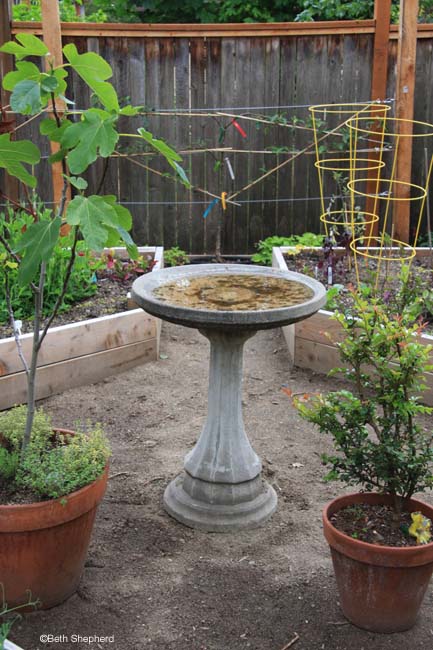
birdie bathOur back-forty is tiny, but what it lacks in size it makes up for mightily in food, both for us human folks and for those who fly, crawl and scamper inside its fenced walls. On the fruit front, Big Papa and I are lucky to host three Greengage plum trees (that are enormously prolific), one small apple tree (that doesn’t really produce much), two baby espaliered apple trees, two figs, three blueberry bushes, one huckleberry,  one lingonberry, and a bunch of strawberry plants that substitute for ground cover along our east fence line. Veggie-wise, we’ve now got four raised beds filled with green stuff (struggling with our abysmal spring but planted nonetheless) plus two raised herb beds.

Mature treesWe’re still working on getting our yard back to 100% after the remodel, but slowly and surely plant and animal life is enjoying our garden once again. Cape Fuchsia bloom day-glow pink in one corner, assorted beans start their skyward climb up trellises and brilliant purple salvia beckon.

Besides the fruit trees, plants and flowers, “our” birds can find cover in two gigantic Poplars, (amazingly enough in our pipsqueak urban location) and a scattering of fluffy shrubs. They can take up long-term residence in two bird houses. Three birdbaths pepper the property so there’s always a spot for them to spruce up and preen.

I’d heard about National Wildlife Federation’s ‘Certified Wildlife Habitat™ for some time and finally decided to hop on to their website and find out exactly what would be required to register the Urban Cabin in their program. It’s quite simple, really. All you need to do is provide elements from each of the following areas in your yard:

  • Splish splashFood sources : native plants, seeds, fruits, nuts, berries, nectar
  • Water sources: Birdbath, pond, water garden, stream
  • Places for cover : thicket, rock pile, birdhouse
  • Places to raise young: dense shrubs, vegetation, nesting box, pond
  • Sustainable gardening: mulch, compost, rain garden, chemical-free fertilizer

Birdhouse for leaseAs the NWF site says, “you don’t need a 20-acre farm to create a garden that attracts wildlife and helps restore habitat in commercial and residential areas. By providing food, water, cover and a place for wildlife to raise their young, and by incorporating sustainable gardening practices, you not only help wildlife, but you also qualify to become an official Certified Wildlife Habitat™.”

Alright then, let’s find out how the Urban Cabin stacks up:


  • Provide food for wildlife: Several mature trees and an assortment of nectar, berries, and seeds that many species of wildlife require to survive and thrive. Plus, we have a few supplemental feeders.
  • Supply water for wildlife:  Bird baths and one rain chain.
  • Create cover for wildlife: Shrubs and nesting boxes offer places to hide in order to feel safe from people, predators and inclement weather.
  • Offer a place for wildlife to raise their young: One Mason bee box, two birdhouses and bushes where butterflies and moths can lay their eggs.
  • Sustainable gardening: Composter, mulch, minimal chemicals and virtually no “turfgrass.”

The missusCheck, check, check, and check. Big Papa and I submitted our application. The Urban cabin will soon take its place alongside thousands of wildlife enthusiasts across the country who have turned their yards and gardens into Certified Wildlife Habitat™.  How cool is that?

Of course the birdies couldn’t give a tweet about any of this. All that matters to them is that the “all you can eat” Urban Cabin Bar and Grill remains open and no one cries fowl at the feeder.

Filed Under: Food, Garden Tagged With: birdbath, Birds, feeders, National Wildlife Federation

White Chocolate-Rose Geranium Ice Cream Recipe

June 2, 2010 by Beth Shepherd

Homemade ice cream is one of my “signature dishes.” Over the years I’ve brought quarts upon quarts of ice cream to potlucks, enough that I’ve (no modesty here) developed a stellar reputation amongst my friends for my ability to prepare this sinful (read: heavy cream, sugar, eggs) treat. My “specialty” is making ice cream using herbs picked from our garden. Fresh mint with shaved dark chocolate, thyme with honey and even simple sage (which, as a sweet treat, is amazingly delicious and perfect when paired with a  garden fresh yellow plum crumble).

Rose geraniums

A couple weeks ago, I cooked a traditional Armenian dinner for friends: sarma, pilaf and shish kebab. Of course, it went without saying that pakhlava would be on the dessert menu. Even though our table was laden with plenty of food to fill four happy bellies, I felt like something would be amiss if homemade ice cream wasn’t along for the ride.

When Big Papa and I visited Yerevan this past September, along with the tasty Armenian cuisine we enjoyed were a few dishes of superlative ice cream. I don’t know what the “secret” was: the milk, some other ingredient or how it was prepared?  No matter, Big Papa and I lapped up every last exquisite spoonful (and I, for one, would have shamelessly licked the bowl  had we been in our own home).

Me, myself and I debated which flavor would pair nicely with our meal. Fennel was a strong contender, but ultimately I selected a recipe where I could use the ‘Bengal Rose’ scented geraniums growing on the deck of the Urban Cabin. Scented geraniums, unlike your usual garden-variety, window box geraniums, have leaves that can be crushed or cut and used for various culinary purposes: baking, jam-making and, in this case, infusing into warm cream. Scented geraniums come in such a variety of flavors and scents that you could designate an entire greenhouse to them. If you love apricot, they have it. If mint is your preference, taste chocolate mint and peppermint. Lemon, lime, apple, ginger and nutmeg are scented geranium flavors, too.

While not traditionally Armenian per se, rose is a flavor used in ice creams (and other desserts) in Persia and the Middle East. ‘Rose water’ is typically the source for imbuing sugary delights and could be substituted in this recipe (a couple teaspoons or “to taste”) as could organic (only organic!) rose petals (say 30 or so).

The recipe I found also incorporates white chocolate, and though it did add some additional richness to the final product, the next time I make this ice cream (and there will most definitely be a next time), I plan to go rose all the way.

Suffice it to say that White Chocolate-Rose Geranium ice cream was a hit. Exotic yet subtle perfumed hints of rose called to mind the summer I hope will eventually unfold in Seattle.

White Chocolate-Rose Geranium Ice Cream

Ingredients
11/2 cups whole milk
11/2 cups heavy cream
10 to 12 fresh organic rose geranium leaves, coarsely chopped
4 large egg yolks
1/2 cup granulated sugar
6 ounces white chocolate, finely chopped
1/4 teaspoon vanilla extract
Garnish (optional):
Organic pink rose petals (at least seven)
Organic rose geranium leaves, whole (at least seven)

Preparation
1. Combine milk, heavy cream and geranium leaves in stainless steel saucepan. Bring mixture to simmer over medium heat. Turn off heat. Allow leaves to steep in warm mixture about 20 minutes.

2. Meanwhile, whisk eggs and sugar in bowl.

3. Place chopped white chocolate and vanilla extract in another bowl. Set aside.

4. Using stainless steel sieve, strain cream into egg mixture to remove geranium leaves. Press any excess fluid from leaves through sieve. Whisk to combine.

5. Place ice cream base in clean stainless steel saucepan and cook over medium heat, stirring constantly, until mixture has thickened, about 5-10 minutes. Do not boil, or base will break.

6. Immediately remove base from heat. Using fine mesh stainless steel sieve, strain mixture into bowl containing chocolate and vanilla. Stir until chocolate is completely melted.

7. Cover surface of base with plastic wrap and allow base to cool to room temperature.

8. Refrigerate mixture until it is has completely cooled to refrigerator temperature, about 40-45°F, or about 3 hours. (You can accelerate this process by placing mixture in shallow bowl in freezer for about 20-30 minutes.)

9. Pour chilled base into bowl of ice cream machine, and churn following manufacturer’s instructions. Remember: Many ice cream machines have bowls that must be thoroughly frozen first. Mixture should churn to relatively stiff consistency within 30 minutes in most commercially available machines. For firmer consistency, turn churned ice cream into small chilled bowl, cover with plastic and freeze for another 1-2 hours before serving.

10. Using small ice cream scoop, transfer ice cream to chilled serving dishes. Garnish each with pink rose petal and geranium leaf, as desired. Serve immediately.

This recipe developed by Julia M. Usher
Want more deliciousness? Check out Wanderfood Wednesday!

Filed Under: Food, Garden Tagged With: herbs, ice cream, Persia, rose water

This little piggy went to market

May 19, 2010 by Beth Shepherd

This little piggy went to the Madrona Farmers Market. This little piggy stayed home (to tend to the garden). This little piggy ate grass-fed roast beef. This little piggy had none (vegetarian). And this little piggy went “wee, wee, wee, wee” all the way home (to the Urban Cabin).

Madrona Farmers MarketLast Friday was this season’s kick-off for the farmers market in our neighborhood and this little piggy was one happy camper. I’m a sucker for farmers markets wherever they may be, but when it’s less than a mile from the Urban Cabin, well that’s nothing short of nirvana in my book.

Oh farmers market how I love thee. Let me count the ways. First there are all the yummy farm fresh veggies. How can you possibly go wrong with home grown greens? Whether it’s my favorite ‘Samantha’ lettuce or tasty lemon cukes, there’s nothing like just-picked-off –the- vine goodness. The only thing better is when the food is coming from my own back forty.

fish guysThen there are all the friendly market folks who sell a diverse selection of deliciousness: Michelle, the “potato lady,” who plies potatoes for Olsen Farms and is also an adoptive mom; Tim and David, the “fish guys” from Wilson Fish who offer up the biggest smiles and some of the freshest, best tasting salmon I’ve ever had; the sweet dynamic duo from Whidbey Island Ice Cream who are the reason all the kids (and many adults) within fifty feet have faces covered with ice cream; and, newbies like lovely Lucy who sells sensuous teas with kicky packaging and healthful benefits.

I actually look forward to seeing the same sellers on a weekly basis. Giving my money to hardworking people I “know” is, in my opinion, the best possible way to part with my dollars. It feels like a big extended community and I’m sure that’s one of the reasons anything that comes home with me from the market tastes oh-so-much better.

You scream, I screamWatching the other market goers who, just like me, have huge grins on their faces is another reason I get giddy about going to the market. We swarm around like a big school of fish grabbing our cheese here and our eggs there as we fill up our sustainable shopping bags until they are brimming with bounty. It’s a chance to gather your grub while enjoying a local adventure all wrapped up into one earthy package.

Seattle is blessed with farmers markets aplenty. There are probably at least a dozen on the west side of the pond (Lake Washington) and a number of markets on the east side too. I’ve visited several of them and they each have their own unique features and charm, but of course there’s something pretty cool about having a farmers market that’s practically in your own backyard.

Veggie startsOpening day for the Madrona Farmers Market was as perfect as it could be. The sun warmed my shoulders. I got to catch up with old friends (hello Wilson Fish!) and make some new ones (nice to meet you, Lucy). A couple tomato plants accompanied me home and are now enjoying their new digs in one of our raised planter beds, and Big Papa and I enjoyed the fruits from my market foraging all weekend long. Summertime and market memories here I come. A fine way indeed to spend a Friday afternoon.

Eat your veggies and more on Wanderfood Wednesday!

Filed Under: Food, Garden Tagged With: Central District, Farmers Market, Herbal Philosophy, Madrona, Olsen Farms, Whidbey Island Ice Cream, Wilson Fish

Food to make my heart SOAR

May 5, 2010 by Beth Shepherd

“She likes the top of matzoun and the bottom of pilaf,” is an Armenian expression which means ‘she loves everything good.’ I was lucky enough to enjoy a lot of ‘everything good,’ this past Sunday in a hands-on Armenian cooking class fundraiser for SOAR (Society for Orphaned Armenian Relief). All the money will go directly to purchase greatly needed supplies for orphans living in orphanages in Armenia. Busy hands-Sarma Hearing the ‘yums’ and ‘ahhs’ echoing during the 2.5 hour class, I know that everyone attending had a delicious time.

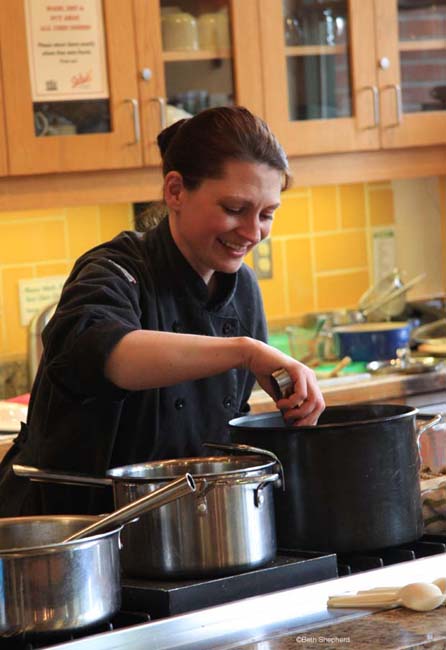
The cooking class was held at Metropolitan Market.  Lesa Sullivan, who taught the Armenian cooking class I attended at PCC Natural Markets, was the chef. She also generously donated her services at a pittance. This cause is near and dear to her heart as well since Lesa’s husband is of Armenian descent. Lesa was also very close to an Armenian family during her younger years growing up in Salt Lake City, Utah.

Lesa CooksThe fabulous menu included:

  • S’rj: spiced Armenian coffee
  • Sarma: rolled and stuffed grape leaves
  • Lentil soup
  • Matzoun: Armenian yogurt
  • Armenian Pilaf: pasta, rice, and chopped apricots
  • Bourma: sweetly spiced rolled phyllo dough dessert

Nineteen participants rolled up their sleeves and then got down to business rolling Sarma and Bourma, and stirring lentils while sipping S’rj and munching on snacks of lavash, Armenian flatbread, and Soujuk, Armenian sausage. I saw a room full of smiles, heard a constant stream of laughter and smelled the intoxicating fragrances of Armenian cuisine.

When the class ended, and after we cleaned up, Lesa gave me a special treat: two pint-jars of Matzoun.  Matzoun, Armenian yogurt, is sour firm and thick. I am a yogurt aficionado and Armenian yogurt, in my somewhat biased opinion, is the crème de la creme. When I was visiting Yerevan, Armenia this past September, I got to eat some of the best darn yogurt I’ve ever had. Yogurt for breakfast with sliced fruit. Yogurt served as a ‘side’ to drizzle on top of dolma and sarma rolls. A refreshing minted yogurt, called Tahn, was chilled with ice and water and offered as a drink to pair cool down the heat of spicy Lamajoun (Armenian pizza).

One interesting thing about yogurt is that it takes yogurt to make yogurt. That’s not so much of a problem today, when plain yogurt purchased from the supermarket provides the necessary bacterial starter. But that wasn’t always the case.

Making MatzounBeing an organic substance, getting the first yogurt starters into the United States in the 19th century was no easy task. There was absolutely no way for the immigrants to simply bring their needed starter through American customs. But American customs agents greatly underestimated Armenian ingenuity.

The essential ingredient for turning milk into yogurt is a complex set of bacteria that basically takes over the medium (milk) and transforms it. The bacteria can live for a period of time under less than ideal circumstances. Knowing this bit of information is essential. Savvy Armenian émigrés would dip some fresh white handkerchiefs into a mixture of water and yogurt before they sailed for America. The handkerchiefs were then line dried and neatly folded into their luggage. Once they were safely through customs and settled into their new homes, they would simply soak the linen in some warm milk, reactivating the culture, and make their yogurt!

Two yogurtsI could hardly contain my excitement as Lesa nestled the pint jars of yogurt into a small carry-out container, wrapping a dish towel tightly around the twin treasures to prevent my precious cargo from too much jostling. They sat and “cured” on my counter at home for twelve hours and are now chillin’ for a few days in the fridge. I can’t wait to dive in and enjoy my homemade Matzoun.

All in all, it was a wonderful way to while away the afternoon. The class, the cuisine, the companionship, and the cause: it all made my heart soar.

Matzoun (Yield 3-1/2 cups yogurt)

  • 3 cups organic heavy cream or half and half
  • 1 package yogurt starter or 3 tablespoons cultured yogurt

Prepare your yogurt maker according to manufacturer’s instructions or have ready a small insulated cooler, warm, damp towels and glass jars. Wrap the jar in the warm towels while preparing the yogurt. Heat cream in a saucepan until a thermometer reaches 180 degrees Fahrenheit. Remove from heat and whisk in the starter or yogurt. Fill your yogurt making container according to the manufacturer’s instructions or fill the glass jar with the cream (or half and half). Wrap the warm towels around the glass jar and tuck them into the insulated cooler (if the towels have cooled, you can toss them in the microwave or your dryer to gently rewarm them). Close the cooler and gently place it in an out of the way place that’s a tad warm (like the top of the fridge) for 8-12 hours. Test for desired thickness; if it’s not to your liking you can let it go another 8-12 hours. Cover and refrigerate. Yogurt will stay good for up to a month and will continue to sour as it ages. When you are ready to make your next batch of Matzoun, simply take 3 tablespoons of your remaining Matzoun for a ‘starter’ and begin again.

Want to read about more tantalizing treats? Check out Wanderfood Wednesday. And, keep an eye out for upcoming weeks in Pampers and Pakhlava, where I’ll share more divinely delicious Armenian recipes.

Filed Under: Adoption, Food, Friendship Tagged With: Armenian pilaf, Bourma, Dolma, FRUA-INC, Lamajoun, lentil soup, Lesa Sullivan, matzoun, Metropolitan Market, Puget Consumers Coop, S'rj, Sarma, SOAR, Society for Orphaned Armenian Relief, Tahn, WA, yogurt

Cooking Thyme

April 28, 2010 by Beth Shepherd

If such a thing as ‘GA’ (Gardener’s Anonymous) existed, I would be a good candidate. When I pass by a garden store, I find myself lacking in willpower to keep from stopping.  And when I stop, I find myself lacking in willpower to keep from shopping.

Sage and rosemaryI tell myself that I can quit at one 4-inch herb pot, maybe the lemon verbena I’ve been hankering for. Next thing you know, the purple sage is calling my name and those lettuce starts are looking pretty enticing too. Soon enough, at least half-dozen plants have jumped into my carry-out cardboard shopping tray.

My impulse control has flown the coop, my debit card is on the counter and before I can say ‘basil’ I’m out the door and in my car with a whole box load of new plant companions. So last week, when I found myself helplessly staring at the sign that said “20% off on all veggies, herbs and flowers” at Ravenna Gardens, I knew I was on a slippery slope.

While paying for my treasures, I found myself chatting with the convivial clerk who asked me, “Do you have any recipes for cooking with thyme?” “Huh?” “What?” “Are you kidding? Of course I do!”

ThymeI love cooking with fresh herbs. A sprig of mint gives homemade lemonade a kick. Sage or fennel ice cream is divinely delicious. Petite purple chive blossoms look adorable and taste fantastic tossed on top of pasta. There is no end to the ways fresh herbs spice up a meal…and life.

As far as thyme goes even a sprinkle of lemon thyme take a simple salad up a notch. I made Honey Thyme Ice Cream and served it with homemade plum cobbler (from our trees, ‘natch). Beyond yummy. Toss a bit of thyme into tomato sauce (along with oregano and fresh basil) or add to an omelet and your taste buds will smile.

Right now several varieties of thyme are growing happily in the yard of the Urban Cabin: lemon thyme, silver thyme, English and French thyme. There are hundreds of varieties of thyme, many scented, like caraway or orange. For the most part, the average gardener (and cook) can be quite happy with just one or two.

A couple of my favorite “recipes” for using thyme are hardly recipes at all. Stuffing a few fronds of thyme under the skin of a chicken breast, accompanied by fresh rosemary and a sage leaf or two (and maybe a slice of lemon) is a quick and easy way to add flavor before grilling.

Lemon thymeFor an appetizer (or vegetarian) my “Goat cheese dip” always receives rave reviews. Start with a log of plain goat cheese, drizzle with a swirl or two of virgin olive oil, mix with a blend of chopped fresh herbs (my favs are thyme, chives, sage and rosemary). Spread on crackers or bread, slather on tomatoes, or stuff between…well, just about anything.

The ancient Greeks believed thyme was a source of courage. So be courageous. Cook with thyme.

Want more deliciousness? Visit Wanderfood Wednesday!

Filed Under: Food, Garden Tagged With: cooking, herbs, thyme

Adoption is green

April 22, 2010 by Beth Shepherd

Since today is Earth Day, I’m thought I’d write about how adoption is ‘green.’ Yes, it’s true that green is the “new black.” These days it seems like everybody’s going green.

Big Papa and I try to tread lightly on the earth. We have one car and it’s not an SUV by a long shot. Big Papa walks to and from work. I buy most of my clothes second-hand from consignment shops. Our house, the Urban Cabin, has a small footprint. With our recent remodel, we now have planter beds for raising veggies.

Still, when it comes to raising children, the drive to leave one’s DNA behind is fierce. So while I couldn’t be prouder that our adoption is one small contribution to population control, I can’t say the path to this point was a straight line.

Mama and baby bird

Let me be clear that we’re not adopting just so we can be hip and trendy. What I will tell you is that being respectful of our increasingly fragile environment and overpopulated planet, is one of the many reasons Big Papa and I decided that adoption was the way we wanted to create our family.

It’s true that getting pregnant the old-fashioned way was not in the cards for us. My egg making days were long since over and, even if they weren’t, Big Papa had his own fertility challenges. But in these modern times, adoption was one of several ways we could become parents.

We seriously considered pregnancy using a donor egg. We’d finding a nice 20-something gal to be a donor; she might even look like me with brown curly hair and a penchant for creative arts. Then we’d inject Big Papa’s sperm into her egg, implant it in me and voila. If we got lucky, nine months later we’d be changing diapers.

I went through all the tests (one, in particular, that was insanely painful), got myself all hopped up on hormones for a trial run to see if my uterus could get “fluffy” enough to host a fertilized egg and, for a few months, even thought we had the support of our insurance company for infertility expenses.

If I didn’t get knocked up, we were told that another option available to us was “egg adoption,” where folks purchase eggs that were IVF “rejects” (e.g. never got used). What this would mean is that we’d get someone’s egg, already fertilized with someone else’s sperm, implant it in me and I’d grow the baby. I’d get to experience being pregnant and giving birth and then we’d have….well, frankly we’d have the equivalent of an adopted kid because there would be no genetic link to either of us.

Egg adoption is fairly cost effective, but it just didn’t feel right to us. There are so many kids in the world already who need homes. How could we put ourselves in a position where we’d be creating yet one more?

Of course, while we were weighing the pros and cons of fertility treatments, we also investigated adoption. My niece is adopted and both of Big Papa’s siblings are adopted. Big Papa was an “only” biological child and Big Papa’s papa was an only child, so as an extended family we’re pretty darn green, in terms of doing our bit not to overpopulate the earth.

We weren’t in a financial position to try in vitro and then, if it didn’t “take” or if I had a miscarriage move forward with adoption. It was one or the other. That’s a pretty heavy decision.  But even if we had been in the position to bet the farm, I’m not sure we would have.

To some degree the decision was made for us. In the eleventh hour, our insurance company bailed out on financial support and the fertility clinic reassigned the donor we’d selected. We’d already drawn the line at egg adoption. Going that route was out of the question.

We chose adoption. Or maybe adoption chose us.

Some days I worry. Will our kid be able to love us and us him? Is it fair to raise an Armenian kid on American soil? Did we make the right decision?

But then there are just as many days when I feel tremendous pride in our choice. We have created a nest right here in the Urban Cabin for our adopted child. We can’t solve all the world’s problems with environmental shortages or find a home for the hundreds of thousands of orphaned kids around the world, but we can exert a bit of greenness right here on our own soil by making a place at our table and in our hearts for one little kiddo who needs a home. It’s one way we can offer up some lovin’ for the big home we call planet earth and the folks who share it with us. Maybe that’s what adoption and Earth Day is all about. Starting right here, at home, with us.

Filed Under: Adoption, Family, Food, Garden Tagged With: Earth Day, egg adoption, green

Lunch with a lama

January 27, 2010 by Beth Shepherd

Inky blackness greets my eyes as I step outside our hotel’s front door. My skin prickles from the intense sharpness of the cold air. As my eyes adjust to the darkness, I can see millions of stars filling the darkness, like a Pointillist painting. The Milky Way spills out in a cloudy haze. I feel so small, just one speck of life.

My husband, Big Papa, and I are spending the night at a hotel in Tingri, Tibet one stop in our trek from Lhasa to Mt. Everest base camp. Tingri has a population of approximately 523 and is at an elevation of 14,107 feet. The elevation combined with the pure, unpolluted skies gives us a view of our galaxy we’ll never forget. I’m sure if I just stretched my arm out an inch or two farther, I could touch the stars.

What a difference a seven-hour plane flight and a couple days of driving makes. Our journey began in Beijing. Traveling from this sprawling, polluted metropolitan city to Lhasa, the capitol of Tibet is a study in contrasts. As the Chinese tear down old Beijing, in its stead an uber-modern sterile hulk of a city rises out of the destruction. Change is afoot in Lhasa too, and some years from now, it may bear little resemblance to its former self.

But once the city of Lhasa disappears over the horizon, the Tibet which emerges has remained unchanged for thousands of years. The feeling of being in a place where the sights, scents and sounds are as ancient as time itself reverberates deeply inside my soul, like the rich bass voice of the monk chanting at Tashilhunpo Monastery, where we’d stopped just the day before.

Tibetan light

Like most of our trip, the previous day’s drive to Tingri could only be described as surreal. We’d just finished a filling lunch in Shigatse and had been on the road for about a half-hour. A short distance in front of us, we see several trucks pulled off to the side of the road and a gathering of people. Tenpa, our Wisdom Tours guide, tells Chimi, our driver, to pull over so we can see what’s going on.

In the middle of a circle of local farmers and villagers we see a bald-headed, burgundy-cloaked Lama: not exactly what you might expect to see in the middle of the countryside. We sit and stare from safe distance for, a few minutes the Lama until notices us and waves us over to join him. We don’t know what to do, but Tenpa encourages us to go, so off we tromp across the field. “Welcome. Please sit down,” the Lama greets us in clear English. He motions us to sit, on the ground, in the middle of a group that has gathered around him. Several monks appear with thermoses of hot water and hot water only. We aren’t sure why we don’t rate a serving of tea. Plates piled full with momos: dumplings with yak meat and vegetables inside, are being passed from person to person. Our lunch is still warm in our bursting bellies, but when you’re sitting in the middle of a field in the middle of nowhere in the middle of Tibet at the invitation of a Lama, what are you going to do?

So, we eat and chat with the Lama, feeling very conspicuous amongst all the local townspeople and the Lama’s entourage, whose impromptu roadside assembly we interrupted. The Lama speaks English quite well and tells us he now resides mostly in Italy. We share that we have traveled all the way from Seattle, Washington in the United States. It feels other-worldly to be chatting with a monk while munching on momos in the midst of the Tibetan wild.

Tenpa and Chimi stand, looking uncomfortable, a short distance from the gathering. Fifteen or twenty minutes pass before we excuse ourselves. Whether our hasty retreat is perceived as rudeness, we don’t know, but we feel torn between our allegiance to our guide and whatever obligation we unknowingly entered into by accepting an invitation to share a meal with a Lama.

Heading down the road once again, Chimi deftly speeds around the curvaceous mountain passes without a moment’s hesitation, swerving within inches of precipitous drop-offs. Big Papa and I sit in the back seat of the Land Cruiser. Our eyes wince with each close call. Tenpa reassures us that Chimi knows exactly what he’s doing and besides, he tells us, it’s only the “crazy Chinese drivers” who get into accidents.

Tenpa starts talking and shares his opinion of the Lama we’d just met. He says he knows of “this Lama” and believes the Lama’s reputation is one of ill repute. He describes shady and politically-tinged quarrels between the Gelug, or Yellow Hat sect, the sect to which most Tibetans and the current Dalai Lama ascribe, and this Lama. Supposedly, this Lama broke from the Gelug sect and tried to form his own sect and followers. From Tenpa’s perspective, this Lama was not a “real” Lama.

Big Papa and I are a bit confused. Why pull our truck over to the side of the road and encourage two naïve Westerners to dine with a Lama if the Lama was of dubious distinction? Our experience feels a bit tarnished.

We ponder this turn of events, and our guide’s interpretation, as we venture higher and higher through mountain passes. Nomadic herders guard their yak and sheep, their forlorn and isolated tents perched on windblown precipices. Tiny villages, a dozen huts strong, pop up every so often in the formidable landscape. No one who lives in this remote and rugged terrain escapes the harsh hot summers or the endless frigid winters. To survive in this place speaks to the incredible tenacity and strength of the people who call the mountain regions of Tibet home.

Tibetan womanPulling off to the side of the road for one of our now infamous “nature toilet” stops, we are greeted by two children. They come running across the highway from their small village of eight or so homes. Their faces and clothing are dirty and they peer at us with eager curiosity. Soon they are joined by an older woman. Her face is lined with crevices as deep as the chiseled mountains that loom behind her village.

Tenpa interprets for us and we have a short conversation. She asks us where we are traveling from and what we do. I try to imagine Big Papa explaining software development to a woman who has spent her entire life in a remote Tibetan village at 16,000 feet.

She tells us she is 44 years old. I blink and attempt to absorb what I see versus what I hear her say. At nearly five years her senior, I look decades younger than she does. I feel guilty about the many privileges I so easily take for granted. The conveniences and wealth of in our westernized lives are likely unimaginable to this woman. By U.S. standards, our house at barely 1000 square feet is a tiny cottage. Yet, our humble home could encompass most of this village.

Before we depart, she asks if I would like to buy her silver waist belt. I am tempted but Tenpa tells us she is asking too much for it and we can get a cheaper price at a market. True, I think, but not with this story. I feel a bit regretful that I pass on her offer, but as we walk back to the truck, I see something sparkle in the dusty earth. It’s a crystal, a lovely gem possibly created in this spot where I stand. I pick it up and tuck it in my pocket, running my fingers over its smooth edges, happy to have a memento to mark this moment.

Sunset at EverestFrom Tingri, we make our way to Mt. Everest, or Qomolangma as the Tibetans refer to it. Qomolangma means Goddess Mother of the Universe, which is quite appropriate if you ask me. The scale in the Himalayas is difficult to imagine. Earlier in the day, when the mountain was completely covered in cloud, I pointed out a smaller peak on Everest’s flank to Big Papa, thinking it was Everest. It could have been: it was a sizeable mountain in itself, maybe 22,000 or so feet tall, with its own snowline, ridges and summit. It stood well apart from everything around. But come late afternoon, the clouds began to clear, and the upper slopes of Everest hove into view. Standing at base camp, at nearly 17,000 feet elevation, you realize how massive a peak it really is. We were already very high, but Everest’s summit towered two miles above us, and it seemed above everything else as well.

You hear about Everest being an “easy” climb, with hundreds of tourists led up it each year. While that is the case, standing there and seeing both the ridge and the “step” that Tenzing Norgay and Edmund Hillary made their way up in 1953, and seeing the very high ridge where George Mallory and Andrew Irvine were last seen making their way towards the summit in 1924 before disappearing into clouds – probably clouds much like we saw that day – one gains a new appreciation for the immense effort and imagination it must have taken to make those early attempts. Everest might be “easy”, but it commands respect, even from those just sight-seeing like we are. After a couple hours of studying the mountain and thinking these kinds of thoughts, we tuck into our rock-hard beds at the Everest Hotel, without a working squatting toilet, showers or heat.

Tea with monksOne of the most memorable moments on our trip occurs as we return to Lhasa from Everest the next day. Passing through Shigaste for a second time, we stop at the Gyatse Monastery. A few of the monks ask us to join them in conversation over a hearty cup of yak butter tea. Tenpa, Big Papa and I stand in the center courtyard chatting with them. Big Papa’s beard has been the subject of much attention during our Tibetan travels, especially amongst the monks. One of the monks asks if he can touch it and Big Papa says yes. The monk reaches out and, with a huge smile and much amusement, loudly growls “Ruff, ruff, ruff,” as he grabs the hair on Big Papa’s chin and gives it a thorough scruffing. Do beards remind Tibetans of dogs? We don’t know, but he is obviously having a great deal of fun.

As we leave Shigatse, Big Papa and I hunker down in the back seat of the truck, giggling. Regaling each other with our favorite stories from the trip, we recount our lunch with a Lama and the beard scruffing incident. We have visited soulful monasteries and have seen spectacular vistas, yet the memories that made the most indelible marks, are those where our lives touched the lives of others. In Tibet, it’s not just the altitude that takes your breath away. How many times in one’s life will two city slickers from Seattle have lunch with a Lama? Not many.

Hungry for more? http://wanderlustandlipstick.com/blogs/wanderfood/category/wanderfood-wednesday/

Filed Under: Food, Travel Tagged With: Andrew Irvine, Beijing, China, Dalai Lama, Edmund Hillary, Everest Hotel, Gelug, Gyatse, lama, Lhasa, Milky Way, Mt. Everest, Qomolangma, Shigatse, Tashilhunpo, Tenzing Norgay, Tibet, Tingri, Wisdom Tours

The color of pomegranates

January 6, 2010 by Beth Shepherd

Shenoraavor Nor Dari yev Pari Gaghand! That’s ‘Merry Christmas’ in Armenian.

While the glow of the holiday season is fading in the U.S. and Christmas trees have been stripped of their glory and are heading to the curb, today is Christmas Day in Armenia. Armenian Christmas is celebrated January 6. So it is both ironic and fitting that the wine tasting at 12th & Olive Wine Company, this past Saturday, featured pomegranate wine.

Pomegranate wineThe pomegranate, with its symbolic association with fertility, is the national fruit of Armenia. When Big Papa and I visited Yerevan this past September, the pomegranate was everywhere. At the Vernissage Flea Market in the center of the city, we saw glass pomegranate earrings, pomegranates painted on bookmarks and artwork and dried pomegranate Christmas tree ornaments.

“Pomegranate” is from the Latin “pomum granatum” which means “apple of many seeds.” Pomegranates are high in antioxidants. 100 ml of pomegranate juice has three times the antioxidants of 100 ml of red wine or 100 ml. of green tea. The health benefits are almost legendary. Consuming this fruit is thought to prevent lung, prostate and breast cancer, Alzheimer’s and Osteoarthritis. It protects the arteries, lowers cholesterol and blood pressure and may reduce dental plaque. It is even purported to increase virility and fertility.

At the 12th & Olive tasting we sampled three wines made from pomegranates, a sparkling wine from Argentina, Armenian wine, and an Israeli dessert wine. All three had their own unique charm. Big Papa and I were excited to have a taste of the Armenian wine as it’s a rarity to find anything made in Armenia here in Seattle.

Both the Argentinean sparkler and Armenian wine were produced by ReVah. Steven, the wonderfully knowledgeable, friendly and helpful owner of 12th and Olive told us ReVah sources the fruit from each country. The Armenian wine is made at the Proshyan Wine Factory, which also makes some of Armenia’s famous brandy. We noticed Proshyan is in Yerevan and hope to visit the wine factory on our next trip.

Holding our glasses to the light, the color of the wine was a deep red, with shades of violet and raspberry. Putting my nose to the glass there was no mistaking the intense aroma of pomegranates. The wine was a bit sweet on the palate but not as syrupy as I imagined it might be, with hints of fresh fruit and light acidity. For $12.99 it’s a nice wine to enjoy on a warm summer’s day…or for those days when I want to conjure memories of being in Armenia.

When I was a child, my parents often bought pomegranates as a special treat. On a recent trip to visit my mother, she had a pomegranate waiting for me. I love the magic of cutting open the fruit to reveal hundreds of ruby-colored seeds.

Pomegranate’s subtle sweetness now holds an even deeper meaning for me, a thread to the heart of Armenia. Many Armenian fairy tales end thus: “Three pomegranates fell down from heaven: One for the story teller, one for the listener, and one for the whole world.”

Check out the WanderFood Wednesday series for more great food postings!

Filed Under: Food Tagged With: 12t & Olive Wine Company, Armenia, Armenian Christmas, pomegranate, Proshyan Wine Factory, ReVah, Vernissage, wine, Yerevan

  • « Previous Page
  • 1
  • …
  • 9
  • 10
  • 11
  • 12
  • 13
  • Next Page »

Some might fend off a mid-life crisis by leaving the comforts of their corporate salary to jet off to a deserted island. Others might buy a Jaguar. I’ve chosen to dive head-long into my 50s and beyond by becoming a first-time parent. At any given moment you might find me holding a camera, a spade, a spatula or a suitcase. Or my little girl's hand. Adopted from Armenia, she puts the Pampers and Paklava into my life.

Subscribe to Blog via Email

Enter your email address to subscribe to this blog and receive notifications of new posts by email.

Recent Posts

  • Ghosts and goblins of Halloweens past
  • Raise a glass—or ten
  • No me without her: A life before motherhood
  • Leaving the orphanage with a priceless pair of tights
  • Rock of ages: Celebrating five years together as a family

Tags

366 Project Adoption anniversary Armenia autumn Bainbridge Island Baja Birds birthday blog cat cats chickadee China Christmas fall ferry flowers France Garden Gyumri Halloween Hawaii Holiday ice cream Kauai leaves London Mamas with Cameras Mexico Mother's Day Mt. Rainier New York orphanage Paris Puget Sound robin Seattle taxi Thanksgiving Tibet USCIS Valentine's Day wedding Yerevan

Categories

  • Adoption
  • Armenia
  • Family
  • Food
  • Friendship
  • Garden
  • Holiday
  • Miscellaneous
  • Paris
  • Photography
  • Recipes
  • Review
  • Seattle
  • Things to do with kids
  • Travel

Sites I like

  • The Wayfaring Voyager
  • Wanderlit
  • Wanderlust and Lipstick
follow us in feedly

Image Copyright

Unless specifically mentioned, all images on my blog are my own original photographs and, therefore, copyright protected (©Beth Shepherd). Feel free to use my images for non-commercial use so long as you provide me with the image credit. Likewise, if you pin my images to Pinterest, please mention me by name.

Copyright © 2026 · Pamperspaklava · WordPress Barista