Pampers and Paklava

  • Home
  • Photography
  • Travel
  • Food
  • Garden
  • Contact

Mishmisheya for a friend

August 1, 2012 by Beth Shepherd

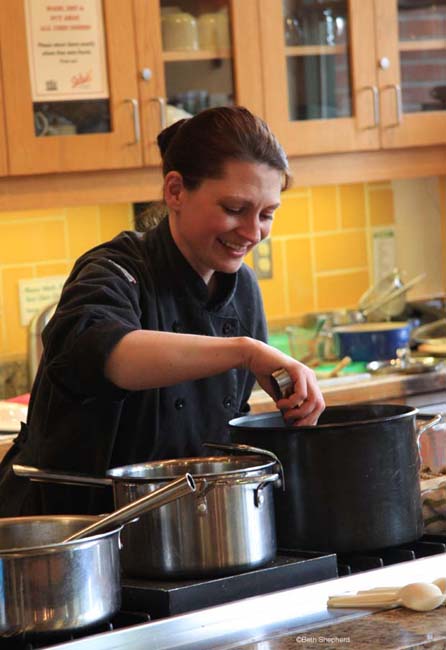
Lesa cooksMy friend Lesa lost her husband, Chris, this past weekend. Chris died in a hiking accident.

Lesa is a fabulous chef, and I met her several years ago at an Armenian cooking class she taught at PCC.  After that class, I asked her to donate her time as a chef-instructor for a class to help raise money for SOAR, an organization that provides support to Armenian orphans. It was at that class I met her husband Chris, who is of Armenian descent.

Like me, Lesa found her husband later in life and two of us bonded over this connection along with our love of Armenian food. We often talked about how rare it was to find such great men “at our age,” and how lucky were to share our lives with them. So hearing the news that Chris was gone was both shocking and heart-wrenching.

Lesa told me Chris’s ancestors came from the western region of Armenia, which is now part of Turkey. I also remember her saying that one of Chris’s favorite dishes was Kofta Mishmisheya.

Mishmisheya takes a bit of time to make, but this dish reminds me of the importance in taking the time whenever we can find it. We never know what tomorrow will bring, and sometimes even today. In our busy lives, with rarely a moment to sit, sitting down to a meal with loved ones is a gift, a precious gift worth savoring.

In memory: Chris Abajian

Kofta Mishmisheya

Kofta Mishmisheya


Ingredients:

  • 1 large onion, chopped
  • 3 -4 tablespoons vegetable oil
  • 1-1/2 lbs ground lamb
  • 1 teaspoon dried lime powder (found at Middle Eastern or Indian shops, or online)
  • 1/4 teaspoon ground cloves
  • 1/4 teaspoon allspice
  • salt and pepper
  • 3 -4 tablespoons tomato paste
  • 7 ounces dried apricots, soaked in water for 1/2 hour (use the tart, not sweetened variety)
  • 3 -4 tablespoons currants or 3 -4 tablespoons raisins
  • 1 lemon, juice of
  • 1 teaspoon sugar

How to:

  1. In a large frying pan, fry the onion in oil until golden.
  2. With your hands, work the meat into a paste with the dried lime, cloves, allspice, 3/4 tsp salt, and pepper, and roll into walnut-sized balls.
  3. Add them to the pan and cook, turning them to brown all over.
  4. Stir in the tomato paste, add the drained apricots and the currants or raisins, and cover with water.
  5. Simmer about 25 minutes (and longer is fine too…the flavors just get richer!).
  6. Crush the apricots a bit with a fork, add lemon juice and sugar and a little salt and pepper, and simmer for another 20 minutes.
  7. Serve over rice.


Want more to savor? Check out Wanderfood Wednesday.


Filed Under: Family, Food, Friendship Tagged With: Kofta Mishmishaya, Lesa Sullivan

Food to make my heart SOAR

May 5, 2010 by Beth Shepherd

“She likes the top of matzoun and the bottom of pilaf,” is an Armenian expression which means ‘she loves everything good.’ I was lucky enough to enjoy a lot of ‘everything good,’ this past Sunday in a hands-on Armenian cooking class fundraiser for SOAR (Society for Orphaned Armenian Relief). All the money will go directly to purchase greatly needed supplies for orphans living in orphanages in Armenia. Busy hands-Sarma Hearing the ‘yums’ and ‘ahhs’ echoing during the 2.5 hour class, I know that everyone attending had a delicious time.

The cooking class was held at Metropolitan Market.  Lesa Sullivan, who taught the Armenian cooking class I attended at PCC Natural Markets, was the chef. She also generously donated her services at a pittance. This cause is near and dear to her heart as well since Lesa’s husband is of Armenian descent. Lesa was also very close to an Armenian family during her younger years growing up in Salt Lake City, Utah.

Lesa CooksThe fabulous menu included:

  • S’rj: spiced Armenian coffee
  • Sarma: rolled and stuffed grape leaves
  • Lentil soup
  • Matzoun: Armenian yogurt
  • Armenian Pilaf: pasta, rice, and chopped apricots
  • Bourma: sweetly spiced rolled phyllo dough dessert

Nineteen participants rolled up their sleeves and then got down to business rolling Sarma and Bourma, and stirring lentils while sipping S’rj and munching on snacks of lavash, Armenian flatbread, and Soujuk, Armenian sausage. I saw a room full of smiles, heard a constant stream of laughter and smelled the intoxicating fragrances of Armenian cuisine.

When the class ended, and after we cleaned up, Lesa gave me a special treat: two pint-jars of Matzoun.  Matzoun, Armenian yogurt, is sour firm and thick. I am a yogurt aficionado and Armenian yogurt, in my somewhat biased opinion, is the crème de la creme. When I was visiting Yerevan, Armenia this past September, I got to eat some of the best darn yogurt I’ve ever had. Yogurt for breakfast with sliced fruit. Yogurt served as a ‘side’ to drizzle on top of dolma and sarma rolls. A refreshing minted yogurt, called Tahn, was chilled with ice and water and offered as a drink to pair cool down the heat of spicy Lamajoun (Armenian pizza).

One interesting thing about yogurt is that it takes yogurt to make yogurt. That’s not so much of a problem today, when plain yogurt purchased from the supermarket provides the necessary bacterial starter. But that wasn’t always the case.

Making MatzounBeing an organic substance, getting the first yogurt starters into the United States in the 19th century was no easy task. There was absolutely no way for the immigrants to simply bring their needed starter through American customs. But American customs agents greatly underestimated Armenian ingenuity.

The essential ingredient for turning milk into yogurt is a complex set of bacteria that basically takes over the medium (milk) and transforms it. The bacteria can live for a period of time under less than ideal circumstances. Knowing this bit of information is essential. Savvy Armenian émigrés would dip some fresh white handkerchiefs into a mixture of water and yogurt before they sailed for America. The handkerchiefs were then line dried and neatly folded into their luggage. Once they were safely through customs and settled into their new homes, they would simply soak the linen in some warm milk, reactivating the culture, and make their yogurt!

Two yogurtsI could hardly contain my excitement as Lesa nestled the pint jars of yogurt into a small carry-out container, wrapping a dish towel tightly around the twin treasures to prevent my precious cargo from too much jostling. They sat and “cured” on my counter at home for twelve hours and are now chillin’ for a few days in the fridge. I can’t wait to dive in and enjoy my homemade Matzoun.

All in all, it was a wonderful way to while away the afternoon. The class, the cuisine, the companionship, and the cause: it all made my heart soar.

Matzoun (Yield 3-1/2 cups yogurt)

  • 3 cups organic heavy cream or half and half
  • 1 package yogurt starter or 3 tablespoons cultured yogurt

Prepare your yogurt maker according to manufacturer’s instructions or have ready a small insulated cooler, warm, damp towels and glass jars. Wrap the jar in the warm towels while preparing the yogurt. Heat cream in a saucepan until a thermometer reaches 180 degrees Fahrenheit. Remove from heat and whisk in the starter or yogurt. Fill your yogurt making container according to the manufacturer’s instructions or fill the glass jar with the cream (or half and half). Wrap the warm towels around the glass jar and tuck them into the insulated cooler (if the towels have cooled, you can toss them in the microwave or your dryer to gently rewarm them). Close the cooler and gently place it in an out of the way place that’s a tad warm (like the top of the fridge) for 8-12 hours. Test for desired thickness; if it’s not to your liking you can let it go another 8-12 hours. Cover and refrigerate. Yogurt will stay good for up to a month and will continue to sour as it ages. When you are ready to make your next batch of Matzoun, simply take 3 tablespoons of your remaining Matzoun for a ‘starter’ and begin again.

Want to read about more tantalizing treats? Check out Wanderfood Wednesday. And, keep an eye out for upcoming weeks in Pampers and Pakhlava, where I’ll share more divinely delicious Armenian recipes.

Filed Under: Adoption, Food, Friendship Tagged With: Armenian pilaf, Bourma, Dolma, FRUA-INC, Lamajoun, lentil soup, Lesa Sullivan, matzoun, Metropolitan Market, Puget Consumers Coop, S'rj, Sarma, SOAR, Society for Orphaned Armenian Relief, Tahn, WA, yogurt

Anoush

October 14, 2009 by Beth Shepherd

Anoush (pronounced “Ah-noosh”) means sweet in Armenian. The word is used in many ways, one of which is to toast to good health and prosperity, “Anoush…enjoy the sweet life.”

I tasted a bit of the sweet life this past Sunday when I signed myself up for the ‘Armenian Adventure’ cooking class at the PCC (Puget Consumers Coop). The instructor, Lesa Sullivan, is not Armenian though she is married to an Armenian man and had a close relationship with an Armenian family during her younger years.

PCC Cooks Armenian

Sitting next to me, were Eloise and David, a recently married young couple who met in Armenia while serving two years in the Peace Corps. We exchanged email addresses and look forward to sharing photos, stories and cooking Armenian food in the not-too-distant future. Eloise, David and I were the only class attendees who had actually been to Armenia. Even Lesa, our instructor, has never been but hopes to visit one day.

The rest of our classmates said they signed up for the class because they were interested in learning about the melting pot that Mediterranean flavors that make up Armenian cuisine. Greek, Turkish, Jewish, Lebanese, Persian, Georgian and Russian dishes all contribute to Armenian cuisine and, in turn, their cuisines are also influenced by this rich and ancient culture.

There are a few distinctions between Armenian cuisine in Armenia and Armenian cuisine in Diaspora (Armenians who left their homeland due to war and persecution). For Armenians in Diaspora, cooking is influenced by the culture they emigrated to, such as Lebanon, Greece, Brazil or the United States.

In Armenia, most dishes are prepared exactly the same way every time, whereas in the U.S., Diaspora Armenians may feel more inclined to branch out and experiment “on a theme.” Some of the variations in Armenian cooking result from the foods that are available in the region where Armenians now live; new recipes and cultural innovations meld with traditional favorites.

During our class we sipped on S’rj (spiced, sweet stovetop coffee) as Lesa demonstrated (it was, unfortunately, not a hands-on class) how to make Lamajun, (Armenian flatbread “pizza”), Kofta Mishmisheya (lamb meatballs in apricot sauce), Sarma (veggie and rice-stuffed cabbage leaves), and Anoush Aboor (rice pudding with rosewater).

WLamajun Armeniahen Big Papa and I were in Armenia we were dined on Dolma (like Sarma but made with grape leaves) and tried tasty Lamajun at a café on Abovian Street in Yerevan. I have to say that eating Armenian food in the U.S. isn’t quite the same as eating it in Armenia. For me, the “flavor” of a cuisine is enhanced when tasting it surrounded by the sound of the language, the aromas of the markets and the sights of the country.

I came home and prepared Mishmisheya for Big Papa that evening. Even though my internet research hinted that the dish was Turkish or Tunisian in origin, it was still pretty darned tasty. And yes, I did vary the theme to include locally grown oven-roasted fingerlings and we sipped on one of our beloved Foxen Syrahs. Just before we took our first bite, we raised our glasses and toasted, “Anoush. To the sweet life.”

Check out the WanderFood Wednesday series for more great food postings!

Filed Under: Food Tagged With: Anoush, Anoush Aboor, Armenian Adventure, Diaspora, Dolma, Foxen, Georgian, Greek, Jewish, Kofta Mishmisheya, Lamajun, Lesa Sullivan, Mediterranean, PCC, Peace Corps, Persian, Russian, S'rj, Sarma, toast, Turkish

Some might fend off a mid-life crisis by leaving the comforts of their corporate salary to jet off to a deserted island. Others might buy a Jaguar. I’ve chosen to dive head-long into my 50s and beyond by becoming a first-time parent. At any given moment you might find me holding a camera, a spade, a spatula or a suitcase. Or my little girl's hand. Adopted from Armenia, she puts the Pampers and Paklava into my life.

Subscribe to Blog via Email

Enter your email address to subscribe to this blog and receive notifications of new posts by email.

Recent Posts

  • Ghosts and goblins of Halloweens past
  • Raise a glass—or ten
  • No me without her: A life before motherhood
  • Leaving the orphanage with a priceless pair of tights
  • Rock of ages: Celebrating five years together as a family

Tags

366 Project Adoption anniversary Armenia autumn Bainbridge Island Baja Birds birthday blog cat cats chickadee China Christmas fall ferry flowers France Garden Gyumri Halloween Hawaii Holiday ice cream Kauai leaves London Mamas with Cameras Mexico Mother's Day Mt. Rainier New York orphanage Paris Puget Sound robin Seattle taxi Thanksgiving Tibet USCIS Valentine's Day wedding Yerevan

Categories

  • Adoption
  • Armenia
  • Family
  • Food
  • Friendship
  • Garden
  • Holiday
  • Miscellaneous
  • Paris
  • Photography
  • Recipes
  • Review
  • Seattle
  • Things to do with kids
  • Travel

Sites I like

  • The Wayfaring Voyager
  • Wanderlit
  • Wanderlust and Lipstick
follow us in feedly

Image Copyright

Unless specifically mentioned, all images on my blog are my own original photographs and, therefore, copyright protected (©Beth Shepherd). Feel free to use my images for non-commercial use so long as you provide me with the image credit. Likewise, if you pin my images to Pinterest, please mention me by name.

Copyright © 2026 · Pamperspaklava · WordPress Barista