Pampers and Paklava

  • Home
  • Photography
  • Travel
  • Food
  • Garden
  • Contact

The full Manti

February 16, 2011 by Beth Shepherd

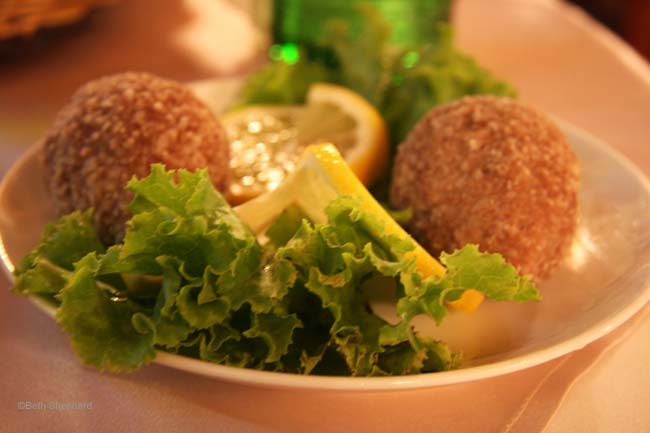
Armenian mantiThe last time I was in Armenia, I ate Manti with Maribeth. We were dining at The Club, a lovely subterranean restaurant with delicious food, located in the center of Yerevan, Armenia’s capitol.

Maribeth and I were there to celebrate. We’d each just registered our adoption (formally accepted our referral). We were in the same room at the same time (Big Papa didn’t make this trip – a story for another post) and a bond was formed between us after sharing this life-changing, emotional experience.

Amazingly, Maribeth is also originally from Seattle (though she now resides on the east coast). The irony isn’t lost on me: Beth and Maribeth, both from Seattle.

Here we were, breaking bread together – and toasting with a shot of Armenian brandy –  to honor this momentous occasion, in a restaurant half-way around the world from the place we call home. How crazy is that?

The meal was stupendous. We ordered a sampler platter filled with dolma, hummus, baba-ganoush, and a host of amazing Armenian dishes.

Then the Manti was served. Honestly, for the next few minutes, the only sound you could hear was Maribeth and I swooning over our Manti.

“Mmmm,” she murmured.

“Wow,” I concurred.

If there is a mantra for Manti, Maribeth and I have been meditating on it ever since. We both dream about Manti.

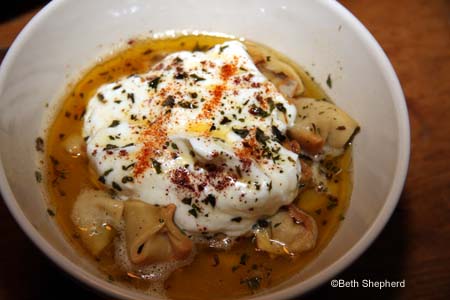
Manti are dumplings. Divine dumplings. Slightly crisped on the outside, melt-in-your-mouth incredible on the inside, and bathed in a savory yogurt sauce. It was so good. I wanted to dive right into that bowl. Of course, first I would have had to arm-wrestle Maribeth.

When it comes to Manti, there are actually two kinds:  baked manti and also a version cooked in broth as a soup. They are each prepared the same general way, but are shaped differently. Baked Manti are baked in the oven whereas soup manti are cooked in broth. Although Manti is not exclusive to Armenia, and I’ve seen a few variations on a theme, they are typically served topped with a yogurt-garlic sauce and sumac, that interesting, sour, Middle-Eastern spice.

Aside from its heavenly flavor, Manti is notable for being a time consuming dish to prepare. I have seen a few recipes that call themselves “short-cuts” and use wonton wrappers for the dough, but come on people, that’s cheating. Yes, it takes a long time to make them, but as Maribeth and I will tell you: when it comes to Manti (and adoption) the wait and the effort is worth it!

This weekend, Manti is on the menu (and it’s a safe bet that our bottle of Armenian brandy won’t be far away). Another celebration is in order. In three weeks, Maribeth is going to Armenia to become a mom! And hopefully, it won’t be long before I’m once again following in her footsteps.

Congratulations, dear friend: this one’s for you!

pre-cooked mantiManti

Makes About 100: Serves 4 to 5

Each of these tiny dumplings is about the size of your fingertip, so you can easily serve 20 to 25 to each person.  It’s traditional to invite friends to help fill and seal the Manti; after all, many hands make light work.  They can be frozen for up to 1 month.

For the Dough:

  • 1 cup all-purpose flour, plus more for dusting
  • 1/2 teaspoon course salt
  • 1 large egg, lightly beaten
  • 3 tablespoons cold water

For the filling:

  • 8 ounces ground lamb
  • 1 medium yellow onion, grated on the large holes of a box grater (1/2 cup)
  • 2 tablespoons finely chopped fresh flat-leaf parsley
  • 1 teaspoon course salt
  • 1 teaspoon freshly ground pepper

For Cooking and Serving:

  • 8 tablespoons (1 stick) unsalted butter
  • 3 cups homemade or low-sodium store-bought chicken stock
  • 1 cinnamon stick
  • 2 bay leaves
  • Course salt
  • 1 1/2 cups plain Greek yogurt or labneh
  • 2 garlic cloves, minced and mashed to a paste with a pinch of salt
  • 1 1/2 teaspoons dried mint
  • 3/4 teaspoon red pepper (or papikra)
  • a sprinkle of Sumac (found in grocery stores or spice shops that specialize in Middle Eastern foods)
  1. Make the dough: Sift together flour and salt in a large bowl.  Make a well in the center and add egg. Using your hands, gently draw flour mixture into egg.  Gradually add the cold water, and continue to work dough with your hands or a spoon until it forms a smooth paste.
  2. Turn dough onto a lightly floured surface. Kneed until dough is smooth and springs back when pressed, 5 to 8 minutes.  Divide dough into 2 balls, cover with a damp kitchen towel and let rest at room temperature for 30 minutes.
  3. Make the filling: Gently combine lamb, onion, parsley, salt and pepper.  (Filling can be refrigerated in an airtight container for up to 2 days.)
  4. On a lightly floured work surface, roll out 1 portion of dough into a 16-by-10 inch oblong about 1/16 inch think.  Using a ruler, cut dough into 1 1/4 inch squares with a pizza wheel or a paring knife.  Keep remaining dough covered with a damp kitchen towel while you work.
  5. Spoon 1/4 teaspoon filing in center of 1 dough square.  Gently pull 2 opposite corners outward to stretch dough slightly, then pull up to meet in center, and pinch to seal.  Repeat with remaining 2 corners, making sure all air has been pressed out.  Pinch together all 4 corners to form a point, then pinch along all 4 seams to seal.  Place on a parchment lined baking sheet, and cover with a damp kitchen towel.  repeat.  Remove towel, and cover with a piece of parchment. (Dumplings can be refrigerated on baking sheets, wrapped in plastic, for up to 1 day.  Alternatively, freeze on baking sheets, uncovered, for 2 hours, then transfer to an airtight container and freeze for up to 1 month.)
  6. For cooking and serving: Preheat oven to 400 degrees.  Coat a 13-by-9-inch baking dish with 1 tablespoon butter.  Arrange Manti in a single snug layer in the dish.  Bake until fragrant and tops and corners are golden brown, about 25 minutes.
  7. Meanwhile, bring stock, cinnamon, bay leaves and 1 teaspoon salt to a boil in a saucepan.  Remove baking dish from oven, and add enough stock to dish so that all but the tops of the Manti are submerged.  Cover tightly with parchment and then foil, and bake until soft, about 2 minutes more.
  8. Meanwhile, stir together yogurt or labneh and garlic paste in a medium bowl.  When Manti have finished cooking, tile baking dish, collect about 1/4 cup liquid with a ladle, and stir into yogurt sauce (sauce should be spoonable).
  9. Melt remaining 7 tablespoons butter in a small saucepan over medium-high heat.  Reduce heat to medium, and cook until amber, about 7 minutes.
  10. Divide Manti among shallow serving bowls.  Spoon yogurt sauce over top, drizzle with browned butter, and sprinkle with mint, red pepper and sumac.

manti close upDying for more dumplings? Check out Wanderfood Wednesday!

Filed Under: Adoption, Food, Friendship Tagged With: Armenia, manti, The Club, Yerevan

A picture is worth a thousand words: food on Kauai

February 9, 2011 by Beth Shepherd

Big Papa and I went to Hawaii to GET AWAY from it all! Sure the sun and surf was a draw, but what we really needed was a big ‘ole break. We picked Kauai, and the north shore where we stayed, because it was purported to be beautiful and remote. We planned on snorkeling, hiking, catching some rays, warming up our Seattle frozen selves and leaving behind as much of our daily reality as we possible could.

Of course, I’d heard about the fresh seafood, but hey…we live in Seattle, right? People mentioned the ‘shave ice’ (like a snow cone but oh-so-much better) and of course we figured we’d knock back a Mai-Tai or something similar. But, we didn’t go to Hawaii for the food.

So it was coconut icing on the shave ice, that the food was just SO DARN GOOD. We only went out to one “restaurant” (e.g. nice sort of sit down place) to eat (Postcards in Hanalei…thank you Beth Whitman), we had one “fast food” dinner (Shrimp Station in Waimea…again, thank you Beth). Because who needs all that when the most divine fresh seafood awaits at the local fish market!

Here are a few pictures of some of our favorite treats on Kauai.

Dolphin Fish market take out Hanalei, KauaiDolphin Fish market take out Hanalei, Kauai: sushi, ahi poke, seaweed salad, ginger beer, taro chips

Ahi burrito Kilauea KauaiAhi burrito Kilauea Fish Market, Kauai: I was SO stuffed but ate every last bite because it was SO yummy!

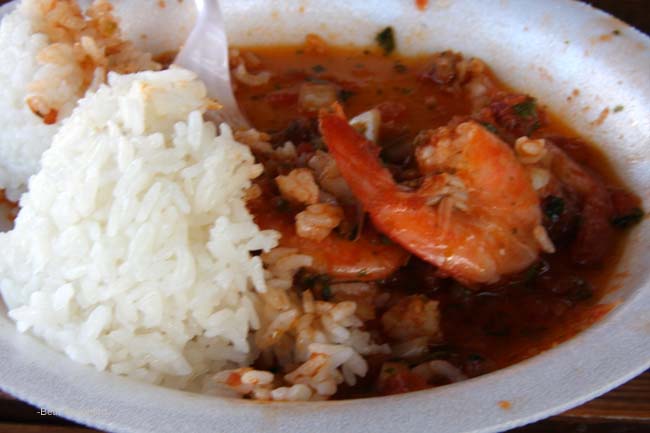
Waimea Kauai Shrimp StationWaimea Kauai Shrimp Station:

Okay it was so good and I was SO hungry that I forgot to take a picture until there were only two shrimp left!

Ono Ono Shave ice Kapa'a KauaiLast but “ono-so-not-least”…Ono Ono Shave ice Kapa’a Kauai

Just so you don’t think we’re all about “healthy” we ate shave ice with ice cream EVERY day. We thought this place was the best (of those we tried) and not just because they super-size their shave ice. We both thought the coconut ice cream and macadamia nut ice cream was the bomb, but how can you possibly go wrong with all that sweet goodness in one cute flowery cup?!

Want to indulge in more treats, tropical or otherwise? Check out Wanderfood Wednesday!

Filed Under: Food, Photography, Travel Tagged With: ginger beer, Kauai

A picture is worth a thousand words: Food in Armenia

January 26, 2011 by Beth Shepherd

Traveling in Armenia is a feast for the senses, particularly where food is involved. Dolma, kufta, amazing yogurt and ice cream…and of course, Pakhlava (which many other countries call Bakhlava)! Here are a few pictures of delicious treats I enjoyed on my visits to Armenia.

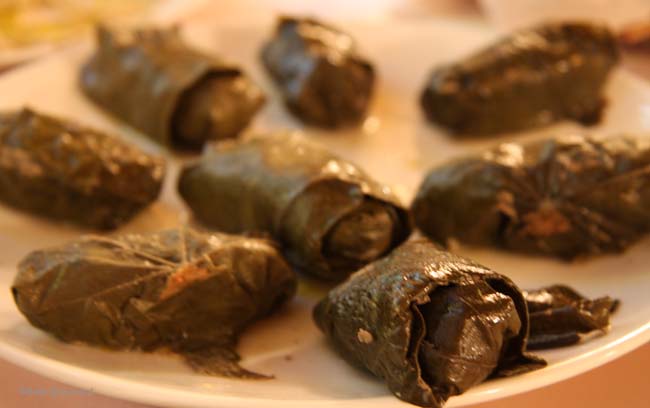
Armenian dolmaDelicious Armenian dolma

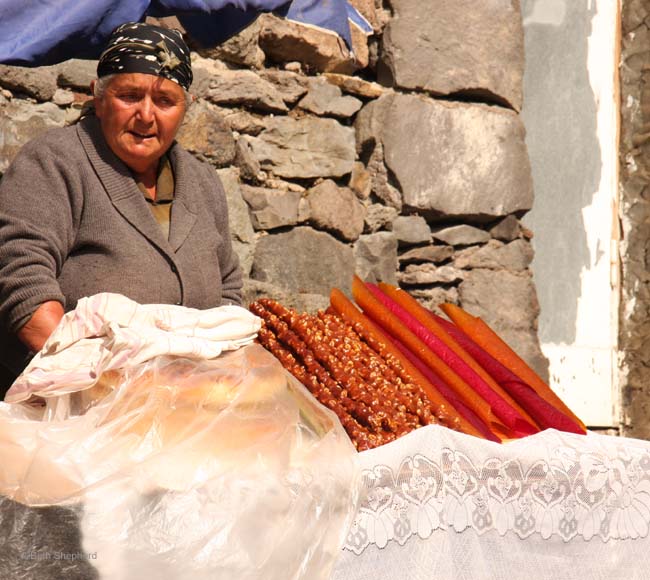
fruit leather ArmeniaSweet fruit leather

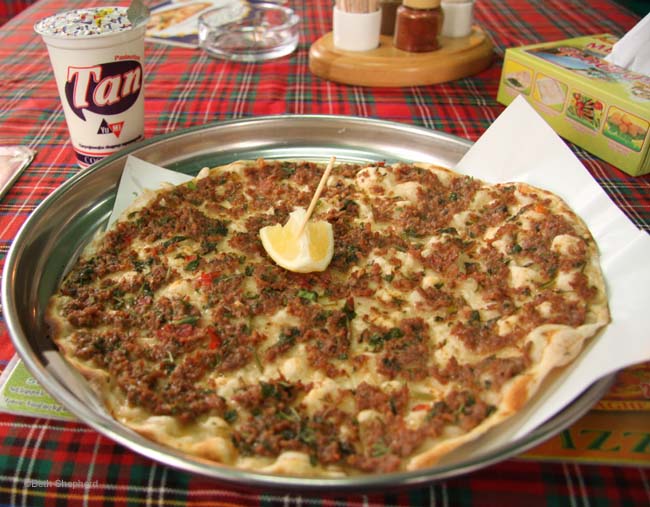
Lamajoun Armenian pizzaLamajoun Armenian Pizza: lamb and garlic with a squeeze of lemon and a side drink of Tan or spiced yogurt

Armenian kufta in YerevanArmenian kufta in Yerevan

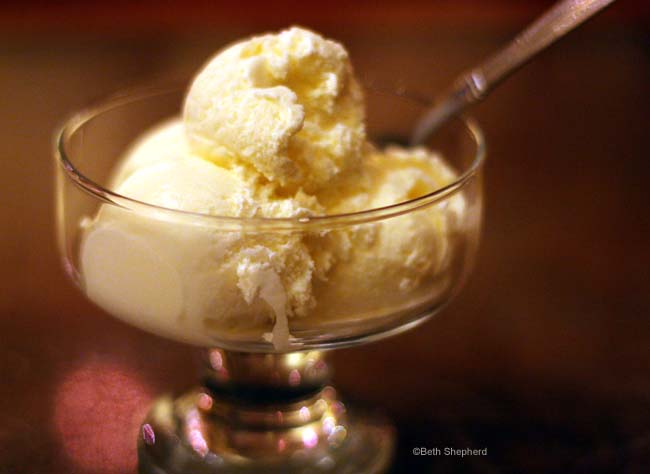
Ice cream yerevan ArmeniaThe most amazing ice cream in Yerevan

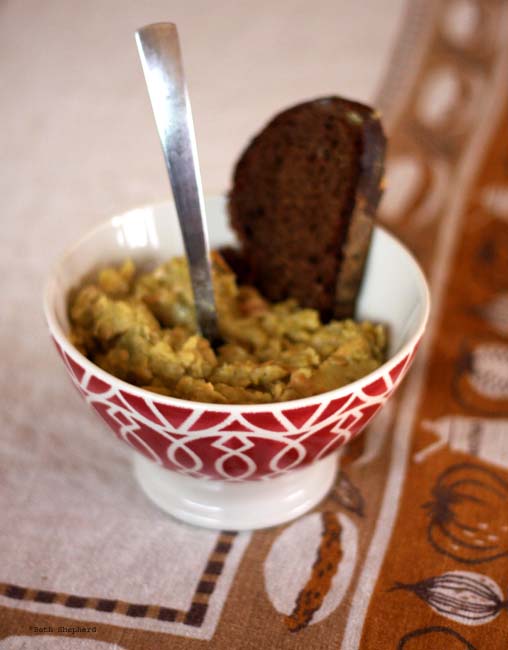
Yogurt and bread in ArmeniaDitto on deliciousness for the yogurt, served here with a sprinkle of nuts on top and bread

Want to see more deliciousness? Check out Wanderfood Wednesday!

Filed Under: Food, Photography, Travel Tagged With: Armenia, Dolma, fruit leather, ice cream, kufta, Lamajoun, photograph, Tan, Travel, yogurt

In a pickle with the Papas

January 12, 2011 by Beth Shepherd

When I was growing up, my father made pickles: lots of pickles. He also made sauerkraut, horseradish and a few jars of pickled Habanero peppers, but mostly he made pickles. My Pop is the veritable Pickle Man.

making picklesI have so many pickle stories that it’s hard to know where to begin. First, there was the way he bartered with pickles. On more than one occasion, a jar or two of pickles were traded for a doctor’s visit or a favor he wanted.

“Beth, you know those tools I use to get the ship in the bottle?” he’d say. “Well, there was this dentist I went to and…”

Then there was the “hot pepper test.” When Big Papa met my father for the first time, he was offered a pickled Habanero and moments later, a slice of cheese. I breathed a sigh of relief. My Dad must like him, I thought. He offered Big Papa the cheese.

Fortunately I’d already clued Big Papa in to this “family secret.” The milk in the cheese cuts the pain from the pepper. Pepper without cheese and you’re in trouble. A glass of water to try to rinse away the offending fire in your mouth equals BIG trouble (water spreads the “Capsicum” the heat-simulating chemical). But take a bite of pepper and then chase it with a bite of cheese, or a sip of milk or yogurt, and you’re golden.

Filling pickle jarsMy Dad’s pickles are noteworthy for another reason. They are made without vinegar. That’s right, no vinegar. And, unlike many pickle recipes, neither the cucumbers nor the water in the jar are boiled. That’s how it is done. It’s how my father made pickles and his father before him in the old country, in Poland.

If you make them, I promise you’ll never taste pickles as good as my Papa’s. These are not floppy, rubbery pickles. You take a bite and are greeted with a hearty crunch. Once you taste the spicy kick of hot dried pepper and suck in the invigorating hit of dill, you’ll swear off any other pickles.

I hope that was convincing. If not, I’ll be disowned. After all, I am my father’s daughter.

My father, now nearly 87, still makes pickles, though not without my help. Forty years ago he had a disabling stroke. Even though it paralyzed his left side, he continued making pickles. But over the past few years, dementia has taken its toll and the arthritis and neuropathy make it difficult for him to do what’s necessary to pickle a peck, so that’s where I come in. And Big Papa. This year was Big Papa’s first as pickling sous chef.

Kosher dill pickles without vinegar I watched the pickling process for decades, but Dad still –uh — coaches me through the process (read: tells me what to do).

“Make sure to put the cucumbers in with the vine end down. Why? I don’t know. That’s how it’s done. Here, let me show you how to do it.”

“Chop the garlic. You chopped it, right? Do you want me to show you how?”

“You can squeeze a few more in that jar. You and your sister used to have a contest to see who could get the most in one jar. Here let me show you how you can get a few more in there (said while jamming cucumber sideways into an overflowing jar).”

“Don’t forget to put in one tablespoon of salt.” “Don’t forget to put in one teaspoon of salt.” “Don’t forget to….did I tell you the story about the night when your mother invited over…”

And so it goes. These days he’s forgotten the exact amounts and he’ll derail the pickling process to go down at least a dozen rabbit trails of tales from days gone by. But in the end, jars are filled and over the next few weeks our emerald treasures undergo a magical transformation, from mere cukes to glorious dill pickles.

Papa’s Pickle’s

Ingredients

  • Pile of small pickling cucumbers (select smallish, firm cukes), washed and scrubbed with a soft brush – OR (if you’re really brave) a bunch of Habanero peppers.
  • Kosher salt (must be Kosher!)
  • Pickling spices
  • Dill seed
  • Fresh dill (nice to have but not essential if you have the dill seed)
  • Garlic (cloves peeled and coarsely chopped)
  • Celery stalks (optional)
  • Dried hot chili peppers (optional)
  • Wide mouth quart mason jars
  • Measuring spoons
  • **no vinegar…that’s right NO vinegar!

Directions

Place cucumbers inside jars (with the end of the cucumber that came off the vine pointed toward the bottom of the jar – you can tell because it has a small indent/brown spot). Leave approximately ½ to 1 inch of headroom at the top of the jar. You can pack them tightly but try not to mash the cukes.

To each quart jar, add:

  • 2 tablespoon kosher salt
  • 1 teaspoon pickling spices
  • 1 teaspoon dill seed
  • Small stalk of dill folded (if using fresh dill)
  • 1 clove chopped garlic
  • 1 celery stalk (optional)
  • 1 dried hot chili pepper (optional)

Fill each jar with cool tap water and cover the cukes. Use sterilized (or new) lids and seals. Cap tightly (my dad always gave the jars my sister and I capped an extra turn for good measure)! Rotate the jar back and forth a few times to dissolve the salt a bit and disperse the spices and garlic (some will settle at the bottom).

Place pickles in a cool dark place (a basement is ideal). Store for 7days for “half sour;” 10-14 days for “full sour.” Then, place pickles in your refrigerator. They will keep for several months unopened. I recommend placing newspaper underneath the jars, which may leak a little.

When you open the jars, they may fizz, so opening in your sink is a good idea. The water may be cloudy and this is okay. Also, the color of the pickles will have changed from bright green to olive green.

Take out a pickle. Eat with chutzpah! I’m willing to bet you won’t be able to stop at one.

Want to nosh on more deliciousness? Check out Wanderfood Wednesday!

Filed Under: Family, Food Tagged With: cucumbers, dad, papa, pickles, pickling

Come on a My House

December 29, 2010 by Beth Shepherd

Just as holiday celebrations are winding down in the west, New Year and Christmas celebrations are ramping up in Armenia. Most Armenian Christians (Armenian Apostolic Church) follow the Julian calendar and Christmas is celebrated on January 6.

During the week between New Year’s and Christmas, most Armenian homes have an “open door” policy: “Ari im toon,” or “Come on to our house” is an invitation extended to anyone and everyone. Welcoming family, friends and neighbors into one’s home and filling their bellies with delicious food, is a tradition that has been honored for generations.

So it’s no surprise that food is a big part of the deal and the seasonal table for Armenians overflows with generosity: dried and fresh fruits, nuts and seeds, cheese, fish (meats are not eaten on Christmas), and Armenian pastries like gata and pakhlava. It is common to see prices soar on precious supplies as the holiday draws year. This year many newspapers even reported shortages in eggs.

So Come on a My House, as Rosemary Clooney (yes, George Clooney’s aunt) sings it. Enjoy the goodness of the season: family, friendship and food.

[youtube=http://www.youtube.com/watch?v=vyCNNrc8F_s?fs=1]

Come on-a my house my house,
I´m gonna give you candy
Come on-a my house, my house,
I´m gonna give a you apple a plum and apricot-a too eh
Come on-a my house, my house ,
I´m gonna give a you figs and dates and grapes and cakes eh
Come on-a my house my house,
I´m gonna give you Christmas tree
Come on-a my house, my house,
I´m gonna give you marriage ring and a pomegranate too ah
Come on-a my house, my house,
I´m gonna give you everything – everything – everything

Shnorhavor Nor Tari…Merry Christmas and a Happy New Year!

Note: The 1951 hit song, Come on a My House, was written by two Armenian-Americans, Ross Bagdasarian (who later created Alvin and the Chipmunks under his stage name, David Seville) and his cousin, the author William Saroyan. It was Saroyan’s sole popular songwriting venture for an off-Broadway musical titled The Son. Rosemary Clooney very reluctantly recorded it and, ironically, it became one of her biggest hits.

Want more deliciousness to sing about? Check out Wanderfood Wednesday!

Filed Under: Family, Food, Friendship Tagged With: Come on a my house, Rosemary Clooney, Ross Bagdasarian, William Saroyan

Thick as pea soup

December 15, 2010 by Beth Shepherd

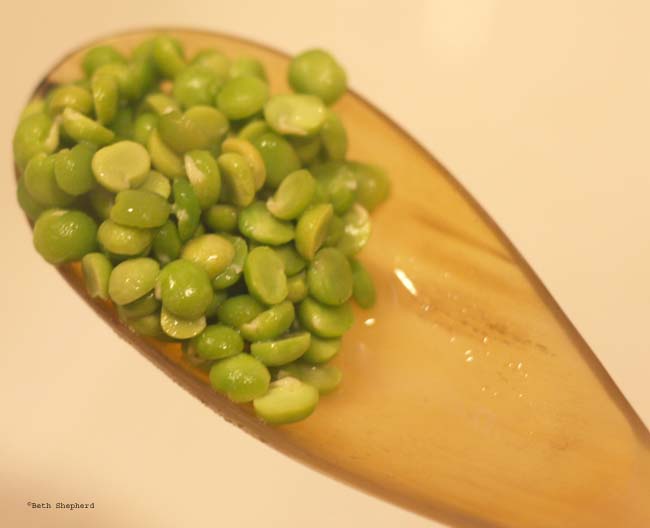
split peasGray fog and clouds as dense as mid-winter lambs’ wool filled the sky, while rain poured down in buckets, helping Seattle live up to its reputation as the ‘rain city.’ During the dark, dank days that seem to stretch on forever, I start dreaming about soup. And this past weekend, one soup in particular: pea soup.

Back in 1980, when I studied abroad in the Netherlands, I lived in the home of a 72-year-old woman whom I affectionately called, ‘Oma.’ Oma made the best darn pea soup I’d ever had. Hers was a soup that changed my idea of what pea soup was possible of being.

Tall Grass Bakersy PUmperkickel bread“So thick you can stand your spoon straight up in it,” is what she would say as she served up a bowlful of her stupendous soup. Pea soup which is called ‘erwtensoep’ or ‘snert,’ by the Dutch is a thick stew chock-full of green split peas, different cuts of pork, celeriac or stalk celery, onions, leeks, carrots, and often potato. Slices of rookworst (Dutch smoked sausage) are added a few minutes before serving. It is customarily served with rye bread (roggebrood) topped with bacon, cheese or butter. The bacon is always ‘katenspek’, bacon which has first been cooked before being smoked. It’s a one-stop shop of a soup if there ever was one.

Erwtensoep is traditionally eaten during the winter and is emblematic of Dutch cuisine. You can even find the soup at ‘koek en zopie’ outlets, small food and drinks stalls which pop up during wintertime along frozen canals, ponds and lakes in the Netherlands, and cater to ice skaters.

During my recent trip to Amsterdam, a bowl of “echte” (authentic) erwtensoep was one of my “top ten” food treats to hunt down and savor. On my last night there, I found it and ordered up a bowl with a snifter of korenwijn (aged Dutch gin). Both did their job to bring back happy memories and take the chill out of my bones on that cold, windy night.

cat and pea soup ErwtensoepI made the soup for Big Papa on Sunday. Pumpernickel bread from Tall Grass Bakery stood in for the roggebrood and added a touch of molasses sweetness as we dunked and nibbled. We washed down our pea soup with a delicious hard cider, Bellwether, ‘King Baldwin,’ which we brought back home after a trip to visit relatives in upstate New York.  It’s light fizz and dry apple flavors perfectly complimented the soup. And, Oma would have been proud. Our spoons stood straight and tall! Even our cat was impressed.

Erwtensoep

  • 4 bacon slices, chopped*
  • ½-1 small onion, chopped
  • 1-2 medium leek (white and pale green parts only), sliced
  • 1-2 large carrots, peeled, chopped
  • ½ cup chopped celeriac (celery root – peel skin and then chop) or 2 stalks celery, chopped
  • 1-2 garlic cloves, minced
  • 4-14 1/2-ounce cans low-salt chicken(or veggie) broth*
  • 1-1/4 cups green split peas, rinsed and soaked overnight (I soaked mine for four hours and they were fine)
  • 2 bay leaves
  • 3-4 small potatoes, chopped (optional: I used Yellow Finn)
  • 2-3 smoked sausages (Dutch preferred, otherwise, German Bratwurst-style), cooked and sliced (1/2 inch slices)*

Preparation

Sauté bacon in heavy large pot over medium-high heat until crisp and brown. Add onion, leek, carrot, celeriac and garlic and sauté until vegetables begin to soften, about 6 minutes. Add broth, peas, and bay leaves and bring soup to boil. Reduce heat to medium-low, cover and simmer until peas are tender, stirring occasionally, about 1 hour. While soup is brewing, cook sausage in a separate pan, slice and set aside. Add sausage and cook for another half-hour. Soup should be thick and peas “decomposed.” Season soup to taste with salt and pepper.

*Vegetarian Note: You can make this recipe vegetarian-friendly by omitting the bacon and sausage, or instead, adding the vegetarian equivalent.

Want to spoon in some more? Check out Wanderfood Wednesday!

Dutch pea soup or Erwtensope and Tall Grass Bakery Pumpernickel

Filed Under: Food, Travel Tagged With: Bellwether Cider, Dutch, erwtensoep, katenspek, King Baldwin cider, korenwijn, Netherlands, oma, pea soup, pumpkernickel bread, roggebrood, rookworst, snert, Tall Grass Bakery

Happy things

November 25, 2010 by Beth Shepherd

Eleven months ago, Big Papa and I started a new habit. Every night, before we go to sleep, we take turns and share a few “happy things” from our day. Then we offer an “appreciation,” something about each other that we are grateful for.

I came up with this idea to counterbalance the frustration, fears and stress in our lives: aging parents, work, home improvement projects, illness (ours or others), aches and pains, insecurities, and the bumps along the road in our journey to adopt. Sometimes it seems like it is so much easier to focus on problems and negativity in life, or all the things we want rather than everything we have.

This might sound Pollyannaish, but I have to tell you, it works! We’ve kept the nightly ritual going and now, nearly a year later, I can honestly say that going to sleep at night with happy thoughts in my brain, has made me a happier person.

Sure, I still fret about our adoption, wish I could buy jeans a size smaller, and feel sad to see my father slip away bit by bit. Careless drivers make me angry and I continue to miss my friend Dee, who passed away two years ago (and who I always called on Thanksgiving Day to tell her how grateful I was for her friendship).

Red Finch in FallThat said, I feel much more aware of the little things that bring me joy each and every day. Maybe it’s a morning when the Cascade Mountains are so clear it feels like I could reach out and touch them. Or a cold afternoon spent watching the birds enjoy the new suet feeder. I don’t feel like I’m bragging when I cite accomplishments from my day that I am proud of: a good work out, two articles written for my writing group, an organized closet or a tasty meal that I made using herbs from our garden.

It is so energizing to share these happy moments with Big Papa along with one appreciation for something he did or said or just for being the wonderful person he is.  Hearing the things that make him happy puts a smile in my heart. And, when he tells me what he appreciates about me, I feel noticed, acknowledged, and loved. Sharing our ‘happy things’ and ‘appreciations’ has been one of the best things we’ve done for our relationship…and for ourselves.

Most of us living in the U.S. have a lot to be thankful for. There is great abundance in our lives, yet we often fail to appreciate what we have in the midst of harried days, and the perceived pressure to be more, do more and have more.

In honor of this year’s Thanksgiving holiday, I celebrate the happiness in my life. There is so much I appreciate:

  • Big Papa: many hours of listening, his steadiness and love, and a big hug every day
  • A healthy, strong and fit body
  • My home: a roof over my head, a bed to sleep in, good food to eat
  • Friends: old, new, near and far
  • Maggie, our cat, who makes me smile and laugh
  • The beautiful northwest that I am so lucky to call home
  • Being able to write my thoughts and put them out there for the world to see
  • That my family members are all still alive and able to see the  happiness in my life
  • My own backyard: the garden, the birds
  • Mamas with Cameras, my writing group and Mom’s Night Out
  • Trips around the Sound, around the state and over the seas
  • …and a few wondrous things – that for now – I’ll keep close inside my heart

To my friends and family, and to anyone who reads this post, may a day of thanks be yours.  Between running here and there, cleaning the house or cooking up a storm, take some time to remind yourself of the beauty in your life, and of the people, places and moments that make you happy. Close your eyes and think deeply about someone who touches your life, someone you appreciate. Better yet, pick up the phone or take them in your arms and tell them.

Filed Under: Adoption, Family, Food, Friendship, Garden, Travel Tagged With: appreciation, happy things, Thanksgiving

Memories of Thanksgiving feasts gone by

November 24, 2010 by Beth Shepherd

This past weekend, I made a recipe that got me to reminiscing about Thanksgiving dinners from years gone by. As a single gal for many years who lived 3,000 miles from her family, I got invited to a number of (as I liked to call them) “orphan feasts.” These were dinners where a family took me in or where a group of friends, who were without (or who were avoiding) their own families, joined forces to create a feast and celebrate the holiday.

One of my favorite potluck Thanksgivings revolved around a “Kentucky” themed meal. Let’s just say that bourbon figured prominently in most of the recipes (and on its own). The turkey was brined and smoked on a grill with cherry wood chips and then the skin was glazed with maple syrup. I told people it was the best darn turkey I ever had and I fantasized about it for many years until finally, one Thanksgiving when both our moms came to visit, Big Papa and I made it. Big Papa, who was never a turkey aficionado, said: That was the best darn turkey I ever had.

Then there was an out –of-state Thanksgiving with a boyfriend who was filming a movie. The family of his friend, lived in the Santa Cruz Mountains, and that meal fulfilled every stereotype you might have of a “hippie” holiday. Everyone was smoking pot around the table, including grandma, who told me quirky stories about the days when she owned two Wallabies that she paraded around the streets just to get a rise out of her neighbors. Forget about having to decide whether you wanted apple or pumpkin pie. They didn’t serve either. Brownies were the sole dessert option and given the pot-filled haze in the air, I wasn’t sure what “special spices” might be in them, so I said: Uh, thanks, I’ll pass.

The recipe I made was one that predates these celebrations, because it is a recipe from college days. In the late 1970s and early 1980s, I was a vegetarian for roughly seven years. Although my food “lifestyle,” was not unheard of, it wasn’t as universally accepted as it is some thirty years later. These days, I can easily name five or six vegetarian restaurants in Seattle, and one or two vegan spots. But back in the day, Moosewood Restaurant was one of the first and one of the only.

I started making this recipe for stuffed squash, from the Moosewood Cookbook, when I came home to visit my family for the Thanksgiving holiday. Skipping the main event, turkey, was disconcerting for my mother, that I’m sure. The fact that she still makes this recipe (and likes it!) is a testament to how good it is. It’s a Thanksgiving classic, in its own way.

Since Big Papa and I are celebrating one of our (now nearly annual) traditions of painting a room this holiday weekend, my cookbooks are tucked away in a spot where I can’t get to them and, amazingly, I couldn’t find this recipe online. So, I made it from memory. I can say with complete confidence, it’s still as tasty as I remember.

Stuffed Squash (as I remember it from the Moosewood Cookbook)

Ingredients:

  • 1 Squash (acorn, butternut or your fav)
  • Cottage cheese, roughly ½-1 cup
  • Cheddar (or other sharp cheese – I used Gouda this time), roughly ½-1 cup
  • ½ Yellow onion, chopped
  • Crimini or button mushrooms, 5-10 sliced
  • 1 Apple (I used a Honey Crisp, but any variety will work), cored and chopped
  • Cinnamon, 1 teaspoon
  • Canola or olive oil

How to:

  1. Split an acorn (or butternut) squash lengthwise down the middle.
  2. Remove seeds and bake (face down on a baking sheet with a little oil) at 350 degrees for 30 minutes.
  3. Saute onions in oil and then add apple and mushrooms. Saute until a tad soft but not fully cooked.
  4. Combine the onions, mushrooms and apples with the cottage cheese and cheddar cheese and add about a teaspoon of cinnamon (or a bit of nutmeg, or both – I also added some fresh thyme)
  5. Take the squash halves out of the oven, flip them over and fill the cavity with the cheese filling.
  6. Bake for another 30 minutes at 350-375 or until the squash is tender and pulls away from the skin.

Want to find more food to be thankful for? Check out Wanderfood Wednesday!

Filed Under: Family, Food, Friendship Tagged With: Moosewood Cookbook, Moosewood Restaurant, Stuffed Squash

Pumpkin Dip

November 10, 2010 by Beth Shepherd

My friend Susan S. first introduced me to Pumpkin Dip about seven years ago when the recipe first came out. Susan had a subscription to ‘Cooking Light’ magazine and it was featured the fall holiday season issue. Susan was a Pumpkin Dip pusher if there ever was one, although once you try this dip, you’ll understand why she didn’t have to push too hard. Be forewarned: this stuff is addicting. I promise you that as soon as you’ve chowed through your pumpkin dip coated apples, you’ll be wondering how else you could use this incredibly yummy dip. Spread on top of oatmeal raisin cookies or gingersnaps? Slathered on pancakes or waffles? Add a dollop to top off a bowl of vanilla ice cream? I once made a loaf of gingerbread to accompany the pumpkin dip and it was a divine match.

This would be perfect for a party alongside a tray of apples and assorted fruits to dip with (I am very fond of it with pears). Better yet, it is kid friendly, a Cooking Light recipe and oh-so-seasonal to boot!

Pumpkin Dip
12 Servings

  • 3/4 cup (6 oz.) 1/3 less-fat cream cheese (Neufchatel)
  • 1/2 cup packed brown sugar
  • 1/2 cup canned pumpkin
  • 2 tsp. maple syrup
  • 1/2 tsp. ground cinnamon
  • 24 apple slices

Place first three ingredients in a medium bowl; beat with a mixer at medium speed until well blended. (I whipped or about 2-3 minutes, to get it nice and fluffy) Add syrup and cinnamon, and beat until smooth. Cover dip, and chill 30 minutes. Serve with apple slices.

Note: Because I can’t leave well enough alone, I have a tendency to reduce the brown sugar and increase the maple syrup and cinnamon because I like that maple-cinnamon flavor).

~Recipe courtesy of Cooking Light Annual Recipes 2004

(Thanks across the miles and years to Susan S. who introduced me to this scrumdiddlyumptious dip)

Want to dip into more deliciousness? Check out Wanderfood Wednesday!

Filed Under: Food, Friendship Tagged With: Cooking Light Magazine, Pumpkin Dip

Dutch treats

October 27, 2010 by Beth Shepherd

Temperatures hovered in the 50s and the wind added a crisp bite to the air. No matter, I was on a mission in Amsterdam’s Albert Cuyp market. Patat frites (French fries) with mayonnaise was the fix I was after: a cone-full of delectable crispy potatoes topped with a dollop of lemon-tinged silky smooth mayo on top. Then again, maybe a fresh stroopwafel (syrup waffle cookies), dripping with hot caramel might do the trick. I could balance the sugary sweetness out with a nice hunk of creamy boerenkaas (farmer’s cheese).

Oh Amsterdam. How I love thee. Once, as a young college student, I lived in this city of sinful delight, and no I’m not referring to the Red Light District or the abundant marijuana. I’m talking about the food. Dutch food is a treat. After a three decade absence, when I found out that I was going to have the opportunity to spend a few days in the city I adored, I can tell you flat out that my list of “must taste” goodies was quite long.

First there’s the cheese. Gouda, Edam, Boerenkaas, even Frisian Clove Cheese (from the north part of the country, Friesland, and made with cumin and cloves). They are all equally tasty and I can never decide so I just nibble on a selection throughout the day.

Then there’s the bread. Put a chunk of cheese on a healthy slice of roggebrood (rye bread) and I am one happy camper. The chewy, heady bread combined with rich flavorful cheese is a match made in heaven. In fact, for nearly nine months straight during my college semester stint in Holland, I ate that duo for lunch.

Breakfast options were all heartbreakers (or heart stoppers, depending on how you look at it). Pindakaas (Dutch peanut butter) slathered on rosijnenbrood (raisin bread) was a favorite, occasionally mixed with hazelnut paste or even some hagelslag (chocolate sprinkles) sprinkled on top. Of course, hagelslag on its own with a schmear of fresh farm butter was mighty fine. That’s how the Dutch eat it.

Just remembering the veritable “spread” (quite literally) of items to slather on bread is enough to make my mouth water. Aside from the peanut butter and hazelnut paste, jams and jellies of every fruit and hue awaited. Appelstroop (apple syrup), in particular, was divine drizzled on…well, just about anything.

In fact some folks find appelstroop pairs nicely with Poffertjes. These small, fluffy, spongy buckwheat pancakes are traditionally served with butter and powdered sugar.  You can find them at Albert Cuyp too. There’s something mesmerizing about standing in front of the poffertje booth while someone – often dressed in a kitschy “old” Dutch costume – whips up your warm and wonderful treat.

If your stomach is starting to churn while reading this, consider a pot of tea and a few hopjes (coffee drops) or salty licorice drops to soothe your digestive woes. Just be warned that the plethora of licorice (black only) choices might give you a headache. Coins, cats, diamonds and windmills: the shapes alone are enough to make your head spin.

Soft or hard? Salty or sweet? Slightly salty or pucker-your-lips salty? Whichever direction you lean, there is a licorice for your liking. Most folks have a love-hate relationship with licorice. I fall solidly on the love-it end of the spectrum which thrilled the “Oma” (grandma) whose home I stayed in and reminded my mother of my own grandmother who was also fond of black licorice.

One of my favorite dishes that Oma made during my semester abroad was a fantastic erwentensoep or pea soup. She always reminded me that it wasn’t “echte” (real) erwentesoep unless you could stand your spoon upright in it. Chunky and chock-filled with peas, carrots, pork and sausage, this soup was the full-meal deal.

Something else I grew to love and long for once I left Holland, was Indonesian food. You could find all sorts of Indonesian snacks, even in vending machines. Little fried balls of this and noodle dishes of that.

Can’t decide? Then get thee some rijstafel or rice table: and endless variety (sometimes as many as forty different dishes) of sates, noodles, meats, fish, and pickled veggies all served with rice.

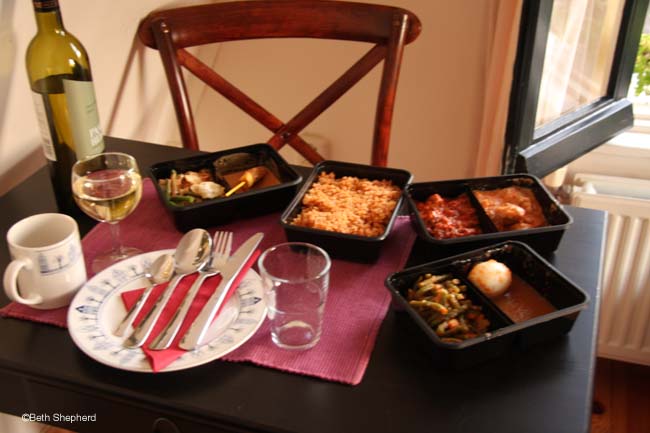
On my recent trip, I found out that there was Indonesian take-out just a half a block from my B&B. It was amazingly tasty and brought tears to my eyes as I stuffed myself, and reminisced about  rijstafel of days gone by, while looking out to the rooftops of Amsterdam from my top-floor B&B room.

Oh for heaven’s sake, I haven’t even dipped into descriptions of the liquid refreshments. The Dutch are renowned for their beer and jenever (Dutch gin). I’m not much of a beer drinker (my loss, I’m sure, given the Dutch reputation for a good brew), but I had a special fondness for Korewijn, which is a jenever that is aged for several years in oak casks. It is smooth and a lovely tummy warmer after an icy bike ride home.

On New Year’s Day, the Queen’s birthday and a few assorted holidays, ‘Advocaat’ was also popular. Advocaat is a rich and creamy liqueur made from eggs, sugar and brandy. It has a smooth, custard-like flavor. Occasionally it’s so thick that it’s eaten with a spoon.  My Oma served it with a touch of whipped cream and some powdered chocolate.

For the non-drinkers amongst you this brings us to the final Dutch foodie lust item on my list: chocolate. Droste cocoa, with whole milk, fresh of the stove was a near daily indulgence, particularly during the long cold winter of 1980 when I lived in the Netherlands. After growing up on Nestle, I can tell you that once I sipped on deep, dark, delicious Droste it was impossible to go back.

Chocolate took many other forms too. Aside from the Hagelslag mentioned earlier there were many shops with enormous assortments of homemade confections. My love affair with high quality chocolate began right then and there.

Let’s just say that during my three-day stay, I managed to check off a fair number of items from my list of much-missed treats. And, if your pants are feeling a bit tighter after reading this post, you now understand why I gained twenty pounds in the nine months I lived in Amsterdam. Smakelijk eten (Tasty eating)!

Looking for more lekkere (yummy) treats? Check out Wanderfood Wednesday!

Filed Under: Food, Travel Tagged With: advocaat, Amsterdam, appelstroop, beer, boerenkaas, Droste, Dutch, Edam, erwtensoep, Gouda, hagelslag, Holland, hopjes, Indonesian, korewijn, licorice, patat frites, pindakaas, poffertjes, rijstafel, roggebrood, stroopwafel, the Netherlands

  • « Previous Page
  • 1
  • …
  • 7
  • 8
  • 9
  • 10
  • 11
  • …
  • 13
  • Next Page »

Some might fend off a mid-life crisis by leaving the comforts of their corporate salary to jet off to a deserted island. Others might buy a Jaguar. I’ve chosen to dive head-long into my 50s and beyond by becoming a first-time parent. At any given moment you might find me holding a camera, a spade, a spatula or a suitcase. Or my little girl's hand. Adopted from Armenia, she puts the Pampers and Paklava into my life.

Subscribe to Blog via Email

Enter your email address to subscribe to this blog and receive notifications of new posts by email.

Recent Posts

  • Ghosts and goblins of Halloweens past
  • Raise a glass—or ten
  • No me without her: A life before motherhood
  • Leaving the orphanage with a priceless pair of tights
  • Rock of ages: Celebrating five years together as a family

Tags

366 Project Adoption anniversary Armenia autumn Bainbridge Island Baja Birds birthday blog cat cats chickadee China Christmas fall ferry flowers France Garden Gyumri Halloween Hawaii Holiday ice cream Kauai leaves London Mamas with Cameras Mexico Mother's Day Mt. Rainier New York orphanage Paris Puget Sound robin Seattle taxi Thanksgiving Tibet USCIS Valentine's Day wedding Yerevan

Categories

  • Adoption
  • Armenia
  • Family
  • Food
  • Friendship
  • Garden
  • Holiday
  • Miscellaneous
  • Paris
  • Photography
  • Recipes
  • Review
  • Seattle
  • Things to do with kids
  • Travel

Sites I like

  • The Wayfaring Voyager
  • Wanderlit
  • Wanderlust and Lipstick
follow us in feedly

Image Copyright

Unless specifically mentioned, all images on my blog are my own original photographs and, therefore, copyright protected (©Beth Shepherd). Feel free to use my images for non-commercial use so long as you provide me with the image credit. Likewise, if you pin my images to Pinterest, please mention me by name.

Copyright © 2026 · Pamperspaklava · WordPress Barista