Pampers and Paklava

  • Home
  • Photography
  • Travel
  • Food
  • Garden
  • Contact

Earth Day 2015: Random acts of greenness

April 22, 2015 by Beth Shepherd

Earth Day 2015

Earth Day

Mother Earth faces a many challenges like climate change and species extinction. This is why, 45 years ago, Earth Day was created, to help activate the environmental movement worldwide, through a combination of education, public policy, and consumer campaigns.

There are so many ways to get involved and participate in random acts of greenness! When I looked through the list of ‘campaigns‘ mentioned on the Earth Day Network website, I realized our family does a number of the actions listed. You don’t have to wait for Earth Day–you can commit to protecting our beautiful Mother Earth all 365 days of the year! Here are a five ways you can go green every day:

  1. Reduce Energy Consumption
  2. Start Composting
  3. Stop Using Disposable Plastic
  4. Buy local produce
  5. End Junk Mail

This year, I decided to participate in one of the campaigns on Earth Day’s website: Create Art to Raise Awareness. Art Works For Change, along with Earth Day Network and Global Footprint Network, invite artists to submit a digital image of original artwork (all visual mediums are welcome) for an opportunity to be featured in their online exhibition, which will open on Earth Overshoot Day 2015  in August.

I submitted three photos and logged my ‘Act of Green,’ because–for me–there’s rarely a day that passes without me noticing something about the beauty of our world. It might be the colorful feathers on a bird, the uniquely shaped petals of a flower, or the majestic skyline views in the spectacular city where I live. When I’ve traveled, I always marvel at the mind-blowing beauty of our natural world: mountains, oceans, creatures in the water, in the air and on the land. Many of the shots that captured my eye recall natural beauty that I was lucky enough to encounter.

Yet sometimes, I am also saddened by the reality that–unless we do something NOW to protect our planet–some of the sights I’ve seen will disappear or be forever changed for future generations.
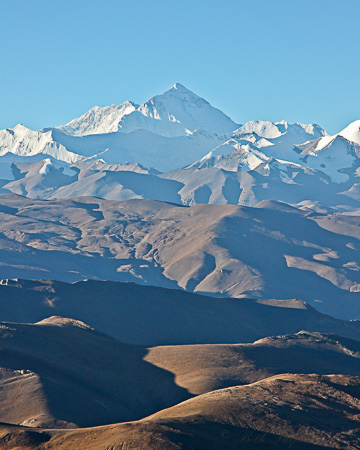
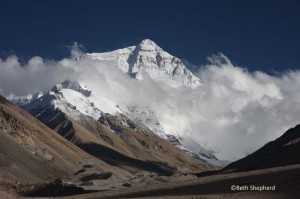
Mt Everest from Tibet

Mt. Everest, the tallest and most iconic mountain on earth, covered with immense glaciers. Unfortunately, like most mountains, Everest is melting. Glaciers in the Mt. Everest region have shrunk by 13 percent in the last 50 years and the snowline has shifted upward by 590 feet (180 meters),

And, this beautiful mountain is also littered with tons of trash: tents, sleeping bags, oxygen cylinders and even the corpses of climbers who never made it down remain. I was heartened to read, in a new move to fix their garbage problem, Nepalese tourism authorities said climbers must bring down 18 pounds of trash when they return.

Baja California whale

Whales. One of the most majestic creatures on the planet. Seven out of thirteen great whale species are vulnerable or endangered. Of course, whales are only one of many–too many–animals who might not be around for future generations.

endangered tropical plants

As a gardener I love plants, flowers and trees. They provide food, shelter, oxygen and beauty. Animals–including us humans–need them to survive. Sadly, like the creatures on our planet, much of our plant life is also in danger of disappearing. Over 20% of plants on earth face extinction.

I know photographs aren’t going to save the world. But awareness–and action–might. Earth Day! Commit a random act of greenness.

And if you want to read more about all things Pampers, follow me on Facebook, Twitter or RSS/email.

Take the road less traveled, Beth


Filed Under: Garden Tagged With: Baja California, Earth Day, Mt. Everest

Tea for two at the top of the world: Chai

February 8, 2012 by Beth Shepherd

Mt Everest, Tibet, ChinaThere is something about standing at the top of the world that takes your breath away. Maybe it’s the elevation. At 17,000 feet and some change, there’s not a lot of oxygen in the air, particularly if you’re used to living at sea level, like I am.

Or, it could be the view. Not many people are lucky enough to have the opportunity I had: to look the Goddess Mother of the World, Mt. Everest, square in the face. Yet that’s exactly what Big Papa and I did when we visited Tibet in 2008.

Temperatures were in the teens, and there was nothing between us and the mountain of all mountains, except an open plain and a fierce wind. Being in Tibet, and seeing Mt. Everest, was unforgettable.

And so was the tea. Back at the Everest Hotel, we headed for the sole dining room and ordered up a big pot of chai. Sensuous aromas of cinnamon, cardamom, clove, ginger and pepper filled the air. I will never forget my first sip: warmth soothed my cold throat and the flavors were simply irresistible. Big Papa and I joyfully drank the entire pot with ease.

In much of the world, including Asia, Eastern Europe, parts of Africa and Brazil, “chai” means tea. Chai tea, frequently called “Masala Chai,” is an aromatic blend of black or green tea infused with warming spices and typically served with sugar and milk.

If you travel to India, Nepal and Tibet, where chai originated, you’ll likely see vendors peddling the tasty brew on street corners or at train stations. According to Ayurvedic tradition, chai boosts the immune system, enhances metabolism, relieves stress, aids digestion and sharpens the mind. Never mind that it’s also out-of-this-world delicious.

You can find hundreds of chai recipes associated with different locales, restaurants and even families. Preparation methods vary, too—some aficionados insist on boiling the tea, spices and milk together, while others take a gentler approach, briefly steeping the tea leaves and spices in hot water, then adding hot milk and sweetener last.

I still drink chai, though I’ve never had a cup that was as good as the chai we drank while traveling in Tibet. The Goddess Mother of the World had a way with tea. She worked her magic on our chai…and on us.

Teapots, Tingri, Mt Everest, Tibet, ChinaTop of the world [chai] tea for two

• 1½ cups cold water
• One 2-inch piece cinnamon stick, broken
• 2 heaping teaspoons black tea
• Seed of 3 cardamom pods
• One ¼-inch-thick slice fresh ginger
• 3 whole cloves
• 2 black peppercorns
• ¼ to ½ cup milk
• 1 to 2 tablespoons sugar

1. Bring water to a boil in small saucepan. Add cinnamon, cover, remove from heat; steep 2 minutes. Return pan to heat; bring to a boil. Add tea, spices, milk and sugar; cover, and remove from heat. Steep 3 minutes.

2. Pour mixture through fine wire-mesh strainer into warm teapot, discarding solids.

Note: If you prefer, omit the milk and sugar and offer them separately. You can also experiment by adding fennel seeds, coriander seeds, nutmeg, star anise, and lemon or orange peel to create your own unique chai blend.
Beth at Everest Base Camp, Tibet, China Want to take your breath away with more deliciousness? Check out Wanderfood Wednesday!

Filed Under: Food, Travel Tagged With: Base camp, Chai, Everest Hotel, masala chai, Mt. Everest, tea, Tibet

Lunch with a lama

January 27, 2010 by Beth Shepherd

Inky blackness greets my eyes as I step outside our hotel’s front door. My skin prickles from the intense sharpness of the cold air. As my eyes adjust to the darkness, I can see millions of stars filling the darkness, like a Pointillist painting. The Milky Way spills out in a cloudy haze. I feel so small, just one speck of life.

My husband, Big Papa, and I are spending the night at a hotel in Tingri, Tibet one stop in our trek from Lhasa to Mt. Everest base camp. Tingri has a population of approximately 523 and is at an elevation of 14,107 feet. The elevation combined with the pure, unpolluted skies gives us a view of our galaxy we’ll never forget. I’m sure if I just stretched my arm out an inch or two farther, I could touch the stars.

What a difference a seven-hour plane flight and a couple days of driving makes. Our journey began in Beijing. Traveling from this sprawling, polluted metropolitan city to Lhasa, the capitol of Tibet is a study in contrasts. As the Chinese tear down old Beijing, in its stead an uber-modern sterile hulk of a city rises out of the destruction. Change is afoot in Lhasa too, and some years from now, it may bear little resemblance to its former self.

But once the city of Lhasa disappears over the horizon, the Tibet which emerges has remained unchanged for thousands of years. The feeling of being in a place where the sights, scents and sounds are as ancient as time itself reverberates deeply inside my soul, like the rich bass voice of the monk chanting at Tashilhunpo Monastery, where we’d stopped just the day before.

Tibetan light

Like most of our trip, the previous day’s drive to Tingri could only be described as surreal. We’d just finished a filling lunch in Shigatse and had been on the road for about a half-hour. A short distance in front of us, we see several trucks pulled off to the side of the road and a gathering of people. Tenpa, our Wisdom Tours guide, tells Chimi, our driver, to pull over so we can see what’s going on.

In the middle of a circle of local farmers and villagers we see a bald-headed, burgundy-cloaked Lama: not exactly what you might expect to see in the middle of the countryside. We sit and stare from safe distance for, a few minutes the Lama until notices us and waves us over to join him. We don’t know what to do, but Tenpa encourages us to go, so off we tromp across the field. “Welcome. Please sit down,” the Lama greets us in clear English. He motions us to sit, on the ground, in the middle of a group that has gathered around him. Several monks appear with thermoses of hot water and hot water only. We aren’t sure why we don’t rate a serving of tea. Plates piled full with momos: dumplings with yak meat and vegetables inside, are being passed from person to person. Our lunch is still warm in our bursting bellies, but when you’re sitting in the middle of a field in the middle of nowhere in the middle of Tibet at the invitation of a Lama, what are you going to do?

So, we eat and chat with the Lama, feeling very conspicuous amongst all the local townspeople and the Lama’s entourage, whose impromptu roadside assembly we interrupted. The Lama speaks English quite well and tells us he now resides mostly in Italy. We share that we have traveled all the way from Seattle, Washington in the United States. It feels other-worldly to be chatting with a monk while munching on momos in the midst of the Tibetan wild.

Tenpa and Chimi stand, looking uncomfortable, a short distance from the gathering. Fifteen or twenty minutes pass before we excuse ourselves. Whether our hasty retreat is perceived as rudeness, we don’t know, but we feel torn between our allegiance to our guide and whatever obligation we unknowingly entered into by accepting an invitation to share a meal with a Lama.

Heading down the road once again, Chimi deftly speeds around the curvaceous mountain passes without a moment’s hesitation, swerving within inches of precipitous drop-offs. Big Papa and I sit in the back seat of the Land Cruiser. Our eyes wince with each close call. Tenpa reassures us that Chimi knows exactly what he’s doing and besides, he tells us, it’s only the “crazy Chinese drivers” who get into accidents.

Tenpa starts talking and shares his opinion of the Lama we’d just met. He says he knows of “this Lama” and believes the Lama’s reputation is one of ill repute. He describes shady and politically-tinged quarrels between the Gelug, or Yellow Hat sect, the sect to which most Tibetans and the current Dalai Lama ascribe, and this Lama. Supposedly, this Lama broke from the Gelug sect and tried to form his own sect and followers. From Tenpa’s perspective, this Lama was not a “real” Lama.

Big Papa and I are a bit confused. Why pull our truck over to the side of the road and encourage two naïve Westerners to dine with a Lama if the Lama was of dubious distinction? Our experience feels a bit tarnished.

We ponder this turn of events, and our guide’s interpretation, as we venture higher and higher through mountain passes. Nomadic herders guard their yak and sheep, their forlorn and isolated tents perched on windblown precipices. Tiny villages, a dozen huts strong, pop up every so often in the formidable landscape. No one who lives in this remote and rugged terrain escapes the harsh hot summers or the endless frigid winters. To survive in this place speaks to the incredible tenacity and strength of the people who call the mountain regions of Tibet home.

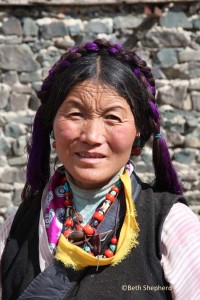
Tibetan womanPulling off to the side of the road for one of our now infamous “nature toilet” stops, we are greeted by two children. They come running across the highway from their small village of eight or so homes. Their faces and clothing are dirty and they peer at us with eager curiosity. Soon they are joined by an older woman. Her face is lined with crevices as deep as the chiseled mountains that loom behind her village.

Tenpa interprets for us and we have a short conversation. She asks us where we are traveling from and what we do. I try to imagine Big Papa explaining software development to a woman who has spent her entire life in a remote Tibetan village at 16,000 feet.

She tells us she is 44 years old. I blink and attempt to absorb what I see versus what I hear her say. At nearly five years her senior, I look decades younger than she does. I feel guilty about the many privileges I so easily take for granted. The conveniences and wealth of in our westernized lives are likely unimaginable to this woman. By U.S. standards, our house at barely 1000 square feet is a tiny cottage. Yet, our humble home could encompass most of this village.

Before we depart, she asks if I would like to buy her silver waist belt. I am tempted but Tenpa tells us she is asking too much for it and we can get a cheaper price at a market. True, I think, but not with this story. I feel a bit regretful that I pass on her offer, but as we walk back to the truck, I see something sparkle in the dusty earth. It’s a crystal, a lovely gem possibly created in this spot where I stand. I pick it up and tuck it in my pocket, running my fingers over its smooth edges, happy to have a memento to mark this moment.

Sunset at EverestFrom Tingri, we make our way to Mt. Everest, or Qomolangma as the Tibetans refer to it. Qomolangma means Goddess Mother of the Universe, which is quite appropriate if you ask me. The scale in the Himalayas is difficult to imagine. Earlier in the day, when the mountain was completely covered in cloud, I pointed out a smaller peak on Everest’s flank to Big Papa, thinking it was Everest. It could have been: it was a sizeable mountain in itself, maybe 22,000 or so feet tall, with its own snowline, ridges and summit. It stood well apart from everything around. But come late afternoon, the clouds began to clear, and the upper slopes of Everest hove into view. Standing at base camp, at nearly 17,000 feet elevation, you realize how massive a peak it really is. We were already very high, but Everest’s summit towered two miles above us, and it seemed above everything else as well.

You hear about Everest being an “easy” climb, with hundreds of tourists led up it each year. While that is the case, standing there and seeing both the ridge and the “step” that Tenzing Norgay and Edmund Hillary made their way up in 1953, and seeing the very high ridge where George Mallory and Andrew Irvine were last seen making their way towards the summit in 1924 before disappearing into clouds – probably clouds much like we saw that day – one gains a new appreciation for the immense effort and imagination it must have taken to make those early attempts. Everest might be “easy”, but it commands respect, even from those just sight-seeing like we are. After a couple hours of studying the mountain and thinking these kinds of thoughts, we tuck into our rock-hard beds at the Everest Hotel, without a working squatting toilet, showers or heat.

Tea with monksOne of the most memorable moments on our trip occurs as we return to Lhasa from Everest the next day. Passing through Shigaste for a second time, we stop at the Gyatse Monastery. A few of the monks ask us to join them in conversation over a hearty cup of yak butter tea. Tenpa, Big Papa and I stand in the center courtyard chatting with them. Big Papa’s beard has been the subject of much attention during our Tibetan travels, especially amongst the monks. One of the monks asks if he can touch it and Big Papa says yes. The monk reaches out and, with a huge smile and much amusement, loudly growls “Ruff, ruff, ruff,” as he grabs the hair on Big Papa’s chin and gives it a thorough scruffing. Do beards remind Tibetans of dogs? We don’t know, but he is obviously having a great deal of fun.

As we leave Shigatse, Big Papa and I hunker down in the back seat of the truck, giggling. Regaling each other with our favorite stories from the trip, we recount our lunch with a Lama and the beard scruffing incident. We have visited soulful monasteries and have seen spectacular vistas, yet the memories that made the most indelible marks, are those where our lives touched the lives of others. In Tibet, it’s not just the altitude that takes your breath away. How many times in one’s life will two city slickers from Seattle have lunch with a Lama? Not many.

Hungry for more? http://wanderlustandlipstick.com/blogs/wanderfood/category/wanderfood-wednesday/

Filed Under: Food, Travel Tagged With: Andrew Irvine, Beijing, China, Dalai Lama, Edmund Hillary, Everest Hotel, Gelug, Gyatse, lama, Lhasa, Milky Way, Mt. Everest, Qomolangma, Shigatse, Tashilhunpo, Tenzing Norgay, Tibet, Tingri, Wisdom Tours

A monk and a fish

January 20, 2010 by Beth Shepherd

Thwap goes my hand, as I smack it down hard on the table, leaving one mortally wounded fruit fly. A remaining undamaged silvery wing twitches a bit before I flick my fingers and send the fly sailing over the table’s edge to its demise.

Big Papa shakes his head. “I guess you haven’t completed your transformation to Buddhism.” He follows with, “There goes my grandmother.” I hang my head. “Yes, you’re right.”

BarkhorWe sit in silence for a few minutes waiting for our meal to arrive at St. Clouds, one of our favorite Seattle neighborhood restaurants. Soon Big Papa is reveling in ribs swathed in barbecue sauce while I savor mussels bathing in coconut milk. Twenty or so mussels nestle inside my bowl. By Buddhist interpretation I am devouring a small village.

Steamy broth sends tendrils of heavenly spiced aroma to tickle my nostrils. I close my eyes, remembering. Mere days ago we sat at a café in Lhasa, Tibet.

The memory seems surreal, yet I can almost see the soft afternoon light filtering through the window of the café as I hold a warm cup of Masala tea in my hands. Its milky spicy fragrance surrounds me.

Outside the window, earnest merchants in the Barkhor haggle with persistent tourists over the price of prayer wheels. Weathered pilgrims chant while circumambulating clockwise around Jokang Temple. Smoke rises from branches of juniper placed on outdoor incense furnaces and mingles with the intense sweetness of yak butter candles.

As the sun slowly lowers itself to the horizon, the light becomes warmer and shadows are more pronounced. Magic hour is nearly upon Lhasa. Soon the walls of Jokang will be set ablaze in glorious hues of gold. Brilliant purples will creep into the turquoise blues of the sky.

I draw in a final sip from my cup, long and slow, letting hints of pepper and cinnamon dance on my tongue. Big Papa and I head outside, through the Barkhor, to the marketplace with our guide, Tenpa. We move alongside the throngs, cobblestones underfoot. Though there is no urgency in our steps, I feel as though I’m being swept through a canyon, one buffalo in a herd of many.
Prayer FlagsLegend tells that in 647 A.D. the first Tibetan king, Songtsen Gampo, built the Jokhang Temple. Its magnificence quickly attracted thousands of Buddhist pilgrims. As a result, a trodden path appeared which grew into Barkhor Street.

Turning to the right, we amble along Zang Yuan Road, passing Jokang Plaza and then a Tibetan prayer flag shop.  Sewing machines whir and nimble fingers connect the blue, white, red, green, yellow flags, which will soon adorn buildings, streams and mountain passes. Each color, arranged from left to right in specific order, symbolizes one of earth’s elements, blue for sky, white for air and wind, red for fire, green for water and yellow for earth.

A monk and a fishA short distance in front of us, a monk swathed in a vibrant burgundy robe squats on a corner step. A bucket of fish, nervously swimming figure eights in their tight quarters, sits at his feet. The monk watches the fish intently, glancing up on occasion. He is slim of stature with ruddy bronzed skin and broad cheekbones. Wizened eyes peer upwards in our direction as he tilts his head. “Just a moment,” Tenpa tells us as he scurries over to the monk. We watch him press a few coins into the monk’s hand.

Tenpa rejoins us but says nothing. Walking a bit further down the street we ask, “What just happened?” He tells us, “That monk purchased those fish from Chinese Muslim merchants who sell them to be eaten. Tonight, on his way back to the monastery, he will stop and release the fish back into a stream.” Tenpa pauses for a moment and takes in a deep breath. “I gave him a bit of money to help with the cost of the fish.”

Big Papa and I think carefully about what we’ve just heard. We have seen Tenpa and other Tibetans eat meat, yak mostly, but occasionally chicken or pork. However, it has not escaped our notice that none of the cafés or restaurants we’ve visited list fish on the menu.

Later, during dinner, we ask Tenpa to help us understand why Tibetans eat yak, but not fish. He looks straight at us and says quite matter-of-factly, “Taking a life for such a small amount of meat is a waste.” His voice is tinged with slight annoyance. I’d venture he’s been asked questions like this innumerable times by countless travelers. It must puzzle and frustrate him that Westerners don’t comprehend this distinction.

MerchantsA moment passes and I catch Big Papa’s gaze. I know exactly what he is thinking. With us, we’ve brought several items which we intend to give as gifts to our guide Tenpa and our driver Chimmi, at the end of our trip. A box containing smoked salmon was selected with Tenpa in mind. Although we’d heard Tibetans did not eat meat, we somehow rationalized that fish would be acceptable. In the U.S. there are many who identify themselves as “vegetarians,” and will not touch meat from a cow, chicken or pig, but will happily dine on seafood. For many years, I was one of these vegetarians.

What a rare treat, we thought. Smoked salmon transported all the way from Seattle. Certainly not something you would find in mountainous central Tibet. Little did we imagine that our carefully chosen gift might be received as an enormous insult by our gracious guide.

That night, back at the Shangri-la Hotel, we tuck the smoked salmon deeper into our suitcase, and our innocent ignorance along with it. By the time we’ve returned home, it is one well-traveled smoked fish, having flown 13,442 miles, the distance from Seattle to Lhasa and back again, not to mention the multi-day side trip all the way to base camp at Mt. Everest. This fish has been from below sea level to the top of the world.

I blink and open my eyes, returning to the moment. Big Papa is elbow deep in his luscious ribs. Outside the window, rain is pouring down fiercely. I see green and trees. I know the mountains behind the clouds are not the Himalayas. At tables on all sides of me, people are speaking English. I take a long, slow sip from my glass of northwest Pinot Noir just as I’d sipped Masala tea in Lhasa. A second glass, filled to the brim with tap water and ice, is right in front of me. It is the first time in nearly a month that I’ve been able to safely drink water that is not bottled. Discarded mussel shells lace the rim of my pure white bowl, like a necklace.

Om Mani Padme Hum. The words reverberate just below the surface of my conscious mind. I contemplate the meaning of this chant I heard hundreds, if not thousands, of times during our trip. According to Buddhists, this six syllable mantra means, “in dependence on the practice of a path which is an indivisible union of method and wisdom, you can transform your impure body, speech, and mind into the pure exalted body, speech, and mind of a Buddha.” After a journey of many thousands of miles in this life, I still have many miles and many lives left to travel.

Check out the WanderFood Wednesday series for more great food postings!

Filed Under: Travel Tagged With: Barkhor, Buddhist, fish, Jokang Temple, Lhasa, monk, Mt. Everest, Shangri-la Hotel, Songtsen Gampo, Tibet, vegetarian, Zang Yuan Road

The Reward is the Journey

May 1, 2009 by Beth Shepherd

This past October, my husband (hereafter referred to as Big Papa) and I were fortunate enough to be able to visit Tibet. He was completing a work project that required a trip to Beijing and I decided to join him. We talked about taking additional time for a vacation after the project launched. Initially we considered Yunnan, after a friend of mine traveled there and told us about the diverse ethnic groups who live in that province.

Looking at the map, I noticed it wasn’t much farther to Tibet. One of Big Papa’s lifelong dreams was to see the Himalayas, so I angled for Tibet. We chose Wisdom Tours to guide us (independent travel is not allowed in Tibet), because they use Tibetan guides and we wanted an authentic perspective.

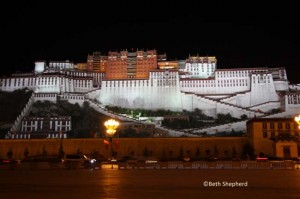
Our itinerary included a few days in Lhasa, with visits to the Barkhor market, Potala Palace (where Dalai Lamas lived for centuries) and Jokhang Temple, along with stops at monasteries and smaller towns as we wound our way through the countryside until we reached the highest spot on earth, Mt. Everest. We were unbelievably excited to see Everest. All the rest was the cherry on our sundae.

Potala Palace

Arriving in Lhasa

We arrived on September 26. The elevation at Lhasa is 12,000 feet. Climbing the stairs to our hotel room left us breathless. That afternoon, we strolled through the Barkhor market. Buddhist pilgrims, many who had traveled thousands of miles, circumambulated clockwise around Jokhang Temple, one of the holiest temples in Tibet. They spun hand-held prayer wheels, sending prayers to the heavens.

Clouds of juniper incense perfumed the air. Colorful prayer flags adorned every rooftop and waved their rainbow of mantras between every building. Monks in beet red robes mingled with the throngs of tourists. Golden rooftops of the temples rose to a crystal clear turquoise sky.

On the road to Everest

Two days later, a bit more acclimatized to the altitude, we began our four-wheel trek to Everest. On the way, we passed tiny mountain outposts. We saw villagers, faces bronzed and filled with lines from hard labor in harsh conditions. Tibetans live simple lives in humble dwellings. They are devout in their beliefs and practices which are woven through every aspect of their lives, like the warm colors in a Tibetan rug.

Tibetan Woman

Visits to several monasteries were mesmerizing. Monks chanted so deeply, I could feel my chest vibrate. Rich saffron orange walls and a king’s ransom of coral, turquoise and precious stones adorned golden Maitreya Buddhas and Taras. Salty yak butter tea was served to us by playful monks who scratched Big Papa’s beard and laughed.

The food was surprisingly good. Thick, tangy yogurt laced with honey. Ginseng roots slathered with rich yak butter and tossed in rice. Hearty yak nestled beside carrots and potatoes in a tasty stew. We did not expect to write home about the cuisine and yet , here we were, praising each meal and looking forward to the next.

We headed skyward, driving by nomads herding noble yaks in remote vistas of spectacular beauty. Three days later, we arrived at Chomolangma National Park (Chomolangma means ‘Goddess Mother of the Universe’ in Tibetan). We hiked the final three miles in to base camp, at 17,000 feet. Finally, we stood facing the mountain, in all her glory.

Seeing the Goddess Mother of the Universe is awe-inspiring. I will never forget the time we spent in her shadows. There is something indescribable about being in that place, achieving a dream, traveling the distance and seeing the unimaginable. It was only nine days and, at the same time, it was life-changing.

Mt. Everest

Had we not experienced the days preceding that moment, I’m not sure it would have meant as much. Before our trip, visiting Everest was a mere dream. Now it was 29,000 feet of rock solid reality. And, we understood more about Goddess Mother by learning about her people and the land beneath her snowy base.

The Dream

Our trip to Tibet and Mt. Everest has many parallels with our adoption journey. Becoming parents is a long-held dream. The road to adoption covers many miles and is very steep. There are many obstacles en route and the unexpected greets us around every corner. With each step, we learn more. We work hard together as a team. There are times of laughter and also times when we have shed many tears. As we make our way, we craft an incredible story. A story we hope to share one day with our child as we encourage him to pursue dreams of his own.

Filed Under: Adoption Tagged With: Chomolangma, Himalayas, Jokhang Temple, Mt. Everest, Potala Palace, Tibet, Wisdom Tours

Some might fend off a mid-life crisis by leaving the comforts of their corporate salary to jet off to a deserted island. Others might buy a Jaguar. I’ve chosen to dive head-long into my 50s and beyond by becoming a first-time parent. At any given moment you might find me holding a camera, a spade, a spatula or a suitcase. Or my little girl's hand. Adopted from Armenia, she puts the Pampers and Paklava into my life.

Subscribe to Blog via Email

Enter your email address to subscribe to this blog and receive notifications of new posts by email.

Recent Posts

  • Ghosts and goblins of Halloweens past
  • Raise a glass—or ten
  • No me without her: A life before motherhood
  • Leaving the orphanage with a priceless pair of tights
  • Rock of ages: Celebrating five years together as a family

Tags

366 Project Adoption anniversary Armenia autumn Bainbridge Island Baja Birds birthday blog cat cats chickadee China Christmas fall ferry flowers France Garden Gyumri Halloween Hawaii Holiday ice cream Kauai leaves London Mamas with Cameras Mexico Mother's Day Mt. Rainier New York orphanage Paris Puget Sound robin Seattle taxi Thanksgiving Tibet USCIS Valentine's Day wedding Yerevan

Categories

  • Adoption
  • Armenia
  • Family
  • Food
  • Friendship
  • Garden
  • Holiday
  • Miscellaneous
  • Paris
  • Photography
  • Recipes
  • Review
  • Seattle
  • Things to do with kids
  • Travel

Sites I like

  • The Wayfaring Voyager
  • Wanderlit
  • Wanderlust and Lipstick
follow us in feedly

Image Copyright

Unless specifically mentioned, all images on my blog are my own original photographs and, therefore, copyright protected (©Beth Shepherd). Feel free to use my images for non-commercial use so long as you provide me with the image credit. Likewise, if you pin my images to Pinterest, please mention me by name.

Copyright © 2026 · Pamperspaklava · WordPress Barista