Pampers and Paklava

  • Home
  • Photography
  • Travel
  • Food
  • Garden
  • Contact

Leaving the orphanage with a priceless pair of tights

April 5, 2017 by Beth Shepherd

Gyumri, Armenia Our daughter spent the first year of her life in a “children’s home” in Armenia, aka an orphanage. All of the children’s homes I visited in Armenia (three in total) were, as orphanages go, “good” homes. The facilities were clean. Children had their own crib or bed. Basic needs were met. Our daughter was well cared for by loving nannies.

But nothing in that orphanage was hers and hers alone. The eight nannies who cared for her, also cared for other children. And whereas in most families a baby can count on the same person feeding, dressing or bathing her, a baby in an orphanage can never be certain who will come soothe her cries, when they will come, and sometimes whether anyone will come at all. Diapers were washed, hung on the line outside to dry, and reused. Blankets, towels, clothing—all shared. Everything our daughter touched or wore, was touched and worn by other babies. I’ve seen pictures of babies who were also adopted from our daughter’s orphanage wearing the same bunny slippers or the same sweater.
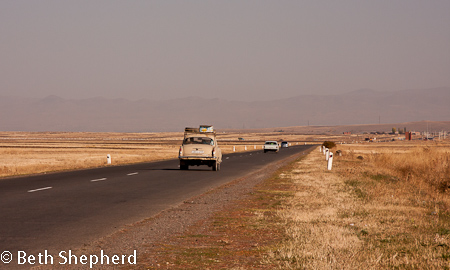
Gyumri Armenia

I think about this a lot, especially when I see babies being cared for by a mom or a dad, knowing that baby associates comfort and security with seeing the same face over and over again. The familiarity her mom’s arms wrapped tightly around her, how she smells, even the baby’s own scent on her very own blanket. Visceral memories deeply ingrained in our psyche.

As an adoptive mom and a photographer I also think about how the minutiae of infancy is meticulously documented, at least in the U.S. Most moms I know have albums full of pictures showing their baby being held and fed, sleeping in their crib, their first smile, cute outfits they wore. Images reflecting their baby’s life during that formative first year.

These are the kinds of things many kids look back on as they grow up, and ask questions about. What did I look like as a baby? What was my favorite toy? What did I wear?

This is why the day we took our daughter out of the orphanage is forever etched in my mind. I was excited and nervous because our lives were about to change and from this moment forward we would be together as a family. At the same time I felt a deep sadness, knowing we were taking our daughter away from the one place she’d lived and the people who had taken care of her. Imperfect as orphanage life was, it was all she knew.

Other than the memories my daughter has tucked deep inside, there are only a few things we can share with her about her beginnings. We have referral photos and a short video we received from our adoption agency when our daughter was a few months old. There are pictures I took on our first visit to meet her when she was almost six months old. But until she became a member of our family that  is all we have, except one precious gift: a pair of tights.

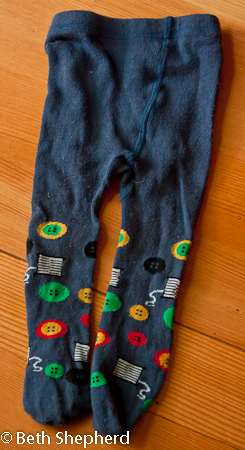
orphanage tights

When we picked up our daughter we made sure we had all the clothes we thought she’d need, because her nanny would change her out of whatever she was wearing before bringing her to us. We brought a long-sleeved onesie, cotton pants, a cotton shirt, a sweater, one coat with a hood, a cotton cap, socks and shoes.

We waited on a bench outside the office of the orphanage director. Her nanny dressed her in the baby room and then came down the stairs and and handed her to us. We took a few pictures with the director and then piled into a taxi and headed to Yerevan.

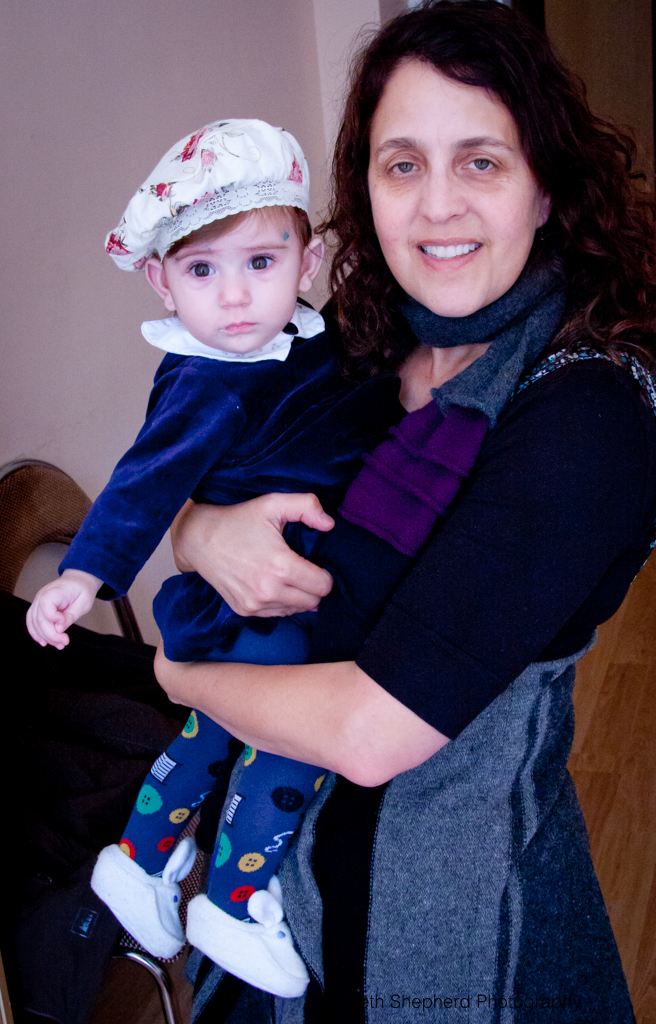
Two hours later, when we reached our apartment in Yerevan and changed our first diaper, we discovered her nanny had also put her in a pair of tights, blue cotton with pictures of buttons and spools of thread woven into the background. I remembered those tights from our “get to know you” visits to the orphanage. Each day when one of her nannies brought her out to us, she was dressed in an adorable outfit. One day she wore a tiny beret, another day she was completely decked out in a white hand-crocheted ensemble, and on yet another she was sporting the cutest bunny slippers. On several occasions her outfit featured the blue tights. But cute as those clothes were, they weren’t hers.

When I look at her tights now, I see a treasure, the one tangible thing she has from her days spent in a children’s home, and the only thing she can literally hold in her hands knowing they were once on her legs when she was a baby. The tights are tiny, only 15-inches long, yet enormous when I reflect on what they stand for. To me those tights are priceless.

It’s all about the journey,

Beth
Filed Under: Adoption, Armenia Tagged With: Gyumri, orphanage

What I remember about waiting to meet my daughter at the orphanage

October 21, 2016 by Beth Shepherd

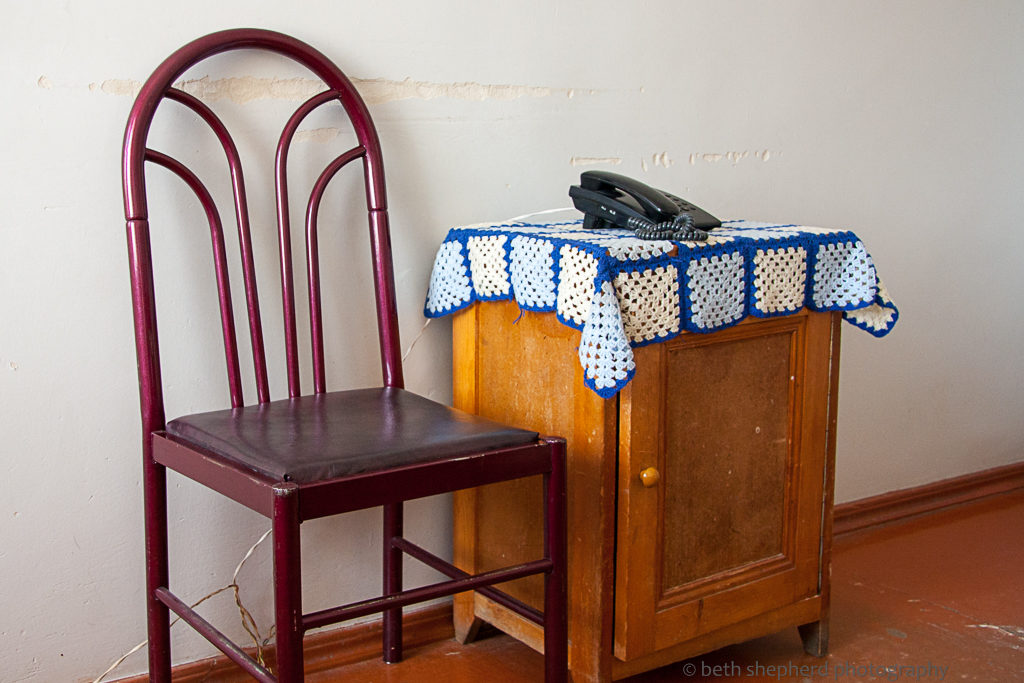
chair and phone

As an adoptive parent, meeting the child who might become your child, is an epic moment. There’s no way to describe the feeling, built from years of yearning, anticipation and uncertainty. And I had already experienced this moment before. Twice. Two times, yet no child. So you can imagine—this journey—half-way around the world to visit yet another baby at an orphanage, was fraught with tension. What if this child had additional medical conditions beyond the scope of what we felt we could manage? What if we encountered paperwork snafus and were unable to register our intent to adopt this child? What if it all fell through in the end?

You might think we were just overly nervous first-time prospective parents. Certainly this was true. I don’t know a single adoptive parent who doesn’t worry about the same questions we worried about. But in our case, there was an additional albatross around our necks. We’d been in this exact place in the process before, and knew meeting a child might not turn out the way we’d hoped. Because, for us, it hadn’t.

In fact when we visited Armenia’s Ministry of Justice department to file the necessary paperwork to meet this baby, the head of the department, Mr. S, shook his head and uttered, “Ohhh…Shepherds” in his deep baritone voice. This was our third visit to his office. Three times, because on our second trip to Armenia to meet the previous child, we found out that one of us would have to come back—one month later. Unbelievably, the child we’d hoped to register our intent to adopt on that trip, was not yet “off the database” meaning available for adoption by families outside the country.

These circumstances set the tone for the day and our moods. Pensive. Anxious.

waiting at orphanage

I remember how I felt when my husband and I sat in that room, five years ago, like it was yesterday. I remember the couch, covered with a white, fringed throw, soft cushions, like my grandmother’s sofa. I remember looking around the room, memorizing every detail. The closet that stood ajar, every angle off, like a scene from a Dr. Suess’s book.

closet

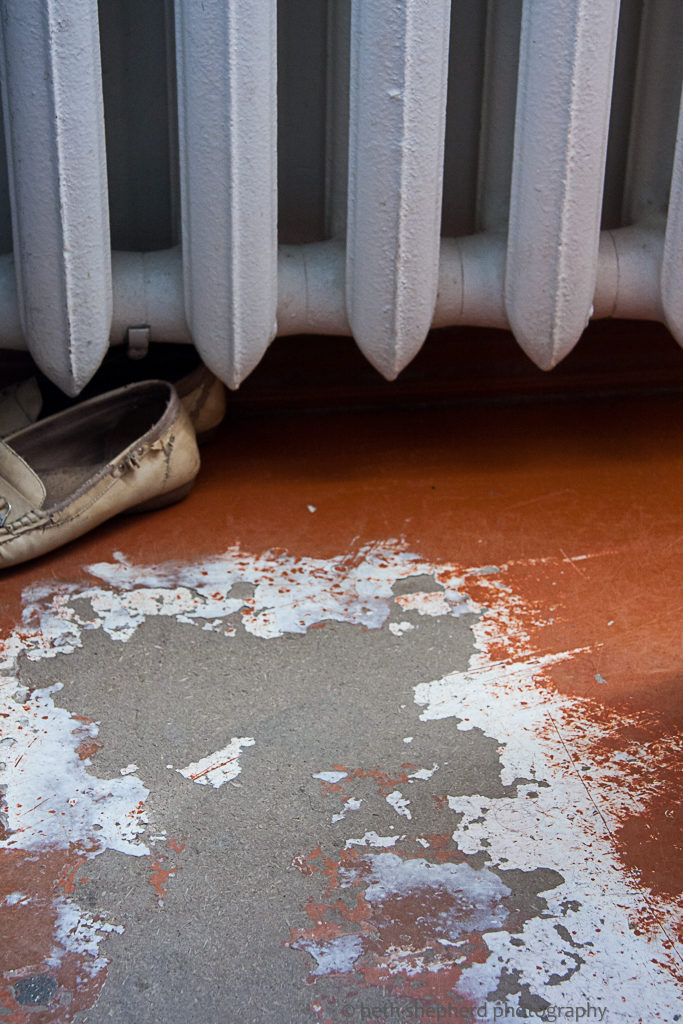
The floor, weathered from thousands of steps back and forth through this same room, where we sat. Waiting. Outside the window, the sun was shining, but I couldn’t stop thinking about life inside, the life a child would have if this were their “forever home.”

floor in orphanage

By this time I’d already been on the receiving end of hate mail on my blog, from people—one in particular—who felt non-Armenian families had no business adopting an Armenian child and taking that child from their birth family, culture, and country. I understand this and truly believe the first choice should always be to keep families together, whenever possible. But sometimes circumstances are such that it’s simply not possible, not for the immediate family and sometimes not even for the extended family. Angry commenters claimed children were “better off” remaining in the country of their birth, even if it meant they’d grow up in an orphanage.

window

This orphanage, along with the other two I’ve seen in Armenia, is run by caring people. The buildings and furniture might not be in the best shape but the orphanages are clean and tidy. Children have their own beds. Diapers, while in short supply, are changed regularly as are the children’s clothes. Nannies give the kids attention, as best they can, given the number of children in their care. I know they form attachments, especially to some of the children, and I can only imagine how heartbreaking it must be when children they’ve cared for leave. But I also know how much they want each of these kids to find a home, because no matter how good an orphanage may be, it is still an orphanage.

office desk

I stared at the desk, where the head nurse sat, a cup of tea abandoned, notebooks sitting off to the side, notebooks where she kept records of the children, their height and weight, any illnesses they had, little details. While I waited I thought about all the details we westerners log, the pictures we take, the celebrations we hold as we keep tabs on our kids’ development: when they held their head up by themselves or roll over for the first time, how old they were when they got their first tooth or haircut, when they said ‘Mama’ for the first time. I thought about how a child in an orphanage might never know any of these details, might not have a single photo of themselves as a baby. I thought about how these kids would reach milestones that might be barely noticed and rarely remembered, that they might never have a single keepsake or memento from these “firsts.”

Sitting in this room, taking it all in, I was really struck by how this could change the course of an entire life and create challenges, some that may never be overcome, memories they can’t fully express that might haunt them and influence their personality, habits, relationships, their ability to bond.

tea cup

We waited a long time before a nanny appeared at the door, holding a baby. I sprang from the couch. Our translator walked over to the nanny and I could tell from her gestures and demeanor, something was wrong. In staccato Armenian words I did not understand she spoke with the nanny who then turned and left with the baby. What had just happened we asked? Our translator explained. She brought the wrong baby.

door

I wilted with despair even as we were assured that our baby did indeed exist. We paced the floor, waited and waited. At long last another nanny appeared at the door, holding a different baby. And in mere moments, there she was, in our arms for the first time.

orphanage meeting

It’s all about the journey,

Beth

Filed Under: Adoption Tagged With: Armenia, orphanage

Nappies for Nork

March 27, 2015 by Beth Shepherd

Do you ever feel like you want do something bigger than yourself, even just a little something? Send a few dollars to Nappies for Nork. Nork is a children’s home in Yerevan, one of the two children’s homes I visited during my trips to Armenia. Here’s more:

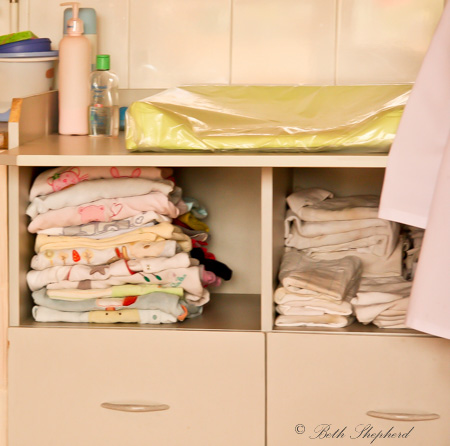
orphanage changing table

Nappies for Nork

Nork orphanage, located in Yerevan, Armenia, is home to approximately 80 orphans, newborn infants to grade-school children. Nork is in dire need of disposable diapers. While it should be the responsibility of the Armenian government to supply basic necessities such as diapers, economic constraints have made doing so a challenge.

In the US, a brand-name diaper costs roughly 15 to 30-cents per diaper. In Armenia, diapers are more expensive, closer to 25 to 50-cent per diaper, depending on the size and brand. The bottom line (sorry…couldn’t resist) is that for $1.50- $3.00, a child at Nork can be clean and comfortable for an entire day. $70 will keep a child in diapers for an entire month. Approximately $135 will ensure every child at Nork has fresh diapers for a 24-hour period.

Hopscotch Adoptions has partnered with SOAR (Society for Orphaned Armenian Relief) to set up a diaper fund: http://soar-us.org/diaper_fund.html where you can make a tax-deductible donation: http://soar-us.org/donate.html. Note: If you pay via the Paypal link on SOAR’s website, make a note in Paypal that your donation is for the Nork diaper fund.  If you send a check, write ‘Nork Diaper fund’ in the “For” line.

Make your contribution, in any amount, between now and Easter Sunday–April 5–and you can also enter a drawing for a variety of items, including a cookbook, Armenian Christmas music cd, Starbucks gift card or an 8×10 photograph taken in Armenia by yours truly! Email viviane8 at yahoo dot com. Let her know you made a donation and provide your contact information.

Hopscotch diaper drive

Take the road less traveled, Beth

Want to be in-the-know on all things Pampers? Follow me on Facebook, Twitter or RSS/email.

Filed Under: Armenia Tagged With: Hopscotch Adoptions, orphanage, SOAR

Leaving one home to join another

March 25, 2015 by Beth Shepherd

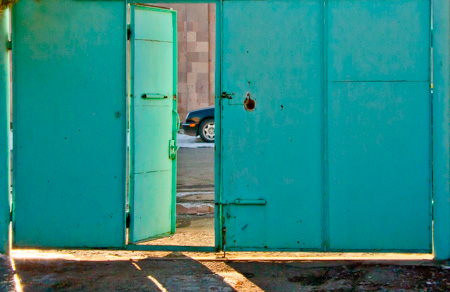
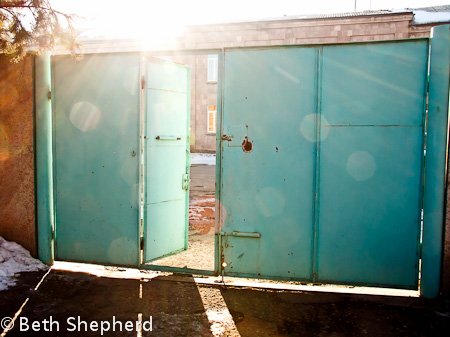
Out the turquoise doors we passed, our daughter leaving one home to join another. Walk through these doors in the other direction and you enter Baby Bird’s first world, a children’s home, where she lived for the first year of her life, surrounded by the voices of nannies and other children just like her, children who–for any number of reasons–were not able to live with their birth families.

I will always be deeply grateful to the nannies who did their best to meet her needs. But to me, these walls also tell another story, one with limited opportunity, where there isn’t space to crawl and run and play, where there are no clothes or toys that were hers and hers alone. The children’s home was a place where even the most loving of nannies cannot meet the needs of a child in the way a family can.

Leaving orphanage

I can only imagine what might have been going through her head as two virtual strangers removed her from the only home she had ever known, from familiar faces, smells and sounds. I often think about what she left behind when–three years later–on most mornings, we clink our glasses together as a family and say ‘Genatz,‘ cheers in Armenian. I think about the women who cared for her, her language and culture. But then I think about the other children we saw, some whose faces I will never forget, many of whom will spend all their growing years inside the walls our daughter left behind in the arms of her new family.

Taxi leaving orphanage

As we drove south, from Gyumri to Yerevan, Baby Bird looked out the window–eyes wide open–studying the new world surrounding her. Catch lights appeared in her eyes. Photographers love catch lights, which are created when a light source causes reflections in their subject’s eyes. They give the eyes depth, soul.

Mt Ararat

If you look into my daughter’s eyes, you will see something beautiful, something that will always be inside her, that she will never leave behind. You will see the land where my daughter was born. You will see Armenia.

Light in eyes

Take the road less traveled, Beth

Want to be in-the-know on all things Pampers? Follow me on Facebook, Twitter or RSS/email.

Filed Under: Adoption Tagged With: Gyumri, Mt. Ararat, orphanage, taxi

Seeing our daughter again after five long months

March 17, 2015 by Beth Shepherd

I’ve never given birth, but I can imagine how desperately you long to meet your child after nine long months of pregnancy. However, while a pregnant mother-to-be has been with her child from the moment she was created, adoptive parents begin their relationship with their child many months later, even if they have the good fortune to be present at the birth. Adopt internationally and you will almost certainly miss out on many months–or years–of your child’s life. This is how it was with our daughter.

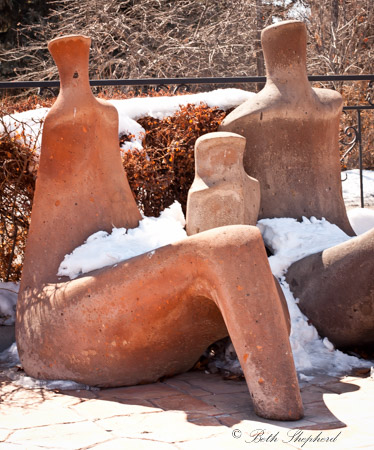
Nane Hotel statues

She was six-months-old when we met her, and the time that elapsed between our first, registration, trip to our second court trip was five months. Five long months.

I remember a number of  people telling us a year is “nothing” in a baby’s life, meaning she wouldn’t remember the orphanage and the transition to her adoptive family would be easy. Three years down the road as a family, I will say I disagree. A year is a lot of time in a baby’s life, especially the first year.

Our daugher at six monthsSaying goodbye at the end of our registration trip. Baby Bird was six-months-old.
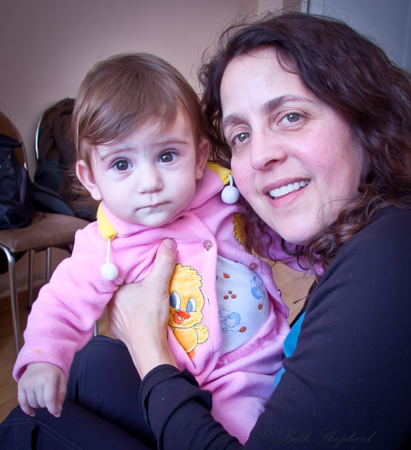
On March 17th, we went back to the orphanage where we’d first met our little one when she was six-months-old. In the five months that transpired between our registration trip and our court trip we hadn’t received any information or photographs. We had no idea what she would look like–what she would be like. For those of you reading this post, who have given birth, try to imagine what it might be like to take a five-month hiatus from your child during the first year of her life.

When they brought her out, it took me a minute to recognize her. She had hair! Lots of hair. Her once green eyes were now decidedly brown. She was much bigger. There was less “baby” in her face and more toddler. And the blue dots? Well, she was recovering from chicken pox and the nurses put a tincture on to help her sores heal.

Me and baby bird at 11 monthsSaying hello again, five months later. Baby Bird is 11 months old.
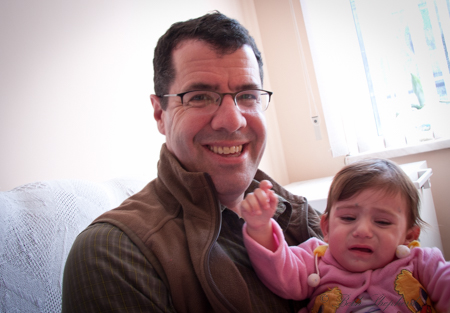
 Big Papa and I passed her between us, wondering if there was any recollection of who we were lodged somewhere in the far reaches of her memory. When we first met her on our registration trip, I’m sure she thought she’d hit the jackpot with two new nannies who were spending a lot of one-on-one time with her. How nice! And I imagine, after the week passed and we left, she might have felt puzzled, “Where did they go?”

At 11 months with DadaDada and daughter. She might have been thinking, “Who are these people?”
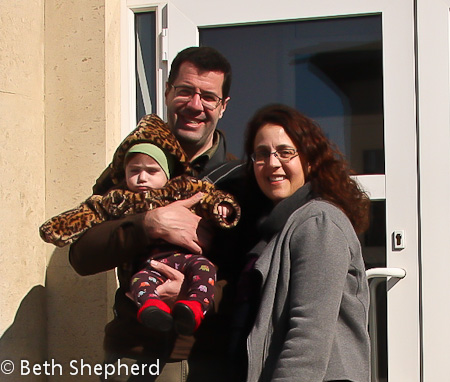
For us, seeing her again was surreal. In a matter of days, this little girl would become our daughter. Forever.

Take the road less traveled, Beth

Want to be in-the-know on all things Pampers? Follow me on Facebook, Twitter or RSS/email.


Filed Under: Adoption Tagged With: Gyumri, orphanage

Through the blue gate

March 25, 2013 by Beth Shepherd

The blue gate

Two days after we became family in the eyes of the court, we went to take our daughter out of the orphanage. Other than a few weeks in the hospital as a newborn, this was the only home she’d ever had. The eight nannies who tended to her every need were the only “moms” she’d ever known.

I’d thought about this moment for nearly four years. Sometime I’d get teary contemplating the enormity of it, but the perspective I always imagined was how I would feel when my baby was in my arms and we were embarking on our first steps as a family. I didn’t spend as much time thinking about the loss her caregivers would feel, and I now know I also underestimated the impact this transition would have on our child.

We sat, waiting expectantly, on a bench outside the orphanage director’s office, waiting for one of the nannies to bring our daughter to us. I was excited and sad at the same time. Excited because we were about to become a family, 24-7, and sad because we’d spent many hours in this building during our two trips to Gyumri, watching the nannies counting diapers in the doctor’s office, seeing the same smiling faces of the children laughing as they ran around the playground. I knew that one day we would bring our daughter back to her homeland, to Gyumri, and to the orphanage where she’d lived, but I didn’t know when that day would be, or if the nannies or doctor who cared for her would still be working there. So this goodbye could be the last goodbye for all of us.

I felt like we’d been sitting on that hard wood bench for a long time, when down the stairs came a nanny holding Baby Bird. She was dressed in the clothes we’d brought for her: a long-sleeved cotton onesie topped with a matching shirt and pants—brown with colorful elephants, a lavender cotton sweater over that, a green cotton cap on her head, a pair of red wool shoes on her feet and a fuzzy leopard print jacket with a hood. It was cold outside, but we knew that in Armenia children are always dressed in multiple layers, and we wanted her nannies to feel confident we’d take good care of her and keep her warm.

As the nanny handed her to me, I noticed a pair of navy blue tights peeking out from under her pants. The tights were decorated with woven buttons. Tights! Of course, the one thing I’d forgotten to bring with us. I felt momentarily embarrassed and then secretly elated, because I’d seen those same tights on Baby Bird on a few of our visits and realized they would be the only belonging from her life here that she would ever have.

Leaving the orphanageThere were—and always will be—unanswered questions about her days in the orphanage. Who were the children who fell asleep in the cribs beside our daughter?  What are their stories and how did those stories end? How did the nannies soothe Baby Bird when she was frightened or woke up during the night? Which nanny did she like the best? Were there memories, even visceral, that she would tuck away in the corners of her psyche?
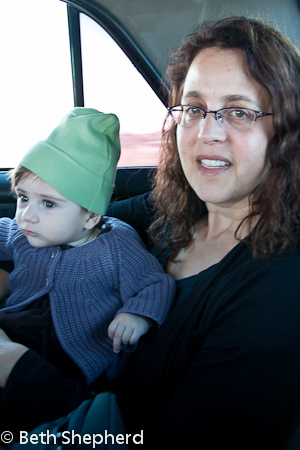
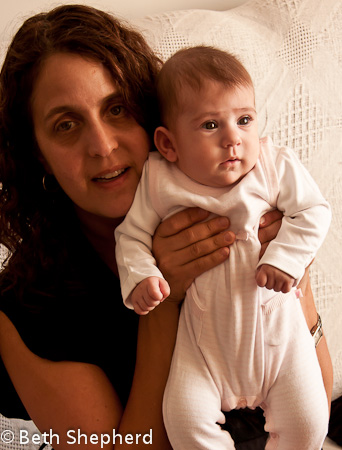
I had planned to tell our daughter’s nannies how much it meant to us that she was so well cared for. We left thank you cards for each of them with pictures of Seattle, and a photo of the three of us taken on our registration trip. But in the end, we weren’t able to say goodbye to them in person We were told there were important visitors at the orphanage so, after taking a photo with the director and signing our names in the book the orphanage keeps to record the names of adoptive parents, we were led out of the building.

We took a few photos together, standing on the steps, and then we walked through the blue gate. I glanced over my shoulder. Sun streamed into the courtyard, and the crisp breeze whipped my hair. The greeter dog we’d seen every day during our visits lay on the steps leading up to the front door of the orphanage. Behind him were the buildings where our daughter spent the first eleven months of her life. Inside were the wonderful nannies who watched over her. I closed my eyes and silently said thank you. As our daughter grows, we will share their names with her in a book we’ve made about her adoption, and make sure she knows these eight women watched over her until we were able to be a family.

Our driver was waiting beside the taxi. We crammed two suitcases in the trunk and strapped a third to the front passenger seat. Big Papa and I climbed into the backseat and looked at each other with that deer-in-the-headlights stare, because there in the back seat, nestled between the two of us, was a baby!

Then we drove off, heading south towards Yerevan, on our maiden voyage as a family, and the first leg of the journey that, in two weeks time, would take us HOME!

Taxi to Yerevan

 Having a place to go – is a home. 

Having someone to love – is a family. 

Having both – is a blessing. 

~Donna Hedges


Filed Under: Adoption Tagged With: blue, caregivers, gate, Gyumri, nannies, orphanage, taxi

Six months in a baby’s life

March 20, 2013 by Beth Shepherd

When we first met Baby Bird, in October 2011, she was a little baby: five-and-a-half months old and around 10 pounds. During our registration trip, we spent a week getting to know each other. Then we had to leave her behind.

Over the next six months, while we waited for both the U.S. and Armenian governments to give us the green light, we received very little information: no pictures, no updates on her health and well-being. No matter how loving her nannies were, I still felt sad she would spend more months living in an orphanage before we could be reunited as a family.

I poured over photos I had taken on our first trip and tried to imagine what she might look like. I grieved over developmental milestones we would miss–the firsts that many moms and dads are lucky enough to see.

Me and A Oct'11


In March of 2012, as we sat in the orphanage doctor’s office waiting for one of her nannies to bring her to us, I wondered: would she recognize us or have any memory of our smell or the way our voices sound?

And then, there she was! Six months later she had really grown, although by U.S. standards she was still a peanut, with her height and weight falling at the 10th percentile on the growth chart. Her glorious hair was auburn and much longer than it had been when we first met her, and her gray-green eyes had darkened to a light brown.

A and Me March '12

She had blue spots dotting her face which we were told was from antiseptic used to help children heal from chicken pox. On top of chicken pox, she had a bad case of the flu (and later on, when we changed our first diaper, we found out she also had a seriously bad diaper rash and yeast infection). Illnesses aside, she was still as cute as we’d remembered.

We were over-the-moon to be able to hold her in our arms once again. And this time, we whispered in her ear, we won’t have to say goodbye.

Filed Under: Adoption Tagged With: baby, orphanage

Going to Gyumri

October 8, 2012 by Beth Shepherd

Going to Gyumri, ArmeniaIt didn’t take very long to realize there’s something about hurtling down a patched and bumpy highway in a taxi, at speeds exceeding 100 miles per hour, in the middle of rural Armenia, that lets you know you are really going somewhere.  Because, in fact, we were.

Side-by-side in the backseat of the cab, Big Papa and I were headed to meet the baby girl we hoped to adopt. A taxi ride doesn’t get much more potent than that.

In Armenia, taxi cabs never have seat belts, so we carefully positioned ourselves as securely as we could, and toughed it out. Our translator sat in the front passenger seat. As she chatted amiably, in Armenian, with the driver, Big Papa and I looked out the window and watched the autumn scenery pass: 13,419 foot Mount Aragats loomed to the east, snow already coating its steep slopes, brown hills as far as the eyes could see, a smattering of trees with leaves turned shades of gold and rust, acres of wheat fields, crops spent for the season, the occasional sheep or cow herder waving a stick at his flock.

Our driver appeared to be in his forties. He was slim and dark haired with an aquiline nose and a pleasant, unassuming face. I got the sense he’d been driving a taxi as long as he was old enough for his legs to reach the pedals.

We sped along toward Gyumri as Yerevan rapidly disappeared behind us. It was a two hour drive from Yerevan, the capitol of Armenia, to Gyumri in the north. As the crow flies, the distance is roughly 75 miles, but because of the twists and turns in the roads and the potholes—despite the speed we were traveling—we were told the journey would take us just under two hours.

This particular cab had seen better days, much better days in fact, which was the case for most of the taxis in Armenia. Absence of seatbelts aside, our taxi on this fine October day was also lacking shocks. Each bump in the road sent our stomach to our throats, and we literally found ourselves airborne. Repeatedly.

“Ow. Ow.” Big Papa moaned as his head made a loud thunk on the interior roof of the cab.

“I think my spine just got two inches shorter.”

I tried to stifle a laugh as I felt myself levitate a good six inches off my seat. It was like riding the mechanical bull at the county fare. My neck was already sore and we were only a half-hour out of the gate.

Two adoptive moms, who had also received referrals from the same orphanage in Gyumri, had warned me about the condition of the roads.

“Be thankful you’re not traveling in winter,” one of them wrote in an email shortly before our trip.

“To say the roads are icy and slippery is an understatement.”

For a moment I let my mind wander. Wouldn’t that take the prize? Our driver underestimates a turn a we find ourselves in a ditch. Fear fueled a burst of adrenaline in my body but I snapped into focus just in time to notice a high pitched whine coming from the rear of the car. In moments the sound of thwakety-thwak followed and the car veered to port.

Our translator anxiously questioned the driver. The driver nervously looked right and then left before pulling the car off to the side of the road. Cars flew by us as he stepped out.

“What’s going on?” I ask her.

“I don’t know. Something’s wrong with the car.”

Big Papa retorts, “You think?”

We both snicker as we turn our heads and see the driver shaking his. He opens the door and says something to our translator.

“Flat tire. We need to get out of the taxi so he can change the tire,” she tells us.

Great. Just great. I can feel a big cloud creep into my psyche as I mentally calculate the time we’re about to lose. We’ve already missed a day of visitation waiting to get permission from the Ministry of Justice Office and now, here we are, stuck roadside.

“Does he have a spare?” I ask standing inches from the ditch by the road, gazing off across the fields towards the eastern hills. The sky is gray and threatens rain.

“A spare that is road-worthy enough to get us the rest of the way to Gyumri?”

Meanwhile Big Papa has maneuvered himself toward the back of the taxi, to help hold the trunk open as the driver assesses the spare, and makes his preparations to fix the flat. I imagine Big Papa’s dilemma: he doesn’t drive, he’s in a foreign country on a highway in the middle of no-where, he’s wondering what his role in this situation is and he’s fully aware of male dominated bias of the culture particularly where it applies to men and cars.

I snap a picture.

Big Papa, a taxi and a flat tire on the way to Gyumri, Armenia“Don’t.” Big Papa admonishes, but I see the hint of a smile.

“I’m not sure I want this moment in history recorded for all perpetuity.”

I chuckle.

Soon it’s apparent that our taxi driver knows exactly what he’s doing. Not more than fifteen minutes pass standing in this wind-swept valley before he nods, smiles, and then motions us back into the taxi, thanking Big Papa profusely as Big Papa sheepishly shakes his head.

“It’s not like I did anything except stand there and be supportive with my hand on the lid of the trunk.”

We continue on our way and another hour passes uneventfully before we reach the outskirts of Gyumri. I’m relieved. I’d rather be stuck here, near the orphanage, than sticking out my thumb trying to hitch a ride in the middle of the Shirak province.

Gyumri, like the rest of the region, is still reeling—now 23 years later—following the devastating 1988 Spitak earthquake. At least 25,000 people were killed in that disaster, and the ridiculously protracted reconstruction of the Shirak region translates into its people continuing to stumble in the aftermath. Because the earthquake destroyed the economy along with the cities, the poverty rate in the northern part of Armenia is higher than the national average, nearly fifty percent, making it the poorest region in the country. I’d read that people were still living in metal cattle cars, set up as temporary housing over two decades ago.

Pulling into town, our driver is awestruck. He hasn’t been to Gyumri in years, our translator tells us, and is surprised at how much improved the city looks. It becomes quickly obvious to us that it has indeed been many years since he’s been here as we pull over to ask first one, then two, and then several people directions to the orphanage. Even the police officer at stop number three has a blank look on his face when our translator tells him the name of the orphanage. As we weave our way through town I recognize the statue of the woman who stands at attention, with her arms in arabesque, we’ve passed by her two or three times as we’ve made our aimless circles.

Finally we arrive at a corner the translator recognizes. Our driver gingerly edges our taxi over and around several crater-sized potholes, pulls over beside a stone wall with fading children’s paintings of mountains and people etched on its face like graffiti. There is an turquoise blue fence sandwiched in the middle. A scraggly tan and white dog , small with strikingly large ears, who appears to be a cross between a terrier and a corgi, saunters up to greet us. We’ve arrived.

The blue gate, Gyumri, Armenia

Filed Under: Adoption Tagged With: Gyumri, orphanage, taxi

All my worldly goods

June 5, 2012 by Beth Shepherd

Blue orphanage tightsThe day we took Baby Bird from the orphanage in Gyumri, her home for eleven months, we brought the following with us: a long-sleeved onesie, cotton pants, cotton shirt, a sweater, one coat with a hood, cotton cap, socks and shoes. Her nannies dressed her and handed her to us. We took a few pictures with the director of the orphanage and then we were on our way.

It wasn’t until two hours later, when we reached Yerevan, and changed our first diaper, that we discovered…the nannies had also dressed her in a pair of tights, little blue cotton tights with pictures of buttons and spools of thread woven into the background.

I remembered these tights from several of our “get to know you” trips to the orphanage. Each day, when we visited, the nanny on shift brought Baby Bird to see us. She was always dressed in an adorable outfit. One day she had on a tiny beret, another day she was a vision in hand-crocheted white, and on yet another day, she sported bunny slippers. On several occasions her outfit featured these blue tights. But I knew, cute as her ensemble was, these clothes weren’t hers.

Before I became a mom, I made several trips to Armenia, to two different orphanages. I know clothing is in short supply and nannies rotate outfits for children in the same age range. On one visit, to meet the baby girl we weren’t ultimately able to adopt, I remember a French couple cooing when they brought “our” baby in. The man turned on their video camera and the woman went to hold her. I chuckled. Our baby was cute and I was flattered they wanted to hold her, until they called her “Liesel,” the name they were going to give their baby. At that moment, I realized the error of their ways. They thought our baby girl was theirs because she was wearing the clothes their baby girl had on earlier that day.

During our two week stay in Yerevan, before we brought Baby Bird back home, we dressed her in those blue tights. For all my preparedness, the one item of clothing I’d neglected to bring, was tights. Then, one morning, it occurred to me: these blue tights are the only thing she has from the place that was her home for nearly a year of her life. These tiny cotton tights were the sum of all her worldly goods.

That afternoon, Big Papa and I went to the children’s clothing shop that was on the ground floor of the apartment building where we were staying. With the assistance of four very attentive Armenian saleswomen, we bought two new pairs of baby tights.

I nestled her blue tights, the tights with the buttons and spools, carefully into our suitcase. When we arrived home, I tucked them into a box, a box that contains other mementos from her first months of life, a box we will keep safe until she is old enough to understand how precious these few tokens are.

Here in the U.S., the land of plenty, it is easy to take for granted what we have to call our own: a house, our own bedroom, toys, books and a wardrobe full of clothes. This morning when I opened Baby Bird’s closet my eyes wandered over two tiers of dresses, shirts, sweaters and pants, plus several rows of little hats and shoes, and socks. All hers. There is a closet full of cute outfits to behold, but I can tell you, without a moment’s hesitation, her most priceless belonging is a pair of blue cotton tights.

Filed Under: Adoption Tagged With: belongings, clothes, goods, orphanage, tights

Return to sender

April 21, 2010 by Beth Shepherd

Newspapers, radio chat shows and the blogosphere have been abuzz for the past week or so with heated discussions of the recent “disrupted” adoption of a 7-year-old Russian boy, who was sent back to Moscow by his adopted mother. I confess I’ve been “glued to the screen” reading about what happened and the outpouring of commentary that has followed. It’s like a car wreck; you don’t want to see it but you can’t look away.

return to sender-adjustedCandidly, stories like this make me uncomfortable because they draw attention to the dark underbelly of adoption whether it’s abuse or abandonment, trafficking or travesties of justice. These are not the “and they lived happily ever after” stories that people (particularly prospective adoptive moms, like me) want to hear.

I debated whether or not to blog about this, partially because there’s plenty of press, both fact-based and personal opinion already out there, and also because I feel hesitant to cast my vote on whether I think the Torry Hansen, the adoptive mother in this case, made the “right” or “wrong” decision.

I don’t believe it’s my place to judge Torry. I don’t know what resources were available to her and whether or not she took advantage of those that were. I don’t know the complete reality of her circumstances. I wasn’t in her shoes.

But ultimately what spurred me on to write is that the story I find most compelling isn’t solely Torry’s story at all. It’s a complex intermingling of stories: Artem (aka Justin), her adopted son and other adopted children; Russian orphanages along with foster care institutions the world over; governments – ours and theirs and the agreements arranged and regulations required; the birth moms we rarely hear about; and, adoptive parents – some faced with enormous challenges, like Torry, and many others who are not.

As an adoptive-mom-wanna-be myself, I know what Torry went through in the first place to adopt her child. I know there were many classes she needed to take. I know there were stacks of forms to be completed. I know there was a home study by a licensed social worker. I know that she was required to provide several references. I know that all her forms were notarized and then apostilled; every little piece of paper was verified at least twice. I know there were criminal clearances, child abuse checks and federal fingerprints. I know there was great financial burden. I know she planned and waited and then waited some more for the day when she became a mom. Adopting internationally, particularly from Russia, is not a fly by night process. So, no matter how I feel about what ultimately happened, I can’t imagine that the decision to undo all of this was undertaken lightly.

What truly breaks my heart is the fallout from her actions and the subsequent reaction of the Russian government which resulted in a temporary suspension of U.S. adoptions from Russia. I feel for adoptive parents-to-be who, like Big Papa and me, have poured their hearts, souls, time and money towards creating a family and yet could now find themselves in limbo indefinitely.

I feel, too, for the 740,000 orphans in Russia alone who, like Artem, remain without families. In the end, that’s who this really hurts. Suspending adoptions isn’t a solution. It’s not even an effective Band-Aid. There are countless international adoptions from Russia and elsewhere around the world that have been a resounding success, for the adoptee and their adoptive family. Stories like this sadden me, because it leaves a picture in the public mind that is so far from the truth. It taints and distorts the image of forming a family through adoption.

According to the Department of Social and Human Services, disruptions (both domestic and international) represent 10%-25% of completed adoptions, with the higher rates rising with the age of the child at adoption.  Adoption dissolutions (legal rights between adoptive parent and child terminated) are between 1%-10%, with the higher percentages being related to adoptions that have involved special needs children and children from a foster care system. Torry Hansen isn’t the first, and certainly won’t be the last, to have her adoption dissolved even if, admittedly, her story was staggeringly dramatic.

Foster care, both in the U.S. and around the world, is in a woeful state. In Russia, there have been many reports of children being abused in orphanages. Once kids leave their system, they end up on the streets leading a life of crime or prostitution. Russia is hardly alone in claims of abuse. Many countries have been cited for a range of physical, sexual and emotional abuses of children under government care. And the U.S. certainly can’t be the one pointing a finger, with our own foster care system dreadfully broken.

But what is the alternative? People have babies they aren’t equipped to care for. Women drink alcohol or take drugs during their pregnancies resulting in permanently damaged children. Disease, economic failure, wars, natural disasters and genocides plague our planet leaving countless children without parents or a home.

When all is said and done, adoption is anything but smooth and straight-forward. It is an unpredictable journey from day one and, continuing on, for the lifetimes of all those involved. Adopting is not a goal that, once “achieved,” fades into a haze of rainbow colored flowers and ‘forever families.’ Just like families formed any other way, adoptive families are a crazy-quilt mix of wildly successful happy endings, abysmal failures and every permutation in between that you can possibly imagine.

We can vilify Torry Hansen all we want. We can rail against the injustices of Russian orphanages until the cows come home. We can bury prospective adoptive parents under mountains of paperwork and regulations. We can suspend adoptions when abuses (in the country or with adoptive parents) are suspect. In the end, what have we accomplished?

I want to be clear that I’m not trying to make excuses for a woman who put her adopted son on a plane and sent him packing. I’m not looking the other way at the systemic abuses in orphanages and foster care both domestically and globally. I’m not pretending that there aren’t horrific stories of adoptions that go south. I’m not writing any of this off.

But as an adoptive mom-to-be and a writer, what I do want to draw attention to is the fact that no matter how thorough the background checks, no matter how strict the guidelines, there will be always be instances of abuse on all sides – by adoptive parents, by governments and by orphanages. There will always be “matches” of children to parents that seem ‘meant to be’ and others that are, at best, oil and water.

What this story, and stories like it that periodically circulate in the media, should be is a call to action. We need to commit to offering more comprehensive and holistic support to kids who are struggling, whether in birth, foster or adoptive homes. We need to find ways to help birth moms make choices that are in the best interests of their children, whether they find it within themselves to parent this child or place this child in the arms of someone who can. And even knowing sometimes things will go terribly wrong, we’ve got to find our way through the maze and keep moving forward to create ways to sustain those who have room in their hearts and space under their roof for children not born to them. Because no matter what, there will always be children who need someone to love them and a place to call home.

Don’t let the perfect be the enemy of the good.
~Voltaire

Filed Under: Adoption Tagged With: Artem Justin Saveliev, disruption, dissolution, orphanage, Russian, Torry Hansen

Some might fend off a mid-life crisis by leaving the comforts of their corporate salary to jet off to a deserted island. Others might buy a Jaguar. I’ve chosen to dive head-long into my 50s and beyond by becoming a first-time parent. At any given moment you might find me holding a camera, a spade, a spatula or a suitcase. Or my little girl's hand. Adopted from Armenia, she puts the Pampers and Paklava into my life.

Subscribe to Blog via Email

Enter your email address to subscribe to this blog and receive notifications of new posts by email.

Recent Posts

  • Ghosts and goblins of Halloweens past
  • Raise a glass—or ten
  • No me without her: A life before motherhood
  • Leaving the orphanage with a priceless pair of tights
  • Rock of ages: Celebrating five years together as a family

Tags

366 Project Adoption anniversary Armenia autumn Bainbridge Island Baja Birds birthday blog cat cats chickadee China Christmas fall ferry flowers France Garden Gyumri Halloween Hawaii Holiday ice cream Kauai leaves London Mamas with Cameras Mexico Mother's Day Mt. Rainier New York orphanage Paris Puget Sound robin Seattle taxi Thanksgiving Tibet USCIS Valentine's Day wedding Yerevan

Categories

  • Adoption
  • Armenia
  • Family
  • Food
  • Friendship
  • Garden
  • Holiday
  • Miscellaneous
  • Paris
  • Photography
  • Recipes
  • Review
  • Seattle
  • Things to do with kids
  • Travel

Sites I like

  • The Wayfaring Voyager
  • Wanderlit
  • Wanderlust and Lipstick
follow us in feedly

Image Copyright

Unless specifically mentioned, all images on my blog are my own original photographs and, therefore, copyright protected (©Beth Shepherd). Feel free to use my images for non-commercial use so long as you provide me with the image credit. Likewise, if you pin my images to Pinterest, please mention me by name.

Copyright © 2026 · Pamperspaklava · WordPress Barista