Pampers and Paklava

  • Home
  • Photography
  • Travel
  • Food
  • Garden
  • Contact

Manly chocolate

October 20, 2010 by Beth Shepherd

Yesterday I went on a Theo Chocolate factory tour with my aunt and uncle who are visiting from New York. It was great fun, an excursion worthy of its own post. The tour got me thinking about chocolate in general and then, about a particular purchase Big Papa and I made on one of our trips to Armenia, namely the ‘Nestle for Men’ bar.

Yes, that’s right, a chocolate bar devoted to men and men only! Who would have thought? Obviously someone in Nestle’s Russian marketing department!  Other than ‘Nestle for Men,’ all the text is in Russian. I presume the assumption is that men who read Russian will be able to ascertain that this bar is for them. A translator read the rest of the wording on the bar which strongly suggests “protecting” this bar from the prying hands of women. No sharing with your gal pal, guys!

Big Papa and I purchased several bars and offered them as gifts to our manly friends. So far, the Nestle for Men bar gets an A+ for novelty. It’s hard not to crack a smile when you see this burly bar. One of my friends has a pre-teen son, who upon seeing the bar asked: Is this for boys too? I suppose so, if you want to put some hair on your chest!

Foodie reviews, however, have been less than favorable. One recipient reported “The chocolate wasn’t that great.” I’m not surprised. The real bang for the buck lies in the packaging, not the flavor. Nestle for Men is a milk chocolate bar with three variations: plain milk chocolate, milk chocolate with almonds or milk chocolate with peanut and raisin. Studies revealed that milk chocolate is where it’s at for men: 48% of men prefer milk chocolate, 37% of men prefer dark chocolate, and 15 % choose other types of chocolate (white and mixed). Though let me tell you a secret, guys, the health and psycho-emotional benefits come with dark chocolate…the darker, the better in fact.

Nestle for Men makes me laugh because, historically, chocolate marketing has been aimed squarely at women. Chocolate stimulates “feel good” serotonin levels in the brain. It’s marketed to help women recover from heartache, celebrate new love, deal with menstrual tension or menopausal woes. Plus, chocolate has anti-oxidants. It’s practically healthy. Some studies show that small amounts of dark chocolate may even lower blood pressure.  And, everyone knows women just LOVE chocolate. What do men get women after jewelry and flowers? Chocolate, of course!

Who knows, maybe Russian marketing is onto something with their macho bar. Here you go boys…dive in. Your very own chocolate bar.

Wanna devour some more? Check out Wanderfood Wednesday!

Filed Under: Food Tagged With: chocolate, marketing, Nestle for Men, Russia, Theo Chocolate

Deux cafe sil vous plait

October 6, 2010 by Beth Shepherd

There’s nothing like a cup of fresh espresso, particularly if one is fortunate enough to drink it in the city of light. Sitting at a sidewalk café and sipping from our demitasse, Big Papa and I watched the world go by, Parisian style.

Across the street at a butcher’s shop, two little girls stood outside waiting for their mother. Dressed in pink and red they coordinated with the colors of the shop to a ‘t.’ Small dogs sat on the laps of doting owners. Cigarettes hung between fingertips of passersby. The white noise buzz of cars and conversation played in the background.

This scene was repeated over and over on street after street. Cafés spilled out along avenues as large as rivers and sandwiched themselves into corners on the tiniest of crooked side streets. Friends, lovers, parents, and students nestled two by two at petite tables, hands holding warm porcelain cups, musing about life.

In Seattle we have many fine restaurants. There are outdoor farmers markets and high end organic grocery stores. But we do not have a café culture like they have in Europe. Starbucks may say they try to create the “third place” and indie cafes might attempt to emulate international coffee culture by placing a few tables outside, but it’s just not the same. Maybe it’s the weather (this year’s non-stop rain isn’t exactly conducive to sipping street-side or maybe (more likely) it’s our social culture – the rush, rush, I need my coffee and I need it now. To go. Or folks sit silently staring at their laptops or texting away madly on their iPhone.

During our recent jaunt to Paris, I also noticed that café goers with an open laptop beside their cuppa java were far and few between. Sure there were iPhones and Paris is hardly anti-technology, but most of the people we saw not only managed to make it through a cup of coffee or two and actually interact with their companions, they even seemed to enjoy it.

I found it refreshing. Taking the time to disconnect electronically and reconnect with one another seems to be rapidly disappearing art in the ‘ole U.S. of A. And while there were many things I was grateful to come back stateside to, a slow cup of espresso and a good long chat shared with someone you care about, was a perk of Europe I was sad to leave behind.

I had some dreams, they were clouds in my coffee.

~Carly Simon

Want to sip on some more? Check out Wanderfood Wednesday!

Filed Under: Food, Friendship, Travel Tagged With: cafe, coffee, espresso, France, Paris

A lovely day in Epernay

September 29, 2010 by Beth Shepherd

Outside our train window, vine covered slopes stretched out as far as we could see, knitting together small villages with red tiled roofs and wooden shutters. The river Marne gracefully cut a green swath along the edges of this landscape. A more peaceful scene I could hardly imagine which belied the history of fierce World War I battles that took place along the Marne’s banks.

Big Papa and I were heading to Epernay, a small town of 25,000 residents in the heart of the Champagne region of France. Founded back in the 5th century by tanners, Epernay was passed into the hands of the Counts of Champagne in 1024. The town is roughly 88 miles from Paris; our train ride took 45 minutes with a few stops at smaller villages along the way.

Once there, we moseyed up the appropriately named ‘Avenue de Champagne,’ passing by many of France’s famous champagne “houses”: Moet and Chandon, Castellane, Mercier, and Perrier-Jouet. It was fascinating to imagine that underneath our feet more than 100 kilometers (or over 328,000 feet) of tunnels dug into chalk soil were sheltering millions of bottles of aging champagne.

Ah, champagne. I confess I rather like the bubbly and so a chance to tour and taste champagne in Champagne was a pretty big thrill. It is, after all, the wine of celebration. No other wine has quite the same reputation for launching ships or toasting weddings. Its meaning is universal.

As wines go, champagne – as we know it – is a relatively recent “invention.” Before the mid-1600s there was no fizzy champagne. The only wines made were “still wines.”

Although Dom Pérignon has been credited as the inventor of champagne, in reality he was only a contributor to the process now associated with bubbly wine. Pérignon was a Benedictine monk who, in 1688, was appointed treasurer at the Abby of Hautvillers, near Epernay. Included in Dom Pérignon’s duties was the management of the cellars and wine making. The bubbles in the wine are a natural process arising from Champagne’s cold climate and short growing season. Of necessity, the grapes are picked late in the year. This doesn’t leave enough time for the yeasts present on the grape skins to convert the sugar in the pressed grape juice into alcohol before the cold winter temperatures put a temporary stop to the fermentation process. With the coming of Spring’s warmer temperatures, the fermentation is again underway, but this time in the bottle. The re-fermentation creates carbon-dioxide which now becomes trapped in the bottle, thereby creating the sparkle.

For Dom Pérignon and his contemporaries, sparkling wine was not the desired end product. It was a sign of poor wine making. He spent a great deal of time trying to prevent the bubbles, the unstableness of this “mad wine.” Although he was not able to prevent the bubbles, he did develop the art of blending grape varietals. He also found a method to press the black grapes and yield a white juice, improved clarification techniques to produce a brighter wine than any that had been produced before. To help prevent the exploding bottle problem, he began to use the stronger bottles developed by the English and closing them with Spanish cork instead of the wood and oil-soaked hemp stoppers then in use. Dom Pérignon died in 1715, but in his 47 years as the cellar master at the Abby of Hautvillers, he laid down the basic principles still used in making champagne today.

Sparkling champagne was only about 10% of the region’s output in the 18th century. But over the years, it became increasingly popular as the wine of aristocrats and royalty. Its influence in the world of wine continued to grow until, in the 1800’s, the sparkling wine industry was well established.

Big Papa and I chose the ‘Mercier‘ house of champagne and signed ourselves up for their tour which involves riding a laser-guided automatic train through caves 100 feet underground. Mercier was founded in 1858 by a young entrepreneur by the name of Eugene Mercier. He was 20-years-old when he started the Mercier champagne house. Mercier was a forward thinker and believed in the power of advertising. To further his reputation as a world-class champagne maker, he built the world’s largest wine vat for the 1889 World Exhibition; it took 150 oak trees to construct the vat which held the equivalent of 200,000 bottles of champagne.

After our Mercier tour we continued up the road to see the castle once owned by the Mercier family. Yes, the castle. I have to admit, it was all a bit surreal. On our way back, we stopped at Castellane and managed to nab two spots on the final tour of the day where we learned a bit more about how champagne is bottled, packed and shipped.

Of course one of the highlights from our day was the several glasses of champagne Big Papa and I enjoyed.  As with all true champagnes, our glasses held a blend of three grapes – Pinot Noir, Chardonnay, and Pinot Meunier. Smooth fine bubbles, a bit of fruit aroma and a touch of toast and apple on the palate.  Delicious!

I must say I was a bit sad to leave lovely Epernay and would have liked to continue tasting our way through the rest of town. But we did buy a small bottle of bubbly to bring home, and have an occasion in mind for when we’ll pop the cork!

Remember gentlemen, it’s not just France we are fighting for, it’s Champagne!
~Winston Churchill, 1918

Want more fizz in your day? Check out Wanderfood Wednesday!

Filed Under: Food, Travel Tagged With: Castellane, chalk, champagne, Dom Perignmon, Epernay, France, Mercier, Moet and Chandon, monk, Paris, Perrier-Joet, river Marne, World War I

Battle of the baguettes

September 22, 2010 by Beth Shepherd

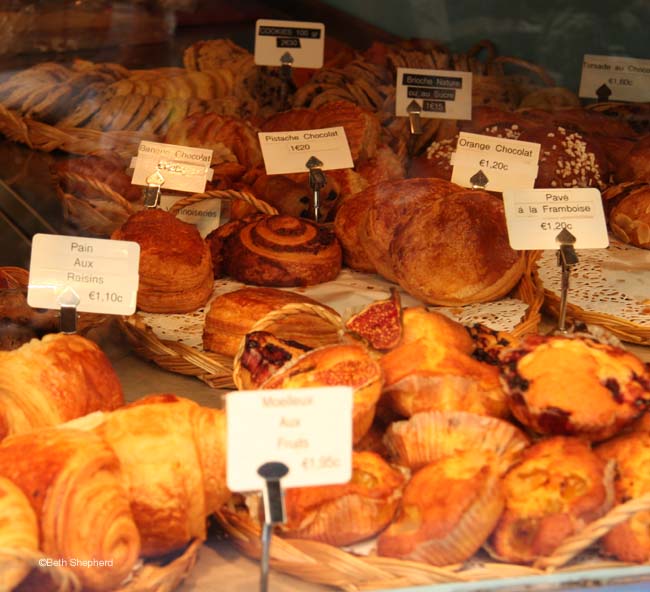
Paris is the city of light. It is also the city of bread. You can’t throw a cell phone without hitting a bakery or pastry shop. Baguettes are tucked under arms wherever you go. In fact a baguette and an espresso is the breakfast, de rigueur, for most Parisians. Croissants, Tarts, Macarons, Palmiers, Langues de Chat (“cat’s tongues”), Madeleines, Brioche, Beignets…the list is endless.

Traveling in a city where wheat abounds is well and good unless you must dine gluten-free. Or, as in the case of Big Papa, have a rare and potentially life-threatening allergy to wheat combined with exercise, otherwise known as exercised-induced anaphylaxis.

One Saturday afternoon, when I was first dating Big Papa, he was out mowing the lawn when I arrived at the Urban Cabin. Unbeknownst to me, he had also just polished off a burrito for lunch. A few minutes later, he announced he might be having an allergic reaction. Barely fifteen minutes passed and we were on our way to the emergency room, his lips so swollen that he looked like he’d had collagen injections gone bad. His tongue was swelling and his entire body was covered in hives. We lovingly refer to that incident as the “Monkey Face” episode.

Then there was the time when he had a pizza at work before walking home. I got a call from a nice paramedic who told me he was O.K. but in the E.R. once again. This time, his blood pressure dropped so fast that he passed out on the street corner mere blocks from our house. When he would come to, he’d sit up and then keel over again. I’m sure passersby figured he’d had one too many to drink. He was completely pink from head to toe and the medics asked him if he’d “been at a tanning booth recently.” For anyone who knows Big Papa, this is pretty funny. We lovingly refer to that incident as the “Human Shrimp” episode.

Ironically, if exercise is not involved, Big Papa is a very pro-wheat sort of guy. He is able to eat pasta for dinner most every night with impunity as long as he doesn’t feel the urge to do a set of jumping jacks. It took several years and half-dozen trips to the emergency room to put two and two together as most of the offending meals consumed before each trip where foods he’d eaten problem-free on more than one occasion.

It should also be mentioned that aspirin is an additional complicating factor as it apparently speeds up wheat absorption.  We found out about this very recently when Big Papa had a headache, took two aspirin and followed that up with a lovely meal of chestnut pasta with mushroom cream sauce (made by yours truly). He then proceeded to wash the dishes. Twenty minutes later, my dear husband was lying on our couch hooked up to an EKG machine and IVs while being attended to by the paramedics. The things guys will do to get out of dish duty!

Needless to say, after we finally figured out the culprits, Big Papa became very careful about ingesting anything with wheat in it if he planned on getting his heart rate (and body temperature) up even the slightest. This allergy is manageable when you’re on home turf and can choose from a wide range of food sources. On the road, it’s another story altogether.

This brings us back to Paris. Most cafes serve baguettes or croissants for breakfast. Finding a cafe that offered eggs or omelets proved to be something of a challenge. We asked at several places if they offered eggs ala carte or even at all. “Mais non” was a common response.

The looks we got at a few cafes were priceless. The cultural divide became very large indeed when we’d ask for a “doggy bag” to take our bread home with us. How can you explain (particularly with only two years of high school French) that later in the evening, once safely ensconced in our hotel room without plans for walking about the city, Big Papa could safely consume these delectable goodies. However, if he eats them now, an ambulance should be called “tout suite.”

Most of the time, even if we told our waiter to “hold the bread, sil vous plait,” bread was delivered, and we either left it sitting on the table or surreptitiously snuck it into our napkins and out the door. On several occasions we had to politely excuse ourselves to find another café when the waiter announced, “Je regrette…our chef is out sick today and we only have baguettes” or “Je regrette…we are fresh out of eggs.”

All in all, leaving the pastries on the other side of the patisserie window is probably a good thing for both of us. Big Papa stays out of foreign hospitals and I stay at the same size jeans. That said, as we passed by window after window filled with flakey, buttery, wheat-laden treats, I confess I felt a little wistful. C’est la vie.

Want more to chew on? Check out Wanderfood Wednesday!

Filed Under: Food, Travel Tagged With: baguettes, exercise-induced anaphylaxis, France, Paris, pastries

Heavenly Honey Ice Cream Recipe

September 1, 2010 by Beth Shepherd

Some years ago, I had the great pleasure to spend a few weeks in New York City, Brooklyn to be exact. It’s ironic because my Dad is a Brooklyn boy, born and raised on Coney Island. I remember going there as a little girl and seeing the boardwalk with its loop-de-loop rides, eating Coney Island hot dogs and my home made pickles at my grandparents’ tenement home with its grapevines growing over the arbor that covered the sidewalk.

subway NYCIt had been several decades since I’d last visited. My grandfather died when I was in grade school and my grandmother moved to Florida. Here I was slated for a two week stint in the Big Apple piloting a train-the-trainer class for bank employees, in Brooklyn no less. My partner in crime was my colleague and friend Susan who loved to cook and eat good food. Lucky me! We poured through guide books and plotted our strategy to check out as many restaurants as we could.

Brooklyn was, and still is, a fascinating cultural melting pot. Jews, blacks, Italians, Russians and many diverse ethnic groups call this borough home. What this also means is that you can find amazing food on just about every corner.

While Susan and I enjoyed our gourmand scouting adventures in Manhattan as we dined our way from mid-town to the Village, the stand-our meal for us was dinner at Al Di La in the Park Slope neighborhood of Brooklyn. In fact, we enjoyed it so much we went back again.

Chestnut honey and plumsThat was about six years ago and I still remember the home made ravioli filled with winter squash and softly coated with brown butter sage sauce, the beet salad so juicy and fresh…and the honey ice cream we enjoyed for dessert, a kiss of honey, light and airy, creamy goodness filling your mouth. I dreamt about that ice cream. It was good enough to bathe in.

So when I got an email a few years later from another friend, Alice, who had moved from Seattle and was ironically now living in Brooklyn, with a link to a cooking blog and a post about ‘Honey Ice Cream’,” I practically fell over my own footsteps as I flew across the kitchen to break out my ice cream machine. “I thought about you when I saw this,” she wrote. Oh dear friend, how well you know me!

This particular ice cream recipe is quite simple: four ingredients; no eggs. No heating and then reheating. I’ve made this recipe a few times, trying out different honeys: Tupelo from Georgia, Knotweed from Seattle (poor Big Papa as our neighbor’s invasive Knotweed was the bane of his existence for the first couple years we were together) and Mille Fleur honey. I was always a bit reluctant to follow the recipe’s suggestion to “use an aromatic honey like chestnut,” thinking it might be overpowering.

Then, last September, Big Papa and I made a three-day stop in Paris on our way to Armenia. I picked up a jar of French chestnut honey or, as they call it, “Meil de Chataignier.” When we were there, chestnut trees were dropping their fruit and carts with roasted chestnuts dotted the city. The French spread this strong amber-colored honey over toast or drizzle it over figs and a ripe blue cheese.

Mine sat in our cupboard for nearly a year, until this past weekend, when I decided it was time to give the honey ice cream recipe another whirl. I was looking for a sweet treat to pair with four Greengage plums – the only plums on our tree this year that Twitchy (our pain in the neck resident squirrel) left for us to eat. I chopped them up and mixed in a teaspoon of fresh French thyme from the garden, a squeeze of lemon and a tablespoon of brown sugar. Then I made the ice cream.

Honey ice cream and Greengage plumsWow! The flavors were mysterious and complex. Big Papa tasted “smoke” and I picked up “malt” and “caramel.” This is definitely not milquetoast honey. It’s all at once assertive and sublime. Big Papa and I liked it so much we both went back for seconds!

“”That buzzing-noise means something. If there’s a buzzing noise, somebody’s making a buzzing-noise, and the only reason for making a buzzing-noise that I know of is because you’re a bee….
And the only reason for being a bee that I know of is making honey…..
And the only reason for making honey is so as I can eat it. So he began to climb the tree.”

~Winnie the Pooh

Maison du Miel’s Heather Honey Ice Cream Recipe (borrowed from 101 Cookbooks)

  • 2 plump, moist vanilla beans
  • 2 cups heavy cream
  • 1 cup whole milk
  • 1/2 cup aromatic honey (chestnut, heather or eucalyptus)

Flatten the vanilla beans and cut them in half lengthwise. With a small spoon, scrape out the seeds. Place the seeds and pods in a large saucepan. Add the cream, milk, and honey. Stir to dissolve the honey. Heat over moderate heat, stirring from time to time, just until tiny bubbles form around the edges of the pan, 3 to 4 minutes.

Flatten the vanilla beans and cut them in half lengthwise. With a small spoon, scrape out the seeds. Place the seeds and pods in a large saucepan. Add the cream, milk, and honey. Stir to dissolve the honey. Heat over moderate heat, stirring from time to time, just until tiny bubbles form around the edges of the pan, 3 to 4 minutes.

Remove from the heat and let steep, covered, for 1 hour. Cover and refrigerate until thoroughly chilled.

Remove the vanilla pods, and stir the mixture again to blend. Transfer it to an ice cream maker and freeze according to manufacturer’s instructions.
From The Paris Cookbook by Patricia Wells (Harper Collins, 2001)

Want more sweetness? Check out Wanderfood Wednesday!

Filed Under: Food, Travel Tagged With: Al Di La Trattoria, Brooklyn, greengage plums, honey, Miel de Chataignier, Paris

Chamomile smile

August 25, 2010 by Beth Shepherd

“One tablespoon, taken at bedtime,” said Mrs. Rabbit pouring a Peter a bit of chamomile tea. Peter rabbit was feeling rather poorly after dining on too much lettuce, French beans and radishes in Mr. McGregor’s garden.

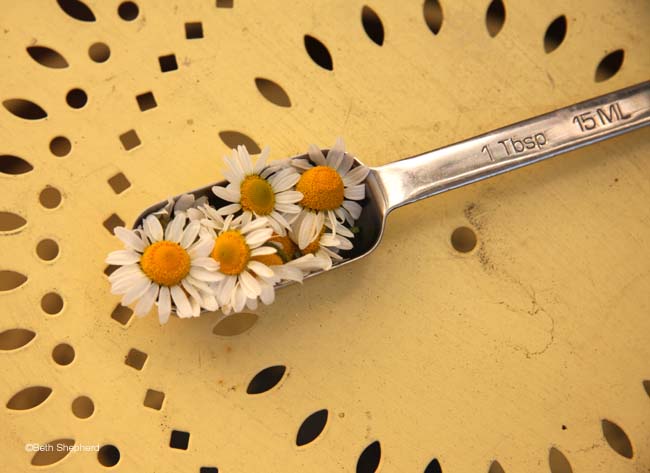
Tablespoon of chamomileMrs. Rabbit was one smart mama bunny. She knew her medicinal herbs. Chamomile has been used for thousands of years for numerous ailments, including sleep disorders, anxiety, digestion and intestinal conditions, skin infections and inflammation (such as eczema), wound healing, infantile colic, teething pains, and diaper rash. Chamomile is an uber-herb, a veritable one-stop cure all. It’s even the national flower of Russia!

In the U.S., chamomile is best known as an ingredient in herbal tea preparations advertised for mild sedating effects.  There are two plants known as chamomile. One is the more popular German chamomile (Matricaria recutita), while the other is called the Roman, or English, chamomile (Chamaemelum nobile). Although they belong to different species, they are used to treat similar conditions. I know I’m not the only one who has sipped on chamomile tea hoping I’d soon feel sleepy or at least less stressed.

Chamomile in herb boxChamomile in our herb garden is plentiful. Their cheery, little yellow faces smile at me, surrounded by a halo of white petals. It’s tempting to pluck them and weave a daisy chain to adorn my neck or sit atop my head. Take me back to my hippie days, bare feet on the grass and ankle-length “granny dresses.”

But this summer I’ve got other plans for our miniature daisies (Chamomile is a member of the daisy family) because I recently found a recipe for Chamomile Cordial. Cordials are sweetened syrups infused with herbs, spices or plants. They are a snap to make (like the lavender syrup I blogged about a few weeks back) and the possibilities of herbs that can be infused is endless.

Chamomile in the gardenFresh (or dried) German chamomile flower heads are used. Chamomile is easy to grow and it makes a fun addition to an herb bed or edging along a walkway. Or, it’s readily purchased at most any grocery store.

For our first round of tasting, we sampled our Chamomile Cordial sans booze with ‘Lavender DRY Soda’ as a spritzy mixer. It was lovely and lightly herby, a drink that was both refreshing and peaceful on the palate.

Chamomile cordialThe next time we enjoyed our flowery cordial, we pulled out the big guns and floated cognac on top as the recipe below instructs. Big Papa and I sat outside on our garden bench enjoying a warm summer’s night. Stress melted away. I felt relaxed, slightly sleepy even. Hmmm…could it be the chamomile or was that the cognac talking?

How the Doctor’s brow should smile, Crown’d with wreaths of camomile.

~Michael Eyquen de Montaigne

Chamomile syrupChamomile Cordial

Note: Chamomile is also part of the Asteraceae plant family, which includes ragweed and chrysanthemum, so people with allergies may react when they use chamomile either internally or topically.

Makes about 2 cups/30 minutes start to finish

  • 2 tablespoons dried chamomile flowers (or 1 tablespoon fresh chamomile flower heads)
  • 2 cups boiled water
  • ¼ cup honey

Add chamomile flowers to a muslin steeping bag or fine mesh tea strainer Chamomile seeds are quite small and thin so be sure to use fine mesh so they don’t escape and float in your syrup. Steep in boiled water until liquid is stained yellow and perfumed, about 20 minutes. Press any reserved liquid out from the muslin bag and discard the solids. Add the honey and stir until dissolved. Keep in the refrigerator until cool.

Once cooled completely, add crushed ice to a glass. Pour in about ½ cup of the chamomile cordial and top with equal amounts seltzer water. Garnish with a thin slice of cucumber to fancy it up. If you like, add a float of cognac and serve immediately.

Store cordial in a clean jar or bottle, covered in the fridge where it will last for several weeks.

~recipe by Amy Pennington in Edible Seattle, July/August 2010

Want to sip on some more? Check out Wanderfood Wednesday!

Filed Under: Food, Garden Tagged With: Amy Pennington, chamomile, Chamomile Cordial, daisy family, DRY Soda Company, Edible Seattle, Garden, German chamomile, herb, medicinal, Mr. McGregor, Mrs. Rabbit, Peter rabbit

Squashed

August 18, 2010 by Beth Shepherd

August is the time of the year when squash recipes run rampant because, well, so is the squash. Sadly, my stunted little plants have thus far managed to eke out exactly one tiny squash. Yes, that’s right: one.

squash blossomStir fry, zucchini bread, and stuffed patty pan with squash from the Urban Cabin’s garden will have to wait…those dreams are squashed for the time being. In the meantime, I’ve been making one of my favorite appetizers with squash blossoms purchased at our neighborhood farmer’s market. Yup, blossoms.

Big Papa oft quotes one of my well-worn phrases: “Oooh look, a [name that flower]. And you can eat it too!” There is nothing I like more than nibbling my way through cheery orange calendula, siesta-colored nasturtium and azure blue bachelor buttons which typically adorn our summer weekend salads. So imagine my delight when the super-sized blossoms a squash offers up are in season.

herbed goat cheeseMany people have never heard of eating the flowers from the squash plant, but they have been part of Central American cuisine for thousands of years, because squash are native to the Americas.

They appear in modern Mexican and South American cuisine under the name of flor de calabaza. You’ll find them in quesadillas, soups, and stuffed with fillings. Cooking with squash blossoms is, these days, all part of the trendy foodie rage and you’ll see them showing up in pasta, omelets, frittatas, salads and fritters.

stuffed blossomMy recipe (so amounts are “a pinch of this and a bit of that”) is something I landed on one day when I found myself with a bit of leftover goat cheese dip (mix a log of goat cheese with a healthy drizzle of olive oil and a few tablespoons of minced, fresh herbs like thyme, chives, basil, rosemary or whatever is handy) and a half-dozen lovely yellow-orange squash blossoms.

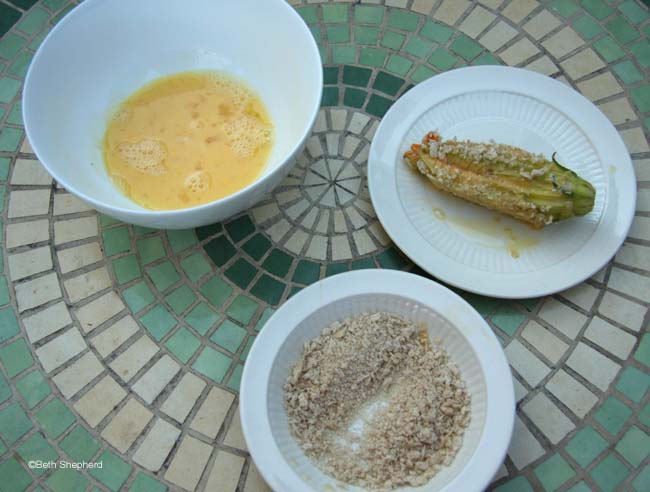
egg, crumbs and blossomStuff ‘em, I thought! And stuff them I did.  I carefully opened up each blossom and plopped in about a tablespoon of herbed goat cheese. Then I took it up a notch and rolled each stuffed blossom in egg (just beat up an egg and put it in a bowl for dipping the blossoms) and coated the eggy blossom with panko bread crumbs (Japanese bread crumbs that are more airy than your garden variety bread crumbs). Swirl some olive oil in the ‘ole skillet and pan fry them to a golden brown state of crispy-on-the-outside, creamy-on-the-inside goodness. I promise you won’t be able to eat just one.

Stuffed squash blossomsWant to stuff yourself with more? Check out Wanderfood Wednesday!

Filed Under: Food, Garden Tagged With: edible flowers, panko bread crumbs, squash blossoms

Lavender Simple Syrup Recipe

August 4, 2010 by Beth Shepherd

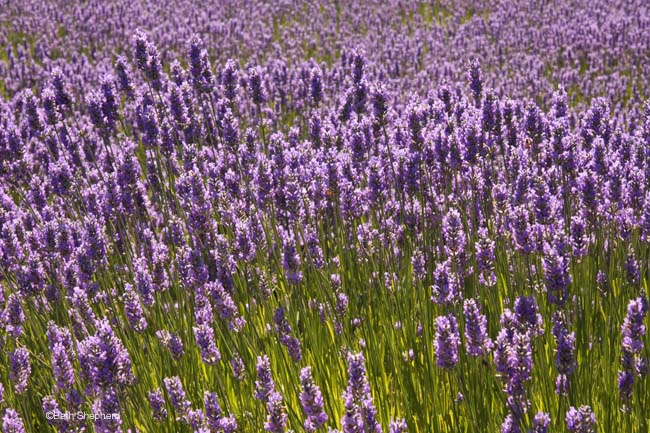
Waves of color, violet, amethyst and plum, glowed in the sunlight like a psychedelic ocean. There’s nothing quite like a field of lavender when the blooms are on the stem, particularly when you’re smack in the middle of it on a beautiful sunny day.

lavenderRecently, I had the great pleasure of taking my friend, Marjan, who was visiting from California, over to Vashon Island for an afternoon. After we drove off the ferry, we meandered along Vashon Highway (which is as much of a highway as the street I live on) stopping for a picnic lunch at a park in town and some refreshing iced coffee at Minglemint before reaching our destination: Lavender Hill Farm.

Lavender Hill Farm is one of several lavender farms on Vashon. In fact Vashon has had its very own Lavender Farm Tour each summer for the past seven years.

The view from Lavender Hill Farm is bucolic: it sits on the Burton Hill and looks out towards Quartermaster Harbor and Mt. Rainier. There is a charming garden which contains 2000 lavender plants of several varieties including Provence, Grosso, Silverleaf, Melissa (pink lavender), Alba (white lavender) and Otto Quast (Spanish lavender). A greenhouse and a cute-as-can-be lavender drying house are tucked in between the fields. The entire scene is evocative of Provence, and even though I knew I wasn’t truly in France with lavender fields stretching out like an ocean as far as your eyes can see, if I closed my eyes, my nose couldn’t tell the difference.

path in the lavenderMarjan and I popped our heads into the drying room and chatted for a few minutes Catherine MacNeal, the owner of this purple paradise. Inside there were bars of lavender soap for sale along with dried lavender wreaths and culinary lavender for cooking. When Catherine mentioned she’d be using culinary lavender to whip up a few batches of lavender lemonade for weekend visitors, it didn’t take me long before I handed her a crisp $10 bill to cover the cost of two ‘U-cut’ bundles to take home.

Strolling across the fields to the designated cutting area millions of bees buzzed, happily drunk on lavender pollen. They didn’t seem to notice me as I snipped a few stems here and there, too busy dreaming of their own honey concoctions that would soon be created when they returned to the hive.

I gathered up my bundles and we headed back for Seattle. As we drove, the heady smell of lavender perfumed the air in the car; the best ‘air freshener’ you could possibly imagine. That night, I made Lavender Simple Syrup to stir into lemonade which would accompany Saturday lunch I planned to serve Marjan and her husband at the Urban Cabin.

lavender lemonadeOf course there are a million ways you can use Lavender Simple Syrup: pour a swirl over ice cream, stir it into maple syrup to slather on blueberry pancakes, drizzle over figs and mascarpone…but since this post is ostensibly about summer sipping, I digress. So here are a few ideas for using Lavender Simple Syrup to quench your thirst:

  • Mix with lemonade to make lavender lemonade
  • Ditto with ice tea (I added some to a green “sun tea” and it was delicious and refreshing)
  • Put ‘em both together to create lavender green tea-lemonade
  • Float into a glass filled with chilled Limoncello (Italian lemon liqueur)
  • Add a spoonful to a lemon drop martini and garnish the rim of the glass with lavender sugar (coarsely grind sugar and a few lavender buds in a blender) or substitute for lemon juice entirely to make a ‘lavender martini’
  • Swirl into chocolate milk or, if you live in Seattle like I do where “summer” weather might be in the 50s, hot cocoa

Making simple syrup is, well, simple. Picking the lavender aside (and you can purchase culinary lavender if fresh lavender isn’t within your reach), the recipe is a snap.

Lavender Simple Syrup

1 cup water
1 cup sugar
¼ cup organic culinary lavender (if picked fresh, simple cut the bloom off the stem, no need to pick off the individual lavender buds)

Heat sugar and water until boiling, stirring occasionally until all the sugar is dissolved. Take sugar-water mixture off stove and stir in lavender. Allow to cool to room temperature. Place covered in refrigerator and continue to cool overnight. Pour mixture through a strainer/sieve and into a glass jar or container, catching the lavender in the strainer. To use, spoon or pour lavender simple syrup “to taste” and note: a little goes a long way.

Thirsty for more? Check out Wanderfood Wednesday!

Filed Under: Food Tagged With: Alba, Burton Hill, Catherine MacNeal, France, Grosso, lavender, Lavender Hill Farm, lavender lemonade, lavender simple syrup, Melissa, Minglemint, Mt. Rainier, Otto Quast, Provence, Quartermaster Harbor, Silverleaf, simple syrup, Vashon Island

Fava beans and a nice Chianti

July 21, 2010 by Beth Shepherd

Fava beans green as fresh spring grass (yes, even though we’re well into summer) graced our table this past weekend. I plucked our entire homegrown crop so that we could make a meal of them because, as I’ll soon explain, it takes a lot of fava beans and a lot of elbow grease to get a bowl of favas for dinner.

fava plantsVicia Faba, the Fava bean, is a “broad bean” also known as Windsor bean, English bean, horse bean and pigeon bean. The fava is among the most ancient plants in cultivation, and has long been a diet staple in Asia, the Middle East, South America, North Africa and Europe. In fact, they are the only beans Europeans ate before they discovered America and all its legumes. They took our beans home and left us the fava, which never really caught on (until recently).

Flowering favasYou figure out why as soon as you begin to prep your favas for feasting. First, you string and shuck the beans (ok, in my case, first you grow the beans!), then parboil them before removing the exterior waxy “shell” and popping out the bright shiny bean inside. It is something to do on a lazy sunny afternoon (now that we have them) on your back porch or around the kitchen table with a couple friends and a bottle of wine. It’s a lot of time to spend on a bean. But it is oh-so-worth-it!

fava beansFor me shelling the beans is almost meditative which is how I feel about gardening in general. Focus, focus, focus but without much actual thought and pretty soon you look around and see how much you’ve actually accomplished. Inner peace and dinner all at once.

Unshelled, fresh favas look like giant, bumpy string beans. They are 5 to 7 inches long and lined with padding that looks like cotton batting. They grew happily and easily in my garden with lovely purple and white flowers late spring before the beans grew. My only gardening regret was that I didn’t plant more of them.

favas in their soft pod nestAside from the fava’s dubious distinction in ‘Silence of the Lambs,’ they are truly a bean to take note of.  Nutritional powerhouses that are high in fiber and iron, and low in sodium and fat, they have no cholesterol but so much protein they are called the “meat of the poor.”

shelling favasItalians even credit the fava bean as a factor in saving Sicilians from starvation during a time of famine. Since then, the fava has been considered good luck and is plays a key role on St. Joseph’s Day. Some people believe that if you keep one in the pantry, there will always be food in the kitchen.

The only drawback that I can see to favas, besides the amount of labor you’ll exert to get them to your table, is that a small minority of people are affected by an enzyme deficiency called Favism. People who have this deficiency can experience severe effects after eating broad beans like fava.

Recipes for dining on favas are plentiful. I’ve had them mashed into a pate, mixed in a salad or served simply with olive oil, a squeeze of lemon and shavings of parmesan cheese. Big Papa and I enjoyed ours tucked into a divine risotto with asparagus (still a bit of local stalks left) and saffron.  Our bowl of risotto paired wonderfully with grilled salmon…and a “nice Chardonnay” (thank you Anderson Family Vineyard).

No disrespect to Hannibal Lecter intended, but to my mind Chianti felt overpowering when I considered the nutty delicateness of fava beans. Granted Dr. Lecter savored his favas with a censor taker’s liver (and such a pairing trifecta it was as only a psychiatrist would know since favas, wine and liver are three no-no’s if one is taking MAO inhibitors used to treat depression).

So try your luck with the lucky bean. Put a dried fava in your pocket  to ward off the effects of our sagging economy. Legend has it that you will never be broke as long as you carry one.

Risotto with fava beansRecipe credit goes to Martha Rose Shulman and the New York Times. And, while I cannot claim to grow saffron-producing crocuses, I did substitute Walla Walla sweet onions from our garden in place of the spring onion. Chives were picked right outside the back door of the Urban Cabin.

Risotto with asparagus, fava beans and saffron

  • 2 pounds fava beans
  • About 7 cups chicken or vegetable stock, as needed
  • 2 tablespoons extra virgin olive oil
  • 1/2 cup minced onion or spring onion* (*I substituted garden-fresh Walla Walla onions)
  • Salt, preferably kosher salt, to taste
  • 2 garlic cloves, minced
  • 1 1/2 cups Italian arborio rice
  • 1 pinch of saffron threads
  • 1/2 cup dry white wine, such as pinot grigio or sauvignon blanc
  • 1 pound asparagus, trimmed and cut into 1-inch pieces
  • 1/2 cup freshly grated Parmesan cheese
  • Freshly ground pepper to taste
  • 2 tablespoons chopped chives (optional)
  1. Prepare the fava beans. Shell them while you bring a medium pot of water to a boil. Drop the beans into the water, and boil small favas for one minute, large favas for two minutes. Transfer at once to a bowl of ice-cold water. Drain. Remove the skins, using your thumbnail to open up the skin at the spot where the bean attached to the pod, then gently squeezing out the bean.
  2. Pour the stock or broth into a saucepan, and bring it to a boil. Add the asparagus, and blanch for three minutes. Remove the asparagus with a slotted spoon or skimmer, refresh in a bowl of cold water, drain and set aside. Turn down the heat under the stock, and keep at a simmer with a ladle nearby or in the pot. Make sure that it is well seasoned.
  3. Heat the oil over medium heat in a wide, heavy skillet or saucepan, and add the onion and 1/2 teaspoon salt. Cook, stirring, until tender, about three minutes. Add the garlic and the rice. Cook, stirring, until the grains of rice are separate and beginning to crackle, about one to two minutes. Rub the saffron between your thumb and fingers, and stir into the rice.
  4. Add the wine, and stir over medium heat until it has been absorbed by the rice. Begin adding the simmering stock, two ladlefuls (about 1/2 cup) at a time. The stock should just cover the rice and should be bubbling, not too slowly nor too quickly. Cook, stirring often, until the liquid is almost absorbed. Add another ladleful or two of the stock, and continue to cook in this fashion — adding more stock when the rice is almost dry, then stirring — for 15 minutes. Then stir in the asparagus and the fava beans and another ladleful or two of stock. Continue adding stock and stirring the rice for another 10 to 15 minutes, until the rice is cooked al dente and the vegetables are tender. Add more stock to the rice, and stir in the Parmesan, pepper and chives. Remove from the heat. Taste and adjust salt. The rice should be creamy. Stir once and serve right away in wide soup bowls or on plates.

Yield: Serves four to six

Advance preparation: You can begin this recipe several hours ahead and finish it just before serving. Cook halfway through step 4 — that is, for about 15 minutes. The rice should still be hard when you remove it from the heat. Spread in an even layer in the pan, and arrange the asparagus and favas over the top. Fifteen to 20 minutes before serving, bring the remaining stock back to a simmer and reheat the rice. Resume cooking as instructed. The favas can be blanched and shelled a day or two ahead and refrigerated.

Bonkers for beans and more? Check out Wanderfood Wednesday!

Filed Under: Food, Garden Tagged With: Anderson Family Vineyard, Chianti, Dr. Lecter, English beans, fava beans, Favism, Hannibal Lectur, horse beans, Martha Rose Shulman, New York Times, pigeon beans, Silence of the Lambs, Walla Walla sweet onions, Windsor beans

Simply salad

July 14, 2010 by Beth Shepherd

greensThere is nothing like walking out your back (or front) door, down your steps and into your yard to collect a bit of romaine here, some Bachelor’s button and Nasturtium there, gather a few Walla Walla sweet onions, a handful of shelling peas, a pinch of thyme, some sprigs of basil and whatever else looks ripe for the picking.

Bachelor buttonTake your treasures back into the house and clean them off before tossing them in a lovely bowl. Pour a stream of nearly local (Oregon Olive Mill) olive oil, a splash of sweet and tangy balsamic vinegar. Slice a couple of farmers market heirloom tomatoes (oh if only I had some that were ripe in my own garden). Top with crumbles of Estrella Family Wynoochie Blue (or shavings of parmesan or pecorino cheese) and a sprinkling of tasty northwest smoked salmon and you have yourself the perfect backyard lunch.

Alpine strawberriesAlong for the ride is fresh-brewed sun tea (fill a big glass jar with water and several tea bags of your choice and let it steep in the sun) and a few still warm-from-the-sun alpine strawberries for touch of something sweet (when the squirrels decide to leave a few to share).

Garden fresh

Sitting on the back deck of the Urban Cabin, with Big Papa at my side and the sunshine (at loooong last) on our shoulders, we listen to the birds splash in the birdbath and watch them flit from tree to tree. Growing stuff we can eat puts a smile on my face. Summer soothes. Life is good.

Want more to munch on? Check out Wanderfood Wednesday!salad

Filed Under: Food Tagged With: Bachelor Buttons, Estrella Family Wynoochie Blue, Nasturium, Oregon Olive Mill, romaine, salad, Urban Cabin

  • « Previous Page
  • 1
  • …
  • 8
  • 9
  • 10
  • 11
  • 12
  • 13
  • Next Page »

Some might fend off a mid-life crisis by leaving the comforts of their corporate salary to jet off to a deserted island. Others might buy a Jaguar. I’ve chosen to dive head-long into my 50s and beyond by becoming a first-time parent. At any given moment you might find me holding a camera, a spade, a spatula or a suitcase. Or my little girl's hand. Adopted from Armenia, she puts the Pampers and Paklava into my life.

Subscribe to Blog via Email

Enter your email address to subscribe to this blog and receive notifications of new posts by email.

Recent Posts

  • Ghosts and goblins of Halloweens past
  • Raise a glass—or ten
  • No me without her: A life before motherhood
  • Leaving the orphanage with a priceless pair of tights
  • Rock of ages: Celebrating five years together as a family

Tags

366 Project Adoption anniversary Armenia autumn Bainbridge Island Baja Birds birthday blog cat cats chickadee China Christmas fall ferry flowers France Garden Gyumri Halloween Hawaii Holiday ice cream Kauai leaves London Mamas with Cameras Mexico Mother's Day Mt. Rainier New York orphanage Paris Puget Sound robin Seattle taxi Thanksgiving Tibet USCIS Valentine's Day wedding Yerevan

Categories

  • Adoption
  • Armenia
  • Family
  • Food
  • Friendship
  • Garden
  • Holiday
  • Miscellaneous
  • Paris
  • Photography
  • Recipes
  • Review
  • Seattle
  • Things to do with kids
  • Travel

Sites I like

  • The Wayfaring Voyager
  • Wanderlit
  • Wanderlust and Lipstick
follow us in feedly

Image Copyright

Unless specifically mentioned, all images on my blog are my own original photographs and, therefore, copyright protected (©Beth Shepherd). Feel free to use my images for non-commercial use so long as you provide me with the image credit. Likewise, if you pin my images to Pinterest, please mention me by name.

Copyright © 2026 · Pamperspaklava · WordPress Barista