Pampers and Paklava

  • Home
  • Photography
  • Travel
  • Food
  • Garden
  • Contact

Plane ride to parenthood

March 12, 2013 by Beth Shepherd

Leavin on a jetplane

One year ago, on March 12, we received a call from our adoption agency with the date we were to appear in court to finalize the adoption of our daughter. Less than 24 hours later (yes, less than 24 HOURS LATER!), Big Papa and I boarded a plane headed to London, where we would stay for two days and two nights before boarding a second plane to Armenia. Only a handful of people knew where we were going and why: Big Papa’s boss, our cat sitter, our pediatrician-to-be, my mother and sister, Big Papa’s cousins (who offered to help us out when we first got back home), and one close friend.

We had waited to take this plane ride for nearly four years and the idea that it was finally happening felt surreal. Only a year before, our pending adoption of another baby girl had fallen through, merely ten days before our scheduled flight. I found it hard to settle myself and put away the fear that something bad would happen this time too.

My mind revisited all the scenarios we’d faced along the way: two referrals, five trips to Armenia, multiple updates to our files and dossier, several trips to our local USCIS (U.S. Citizenship and Immigration Services) office for several sets of fingerprints, numerous visits to our bank to have paperwork notarized, and a number of road trips to Olympia (our state’s capitol) to have our documents apostilled.

I recalled the RFE (Request for Evidence) that had us gripping edge of our seats in the cliffhanger that was our prior adoption attempt, the interminable angst as we waited for nearly three months to get resolution when that adoption was interrupted, the uncertainty of how to “undo” our Article 5 (final Hague approval from the U.S. Department of State), a situation–as we were told by our immigration agent–that no prospective adoptive parents had faced before, and then the crazed race to update our paperwork yet one more time so we could be eligible for a new referral.

Reverently, I remembered the soul-wrenching isolation I felt, and the deep dark depression, when I couldn’t share what was happening–what had happened–even with some of my closest friends, for fear that we might jeopardize the future of our adoption. I couldn’t talk about it. I couldn’t blog about it. The only thing I could do was stew about it.

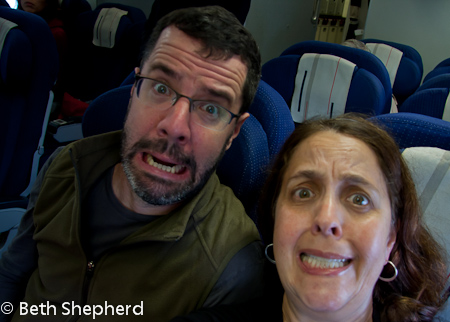
I thought about all the excitement, disappointment, hope and heartache that led to this moment. And yet here we were, passports and suitcases in hand, getting on a plane, literally on our way to parenthood!

That’s when it hit me. We were really on our way: TO PARENTHOOD!
Leavin on a jetplane and scared

Filed Under: Adoption, Travel Tagged With: apostille, British Air, dossier, Hague, London, notarize, Paperwork, parenthood, plane, RFE, USCIS

Now serving ticket H-16: Spending the day at the Office of Immigration

July 11, 2011 by Beth Shepherd

Office of Immigration Tukwila, Washington “Now serving ticket H-5 at counter number 11” says the electronic voice over the loudspeaker. Then we hear a ringing ping, like a finger tapping on a crystal goblet.

“Now serving ticket H-6 at counter number 11.”

Big Papa and I are at the Office of U.S. Citizenship and Immigration Services, USCIS. We are trying to expedite our fingerprints in an effort to extend our approval to adopt, both here and in Armenia. Both countries’ approvals will expire. Soon.

Although we received notice from our government with a fingerprint appointment for later this month, we decide to take our chances as “walk-ins” in an attempt to shave a few weeks off the process. It is 8:00 a.m. in the morning. We arrive, promptly at 7:45 a.m., in time to park in the pay lot (cash only and a $1 more since we were here last year), and walked the surprisingly long walk from the parking lot to the nondescript government building located in the middle of nowhere land south of Boeing Field in Seattle.

I tell Big Papa “Let’s wait a couple hours. Maybe until 10:00 and then, if we don’t get in for the fingerprints, I’ll take you back to work.” I know he has several meetings today that he’d like to make. Frankly the thought of sitting inside these four walls for the remainder of the day is pretty unappealing to me too.

After passing through airport-like security, our bags and bodies scanned, we move to the second check point where we tell the man behind the counter: “Our appointment isn’t until later this month. We’d like to walk-in.” He hands us two numbers–H-16 and H-17–and directs us to the next room to wait until our number is called so we can put our names on the “walk-in list.”

Once our numbers are called by the electronic voice, we queue up behind H-15 and in front of H-18. When we reach the window, we plead our case to the young clerk behind the glass window. She asks us, in a very quiet voice, to take a seat and tells us she’ll alert a supervisor. We sit and wait. An hour passes. Have they forgotten about us, I wonder aloud to Big Papa?

Finally, a smiling-faced man, a supervisor, approaches and asks us to come to his office. He tells us that Seattle’s immigration office is one of the busiest in the county, “Next to L.A.” he says in a matter-of-fact sort of way. We are welcome to wait but there is no guarantee we will be called. He lets us know there are two others ahead of us.

“Sometimes we see a bit of a lull, at 11:00 and then again around 3:00 or 4:00.” I can see Big Papa squirm in his seat.

We head back into the big waiting room, now filled with dozens of people. The sounds of languages from all around the world surround us as we sit and wait some more. And hope. Hope that we will be one of the lucky few (and I do mean few, as we’d just been told by the supervisor that roughly 3-5 walk-in appointments are taken each day) who will be called, before the office closes at 5:00 p.m.

This morning, as we bolted from our house, we did not consider that we might be waiting at the USCIS office all day long. I am grateful that Big Papa has two protein bars and his sandwich, the sandwich that is supposed to be his lunch sandwich. There is no cafeteria, no convenience store within walking distance and the selection in the fast food machine is slim pickings.

I am also pleased that, in my hurry, I’d remembered to bring a book, <a href=”http://www.amazon.com/gp/product/B000CDG8EW/ref=as_li_qf_sp_asin_tl?ie=UTF8&tag=pampeandpakhl-20&linkCode=as2&camp=217145&creative=399369&creativeASIN=B000CDG8EW”>Almost French: Love And A New Life In Paris</a><img src=”http://www.assoc-amazon.com/e/ir?t=pampeandpakhl-20&l=as2&o=1&a=B000CDG8EW&camp=217145&creative=399369″ width=”1″ height=”1″ border=”0″ alt=”” style=”border:none !important; margin:0px !important;” />.

At least, for the duration of the time we spend holed up inside the dreary USCIS office, I can be an armchair traveler and let the author’s words take me to Paris. Ah, croissants, French espresso. What I wouldn’t do, right this very moment, for a double, served with a piece of dark chocolate.

At various points during the day, Big Papa and I explore our options: leave and come back another day, bribe someone else in the waiting room to trade places with us, or continue to wait. As it turns out, we continue to wait in this very room, in these very seats, until the clock strikes 2:30. By this time, the electronic bell has chimed many, many times, and the electronic voice has reached number H-162.

When I finally hear a real voice, albeit ushered in a whisper, say “Beth,” I resist the urge to jump and scream “We made it,” and hug the soft-voiced woman behind the glass window who just said the two words I’ve longed to hear a live person say all day: our names. Instead, Big Papa and I high-five each other and stand up. My butt is sore and my patience has worn thin, yet I feel as elated as I felt the first time we came here to get our fingerprints…over three years ago. It’s been a long journey since that day, in every sense.

We walk into the next, and thankfully last, waiting room of the day and another fifteen minutes passes before we hear our names called once again, this time to have our inkless prints scanned. I walk over to where the three fingerprint technicians stand by their fingerprint machines, capable of scanning and then emailing our prints to the Hague unit of the Big Immigration Office in Missouri. Then it’s Big Papa’s turn.

“Is this your first time here?” I hear the fingerprint technician ask Big Papa.

“Nope” he tells her, “Third.”

My technician asks a few questions too. I give her the elevator story on our adoption. Just the bare bones, but still she is intrigued. And sympathetic which, right now, feels pretty good.

And then, it’s over. 6-1/2 hours, one sandwich, a Diet Coke and two protein bars later, we have our fingerprints.

“It’s like a flight to Paris,” Big Papa jokes.

“Oui. Deux cafés s’il vous plait.” I reply, though truthfully I’m feeling like I need something stronger, and boozier, than a double espresso at the moment.

I put down my book, now three-quarters of the way finished. We head to our car which is parked outside the Office of Immigration, in the $7 cash only parking lot, in Tukwila, Washington. It’s been a long day. And, Toto, we are definitely not in Paris.

Filed Under: Adoption Tagged With: fingerprints, Nearly French, Office of Immigration, Tukwila, USCIS

Crime and punishment

April 16, 2010 by Beth Shepherd

“Now serving ticket number H1 at counter 11.” “Now serving ticket number H2 at counter 11.”

Office of ImmigrationBig Papa and I were tickets number H21 and H22 respectively as we sat in the waiting room at the Tukwila, Washington office of U.S. Office of Immigration. We’d received our appointments (Big Papa at 8:00 and me at 9:00) a couple weeks ago in response to our application to update our approval to adopt internationally. Approval expires in fifteen months time, so any family whose international adoption takes longer than that must reapply.

Because of this, and because regulations have changed recently for adoptions in Armenia, Big Papa and I have to update/redo the following, all of which will also need to be both notarized and then apostilled down in Olympia, Washington, our state’s capitol:

  • Home study (which also involved a home visit) and home study agency license
  • FBI clearance for each of us (including ink fingerprints at our local police station)
  • Local/state police clearance for each of us
  • State child abuse clearance for each of us
  • Immigration fingerprints for each of us
  • Physical by each of our doctors
  • Letter from employer verifying employment
  • Three (most recent) years of tax returns

We drove to Tukwila and parked at the (cash only) lot. Our appointment form and signs at immigration say “no cameras or cell phones,” so we left ours in the car. After putting our belongings on the conveyor belt and passing through security inspection we sat in the large waiting room with about thirty other folks. The sign at the front desk says, “Please turn all cell phones off.” I noticed that several people are either making or taking calls and the gal sitting next to us is busily texting away. Is there something about “off” that is not clear?

It occured to me that all the people here with cell phones also likely have cell phone cameras. Part of me wanted to simply get through this process though the other part of me was tempted to prove a point and go get my SLR from the car.

As each person’s number is called he or she stands up and goes to the line at the check in counter. Soon, most of the room is standing in line. After we’re each checked in, we are ushered into a second waiting room. This room does not have enough chairs for everyone to sit.

While we waited I noticed that the couple sitting next to us also had ‘I-797C’ forms in hand (the form from U.S. Immigration which is adoption-specific). I asked them if they are adopting, “Yes.” From where? “Ethiopia,” they told us. As it turns out they have a referral and plan to go pick up their daughter this coming June. Like us, they are redoing paperwork for the U.S. government that is soon to expire.

Print emFinally we are called, individually, to have our fingerprints taken. Fingerprints for immigration are “inkless” which is pretty cool (and less messy). FBI still does ink prints, a process we completed a couple months ago down at our local police station.

Prints are taken of your thumb and each finger separately by rolling it over a screen. The information is captured via computer. Then all four fingers, sans thumb are printed and you’re ‘scot-free.’

As we’re leaving Big Papa says that the fingerprint gal asked him where we were adopting from and when he told her ‘Armenia,’ she questioned “Why?” When Big Papa filled in a few of the details around our choice, she asked if he knew about what was going o right now with Russia (suspension of all adoptions from the U.S. as a result of one woman “returning” her adopted son). “Yes, we know.” Big Papa replies. “Armenia is not Russia.”

Next stop is the police station in downtown Seattle where we request criminal background checks. They also only accept cash. What is up with that? So we hoof it over to the nearby bank to get some bills while the (very nice) gal behind the counter at the police station is processing our forms.

This year, criminal clearances alone set us back $133 including parking for immigration. We will also pay the cost for apostilling at $15 per document, the fee to have our home study updated and then the (rather large) chunk of change to have all of our documents translated once again into Armenian.

How is that two honest, law-abiding, conviction-free citizens spend so much time (and money) proving they are two honest, law abiding, conviction-free citizens?

Filed Under: Adoption Tagged With: apostille, fingerprints, Home Study, immigration, USCIS

Why aren’t you adopting from Haiti?

January 28, 2010 by Beth Shepherd

If I had a $10 for every time someone has asked me recently why we aren’t adopting from Haiti, I could probably fund the update to our home study (more on this in an upcoming post). Here’s the thing, even if we wanted to adopt from Haiti, we can’t.

Haitian orphans: http://upload.wikimedia.org/wikipedia/commons/c/cd/HaitiOrfaos2.JPG

Haitian orphans: http://upload.wikimedia.org/wikipedia/commons/c/cd/HaitiOrfaos2.JPG

In the wake of the disaster in Haiti, the government isn’t fully functioning, so there is no way to process a Haitian child through the Haitian courts. For families who already are “matched” with a child and waiting for their court dates, this is heartbreaking, though when the government is up and running, hopefully they’ll get their day in court. As for new adoptions, they are not being processed at all.

Had the earthquake not occurred, Big Papa and I still would not be able to adopt from Haiti. Since 1974, Haitian guidelines require that couples be married for ten years (single women, however, are allowed to adopt). Prior to the earthquake, some U.S. adoption agencies were hopeful that the adoption law pending in Haiti would pass, widening the guidelines and reducing the marriage requirement to five years. In our case, that would still prohibit us from adopting as we will hit three years this July.

It’s not easy to adopt from Haiti, even when life there is “normal.” I know one woman, who lives nearby, whose [now] three year old daughter was adopted from Haiti. She and her husband made four trips to Haiti over a two year period before being able to bring their daughter home.  She described a slow, unwieldy government process with complexities and unforeseen stumbling blocks at every step in their journey to adopt.

Once a family is “in process” to adopt internationally simply switching countries is not typically a viable option (unless the adoption agency you select also represents that country and, even then, you must still resubmit paperwork and redo portions of your home study). The I-800a, which is the request to the U.S. government to adopt an international orphan, asks prospective adoptive families to specify: country, gender of child(ren) and age of child(ren). If a family says: China, girl, infant, the only way to change that is to update a home study or, in the case of country change, redo the entire home study and supporting paperwork before submitting a new I-800a to U.S. Immigration (USCIS). Of course, submitting a new I-800a is $830 for a couple and that’s just the I-800a, never mind a new home study and all supporting documentation.

While some of the regulations might seem to keep families from adopting, most are in place to protect prospective adoptees. We are adopting from Armenia, a Hague Convention country. In part, this means that all children available for adoption have been placed on a registry, giving extended family a chance to step forward and offer to raise this child. Imagine a child in Haiti, separated from family and then adopted to a family in the U.S., when there is an aunt or uncle in Haiti who might willingly take that child in, if they knew he was in need. Or consider the possibility that a mother or father might “sell” their child for emergency rations or medical care, a situation that has occurred in other countries and resulted in the U.S. ceasing to allow further adoptions to be processed. Acting in haste to find homes for children of disaster can open the door to a host of new, equally troubling scenarios.

While it’s heartening that people in the U.S. are thinking more about Haitian orphans in need, the truth is that, worldwide, there are children living in horrific circumstances. Hunger, homelessness, abuse, war, disease and natural disasters befall hundreds of thousands of children in countries around the globe, including the U.S.  I want to believe that the flurry of interest in Haitian adoption isn’t just a result of jump-on-the-cause-du jour bandwagon. Haitian orphans need help, no doubt, but so do orphans in Vietnam and Guatemala (two countries which the U.S. currently has closed to international adoption), as do orphans in Sudan (adoption not allowed for Moslem children), as do children in a host of countries that the U.S. does have agreements with.

The list of children needing loving permanent homes is endless. If something good can come from all the death and despair in Haiti, I hope it will be to widen the net of families who might consider adoption from a range of counties (including the U.S.), and who are prepared for all that’s entailed to make it from square one to bringing a child home and then raising that child. When all is said and done, and the fallout from this disaster passes, there will be another and then another.

Adoption is not for the faint of heart, nor those in a big hurry. It isn’t meant to be a panacea to assuage the guilt we might feel as we watch the tragedy unfold in Haiti. Adoption isn’t just for the time being. Adoption is a life-long, life-changing decision, because the child you adopt becomes your child for a lifetime.

Filed Under: Adoption Tagged With: Armenia, China, earthquake, Guatemala, Haiti, Haitian, I-800a, orphan, Sudan, U.S. Immigration, USCIS, Vietnam

Deja vu

January 4, 2010 by Beth Shepherd

On November 11, 2008, Big Papa and I submitted our “I-800A,” a form to USCIS (U.S. Citizenship and Immigration Services) requesting approval to adopt internationally. As part of that process, we had to have our fingerprints to run a criminal background check and obtain FBI clearance.  Our approval, called the I-797C, was received on January 2, 2009.

I-800a approvalI completely (and blissfully) forgot about the entire process until an email from our adoption agency arrived in our in-box this past week.  It read: “Please be mindful of your I-797C expiration date and your FBI/USCIS fingerprint expiration dates. It is your responsibility to monitor these expiration dates and act on them as directed in the I-800A instructions. The expiration dates for both approval and fingerprints are located in the top section of your I-797C.”

Happy New Year! Each phase of the adoption process bears its own unique brand of torture. Processing paperwork, ad nauseam, and obtaining every legal document known to man (and having each document notarized) was exhausting. Once our dossier was on its way to Armenia, I gladly put the paper chase behind us. Or so I thought.

As it turns out, that little piece of paper is good for fifteen months. Ours expires April 2, 2010, hence, the extension, officially known as I-800A, Supplement 3.

797Fortunately, the first extension is gratis. After that, an extension will set a family back $340 plus $160 for two sets of FBI fingerprints. The initial I-800A cost $670 to file the document and an additional $160 for two sets of fingerprints. For people adopting from countries, like China, where there is currently a three-year wait to get a referral, that’s a lot of extensions to file. I’m crossing my (FBI approved) fingers that this is our only extension and it’s processed without any glitches.

Simply reading through the (thankfully short) list of documents that we must attach makes me feel a bit dizzy. I think I am “done” with the paper process in my brain, so revisiting it feels like a bad dream. The only papers I want to sign right now are those accepting our referral to adopt our child.

That said, I plan to sign, seal and deliver every last item on the check list for the I-800A extension, and pronto. A year may have passed, but my desire to finish what we set out to do in the first place has not waned. I still want to adopt a child. I still want to be a mom.

Filed Under: Adoption Tagged With: extension, FBI, fingerpints, Hague, I-800a, USCIS

Walk a mile in my shoes

May 29, 2009 by Beth Shepherd

A year ago, at the end of May, Big Papa and I started our adoption journey. I suppose the exact anniversary date is a bit hazy. It’s a bit like trying to pin down when a romantic relationship started. First date? First kiss? Everyone seems to have their own unique way to define when “it” all began.

I find that most everyone is amazed by how long international adoption takes and how much sweat equity is involved. When I’ve shared the news that we’re adopting people are incredulous when, some months later, they ask if we’re close to getting a kiddo and I tell them the blessed event could still be a year out.

We’re now at the stage where our dossier is in Armenia, translated and sitting in the Prime Minister’s office waiting for approval, which could take months. To get to this point, we had two major hurdles to vault, our Home Study and our Dossier.

Adoption Home Study

Everyone who adopts has must have a Home Study, which is a thorough background investigation by a licensed professional (generally a social worker) to determine whether the prospective adoptive parents are suitable to adopt. Big Papa and I filled out pages of answers to questions about our backgrounds, our family, our beliefs, our strengths and weaknesses, why we want to adopt, our relationship, a chronological history of each of our lives, jobs, hobbies, education…and much more. Between us we wrote twenty-six pages. We also attended a ten-hour training class which is required for anyone adopting from a Hague-convention country.

Then, our social worker interviewed us individually and twice as a couple, once in our home. I can’t tell you how many people make sure their homes are spic ‘n span, bake cookies, and primp and prepare for this moment. We tried not to obsess too much. I didn’t think our social worker was going to show up and perform the ‘white glove’ test. Where the rubber meets the road is the list of documents you collect:

1. Birth certificates for each and every resident of the household
2. Marriage certificate
3. Copy of three most recent Federal Tax Returns
4. Two most recent pay stubs confirming employment
5. Proof of insurance: health, life, other
6. Physician’s Report for each member of the household
7. Guardians: The complete name(s) address and phone number of the guardians of this child in the event of the death(s) of the applicants, and how this has been established
8. Five references, only one of which can be a family member
9. Child abuse clearances from every state and/or country you’ve ever lived in
10. Criminal clearances for all adult household members (this includes fingerprinting at the local police department)

Whew! I get tired just rereading the list. Completing the Home Study process took us about four months. Next, we filed our I-800a, which requests U.S. government permission to adopt an international orphan. This process took three months from submission to approval. We had to get FBI fingerprints and clearance for this stage. While we were waiting, we got busy putting together our Dossier.

my-moccasins

Adoption Dossier

The dossier is a large packet of documents that the adoption agency submits to the country in which prospective parents are adopting from. Most of these documents also need to have both notary signatures and apostille seals (subject for another post!). Here’s a list of what was in our dossier, which was shipped late February:

1. Letter to Prime Minister requesting adoption of child
2. Copies of Passports
3. Authenticated Birth Certificates
4. USCIS Approval, also known as the I-171H or 797C form
5. Home Study (notarized agency license attached to back)
6. Personal Residence Description
7. Three blank white sheets of paper with signature
8. Employment Verification Forms
9. Letter of Recommendation
10. Letter of Recommendation
11. Letter of Recommendation
12. Letter of Recommendation – Pastor
13. Financial Statement: Liabilities and Assets
14. 1040 Form Copies – three years
15. Medical Exam Reports
16. Local Police Clearance
17. Marriage Certificate
18. Power of Attorney
19. Photo Page (Family, home, work, church, pets, vacation, nursery)

Yay for us! Our dossier is signed, sealed, delivered and speaking Armenian. It’s been one heckuva year, and Big Papa and I know we’re in for more of the same over the coming year. Adoption is a phenomenal paper chase. The accompanying waiting game is the mother-of-all-waits. The entire experience tests your metal and stick-to-in-ness.

Now when we see a family with, what appears to be, an adopted child, I smile and nod knowingly. We’ve walked in their moccasins.

Filed Under: Adoption Tagged With: adoption agency, birth certificate, dossier, fingerprint, Home Study, letter to Prime Minister, marriage license, moccasins, Paperwork, passports, police clearance, USCIS

A Fork in the Road

May 15, 2009 by Beth Shepherd

Adoption is not for the faint of heart. Navigating the twists and turns that you expect to encounter sounds relatively straight-forward at the onset. You figure you’ll gather this form and that form, find a few people to say nice things about you, get some fingerprints, pay a few fees, wait awhile and, voila, parenthood. You expect there’ll be a lot to track and do, but that it will be doable nonetheless. Anyone who has been down the road to adoption, particularly international adoption in a “post-Hague Convention” world, knows that the reality is something else altogether. Not to mention traveling this path while trying to retain some sanity.

This week we reached another fork in the road. Our agency informed us that while things are still moving in Armenia, they are moving very slowly. Emphasis on very. Since implementation of The Hague Convention, which sets forth guidelines and procedures to prevent abduction, exploitation, sale, or trafficking of children, international adoption has slowed to a snail’s pace. We hear that adoptions in China are now taking 37 months, after dossier submission. The U.S. has closed the door, indefinitely, for several countries that are not “Hague-compliant,” such as Guatemala and Vietnam .

Fork in the Road

We were proud to choose a country that is Hague-compliant and happy to find a reputable agency that is also Hague-accredited. But I will tell you that it has been a wild ride.

International home studies required child abuse clearances from each state we’d lived in, which between Big Papa and I was nine. Hague was newly implemented in April, and states were changing policies right and left. We filed and re-filed our California clearances three times. Colorado returned Big Papa’s clearance, along with the check for $15 he’d written on August 15. They had raised their fee to $30…on August 15!

Then, just as I was about to send our home study to USCIS (U.S. Center for Immigration Service) along with our I-800a (U.S. government for permission to adopt an international orphan), I noticed our home study agency’s notary had a nearly expired license. Two more weeks passed before finding a notary whose license would be good for at least six months, and our home study was revised and reprinted. Pre-Hague, waiting times for I-800a approval had been 30 days. We began hearing that I-800s were being rejected for a multitude of revisions needed, and the process was taking upwards of four months. Submitting ours with a notary whose license might expire in that time period would not be a wise step.

Now that we’ve learned that the process is going to take longer than we first thought, what do we do? Cross our fingers and hope that this will be one long hiccup but we’ll still “get there?” Abandon Armenia and try for another country that our agency represents? Change our parameters for the type of child we’ll consider? My head is swimming with questions and uncertainty.

“When we walk to the edge of all the light we have and take the step into the darkness of the unknown, we must believe that one of two things will happen. There will be something solid for us to stand on or we will be taught to fly.”

~Patrick Overton

Filed Under: Adoption Tagged With: child abuse clearance, China, dossier, Guatemala, Hague Convention, I-800a, USCIS, Vietnam

Some might fend off a mid-life crisis by leaving the comforts of their corporate salary to jet off to a deserted island. Others might buy a Jaguar. I’ve chosen to dive head-long into my 50s and beyond by becoming a first-time parent. At any given moment you might find me holding a camera, a spade, a spatula or a suitcase. Or my little girl's hand. Adopted from Armenia, she puts the Pampers and Paklava into my life.

Subscribe to Blog via Email

Enter your email address to subscribe to this blog and receive notifications of new posts by email.

Recent Posts

  • Ghosts and goblins of Halloweens past
  • Raise a glass—or ten
  • No me without her: A life before motherhood
  • Leaving the orphanage with a priceless pair of tights
  • Rock of ages: Celebrating five years together as a family

Tags

366 Project Adoption anniversary Armenia autumn Bainbridge Island Baja Birds birthday blog cat cats chickadee China Christmas fall ferry flowers France Garden Gyumri Halloween Hawaii Holiday ice cream Kauai leaves London Mamas with Cameras Mexico Mother's Day Mt. Rainier New York orphanage Paris Puget Sound robin Seattle taxi Thanksgiving Tibet USCIS Valentine's Day wedding Yerevan

Categories

  • Adoption
  • Armenia
  • Family
  • Food
  • Friendship
  • Garden
  • Holiday
  • Miscellaneous
  • Paris
  • Photography
  • Recipes
  • Review
  • Seattle
  • Things to do with kids
  • Travel

Sites I like

  • The Wayfaring Voyager
  • Wanderlit
  • Wanderlust and Lipstick
follow us in feedly

Image Copyright

Unless specifically mentioned, all images on my blog are my own original photographs and, therefore, copyright protected (©Beth Shepherd). Feel free to use my images for non-commercial use so long as you provide me with the image credit. Likewise, if you pin my images to Pinterest, please mention me by name.

Copyright © 2026 · Pamperspaklava · WordPress Barista