Pampers and Paklava

  • Home
  • Photography
  • Travel
  • Food
  • Garden
  • Contact

Patat Frites Recipe

February 1, 2012 by Beth Shepherd

Frites with mayonnaiseThe first time I traveled overseas was for a study-abroad semester in Amsterdam. We arrived in January of 1980, and as we walked along narrow cobbled streets, wind from the North Sea blew frigid air in our faces. Thirty-two years later, I can still conjure up memories of the excitement I felt for the big adventures which lay ahead. And I clearly remember what I saw during my first few days: quaint canals, tall brick buildings with gingerbread roof lines, bikes as far as the eye could see, and tiny plastic pastel-colored forks littering the ground.

What were they for? Why were there so many of them? What did it all mean? And then I discovered ‘Patat frites.’

Patat frites are the Dutch version of fries: long thick cuts of deep-fried potato are stuffed into a paper cone or plastic plate and served up with a dollop of the sauce of your choice…and a plastic fork. In Holland, potatoes are serious business and frites are the number one snack food. It would be impossible to visit Amsterdam without catching a whiff of frying potato wafting from a frite stand. When Big Papa and I visited Amsterdam last year, I made sure we stopped at a few frite stands.

There are several choices for toppings:  light lemony “mayonnaise,” garlic sauce and “patat oorlog” which translates to “war chips.” My personal favorite was “pindasaus” or peanut sauce, a riff on the sauce the Dutch discovered when they colonized Indonesia. Versions of this sauce are served on sate (grilled chicken or meat on a stick) and with Indonesian rijstafel (rice table) cuisine, a food-fest with countless little dishes. You could also serve it over noodles or on top of just about any vegetable dish.

I’ve been thinking a lot about my first overseas trip, how it changed me, opened up my world, and the wanderlust it inspired…even if I’ve never been able to wander as far or as often as I might like. And as I walk down Seattle streets this January, with a bitter wind biting my face and smell of salt air from Puget Sound in my nostrils, I dream about patat frites met pindasaus warming my belly, a heel lekker (which means “completely yummy” in Dutch) treat if there ever was one!
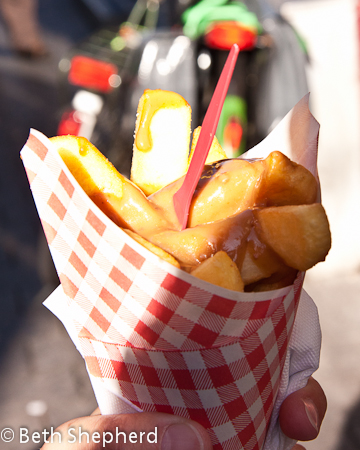
Dutch frites with pindasausPindasaus (Dutch peanut sauce)

4 T peanut butter
8 T hot water
2 t or 1 T Sambal Oelek or to taste (1/2 t or more crushed red pepper is good substitute)
1 T Ketjap Manis or 1 T soy sauce plus 1 t molasses or brown sugar
1 t to 1 T fresh ginger, grated
1 clove garlic, minced
Juice of half a lemon

Combine all the ingredients in a saucepan; gently simmer for 3 to 5 minutes. Stir occasionally.

Note: Sambal Oelek is an Indonesian chile sauce with no added flavors added like garlic or spices. It adds hot without changing the flavor of a dish. A swirl of Sambal Oelek is lovely in a bowl of hummus. Crushed red pepper can be used as a substitute.

Ketjap Manis is Indonesian sweet soy sauce. It is a forerunner of ketchup. It is the only soy sauce developed outside the Asian continent. For a substitute use equal parts soy sauce and brown sugar or molasses. Simmer the two until blended.

Want more lekker treats? Check out Wanderfood Wednesday!
Filed Under: Recipes, Travel Tagged With: Amterdam, frites, Holland, Netherlands, patat frite, pindsaus

Thick as pea soup

December 15, 2010 by Beth Shepherd

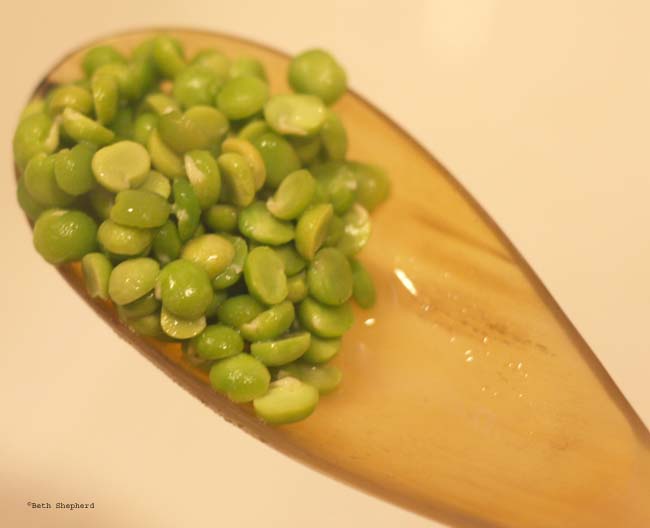
split peasGray fog and clouds as dense as mid-winter lambs’ wool filled the sky, while rain poured down in buckets, helping Seattle live up to its reputation as the ‘rain city.’ During the dark, dank days that seem to stretch on forever, I start dreaming about soup. And this past weekend, one soup in particular: pea soup.

Back in 1980, when I studied abroad in the Netherlands, I lived in the home of a 72-year-old woman whom I affectionately called, ‘Oma.’ Oma made the best darn pea soup I’d ever had. Hers was a soup that changed my idea of what pea soup was possible of being.

Tall Grass Bakersy PUmperkickel bread“So thick you can stand your spoon straight up in it,” is what she would say as she served up a bowlful of her stupendous soup. Pea soup which is called ‘erwtensoep’ or ‘snert,’ by the Dutch is a thick stew chock-full of green split peas, different cuts of pork, celeriac or stalk celery, onions, leeks, carrots, and often potato. Slices of rookworst (Dutch smoked sausage) are added a few minutes before serving. It is customarily served with rye bread (roggebrood) topped with bacon, cheese or butter. The bacon is always ‘katenspek’, bacon which has first been cooked before being smoked. It’s a one-stop shop of a soup if there ever was one.

Erwtensoep is traditionally eaten during the winter and is emblematic of Dutch cuisine. You can even find the soup at ‘koek en zopie’ outlets, small food and drinks stalls which pop up during wintertime along frozen canals, ponds and lakes in the Netherlands, and cater to ice skaters.

During my recent trip to Amsterdam, a bowl of “echte” (authentic) erwtensoep was one of my “top ten” food treats to hunt down and savor. On my last night there, I found it and ordered up a bowl with a snifter of korenwijn (aged Dutch gin). Both did their job to bring back happy memories and take the chill out of my bones on that cold, windy night.

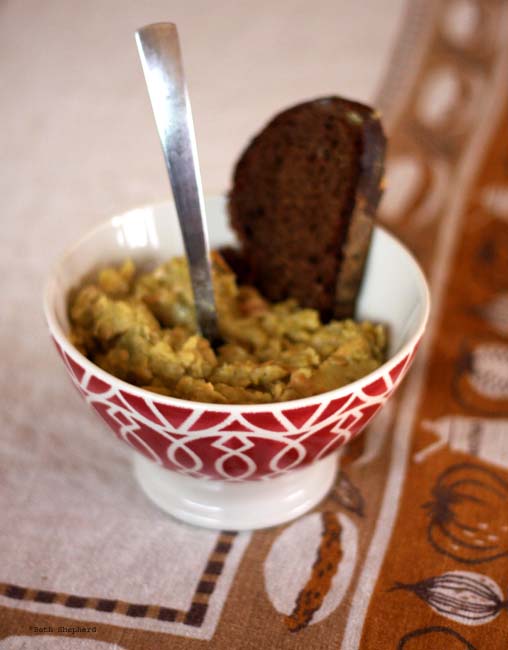
cat and pea soup ErwtensoepI made the soup for Big Papa on Sunday. Pumpernickel bread from Tall Grass Bakery stood in for the roggebrood and added a touch of molasses sweetness as we dunked and nibbled. We washed down our pea soup with a delicious hard cider, Bellwether, ‘King Baldwin,’ which we brought back home after a trip to visit relatives in upstate New York.  It’s light fizz and dry apple flavors perfectly complimented the soup. And, Oma would have been proud. Our spoons stood straight and tall! Even our cat was impressed.

Erwtensoep

  • 4 bacon slices, chopped*
  • ½-1 small onion, chopped
  • 1-2 medium leek (white and pale green parts only), sliced
  • 1-2 large carrots, peeled, chopped
  • ½ cup chopped celeriac (celery root – peel skin and then chop) or 2 stalks celery, chopped
  • 1-2 garlic cloves, minced
  • 4-14 1/2-ounce cans low-salt chicken(or veggie) broth*
  • 1-1/4 cups green split peas, rinsed and soaked overnight (I soaked mine for four hours and they were fine)
  • 2 bay leaves
  • 3-4 small potatoes, chopped (optional: I used Yellow Finn)
  • 2-3 smoked sausages (Dutch preferred, otherwise, German Bratwurst-style), cooked and sliced (1/2 inch slices)*

Preparation

Sauté bacon in heavy large pot over medium-high heat until crisp and brown. Add onion, leek, carrot, celeriac and garlic and sauté until vegetables begin to soften, about 6 minutes. Add broth, peas, and bay leaves and bring soup to boil. Reduce heat to medium-low, cover and simmer until peas are tender, stirring occasionally, about 1 hour. While soup is brewing, cook sausage in a separate pan, slice and set aside. Add sausage and cook for another half-hour. Soup should be thick and peas “decomposed.” Season soup to taste with salt and pepper.

*Vegetarian Note: You can make this recipe vegetarian-friendly by omitting the bacon and sausage, or instead, adding the vegetarian equivalent.

Want to spoon in some more? Check out Wanderfood Wednesday!

Dutch pea soup or Erwtensope and Tall Grass Bakery Pumpernickel

Filed Under: Food, Travel Tagged With: Bellwether Cider, Dutch, erwtensoep, katenspek, King Baldwin cider, korenwijn, Netherlands, oma, pea soup, pumpkernickel bread, roggebrood, rookworst, snert, Tall Grass Bakery

Wooden shoes and hearts of stone

January 12, 2010 by Beth Shepherd

Miep Gies died yesterday. She was 100 years old. Miep and her husband, Jan, are the Dutch couple who hid Anne Frank and her family for more than two years in an Amsterdam attic. When the Franks were discovered and sent to concentration camps, Miep found Anne’s diary. She kept it until the war ended when she presented it to Otto Frank, Anne’s father and the only surviving member of the Frank family.

Dutch shoesI remember reading Anne Frank’s ‘Diary of a Young Girl’ when I was a young girl. Aside from my own family’s connection to the Holocaust, I held a deep fascination with the Netherlands, its windmills, wooden shoes and plucky populace. One night, my father snuck into my room one night and measured my feet while I was sleeping. He made a pair of wooden shoes for me, just like the Dutch children had, with red stripes running up the sides.

Years later, I chose Amsterdam when I decided to spend a semester studying abroad during my junior year in college. The experience of living overseas and seeing the world from a different perspective was life-changing for me. On a recent trip back to my childhood home, I found a stack of photos and letters from years ago, including one I wrote to my parents when I lived in Amsterdam. I mentioned going by myself to visit the Anne Frank Museum. “It was really very interesting and made me do a lot of thinking,” were the words I wrote to my parents some thirty years ago.

Hearing of Miep’s passing today inspired more thinking. Throughout her life, Miep repeatedly said she wasn’t a hero, but simply a common citizen doing what seemed necessary at the time. ”My decision to help Otto was because I saw no alternative. I could foresee many sleepless nights and an unhappy life if I would refuse. And that was not the kind of future I wanted to for myself.”

In my opinion, this is Miep’s legacy. One individual making the choice to stand up for what she believed was right by helping those in need, even if it meant risking her own life. While she couldn’t change hearts of stone or the chaos that surrounded her, she could make a difference in the hearts of those she cared for, even if only for a short while.

There is so much that happens in life which we can’t change and can’t control. In the face of adversity, sometimes all we have is our ability to hold tight to what we believe and do right by ourselves by doing right by others.

“I must uphold my ideals, for perhaps the time will come when I shall be able to carry them out.”
– Anne Frank

Filed Under: Travel Tagged With: Amsterdam, Anne Frank, Diary of a Young Girl, Miep Gies, Netherlands, Otto Frank

Some might fend off a mid-life crisis by leaving the comforts of their corporate salary to jet off to a deserted island. Others might buy a Jaguar. I’ve chosen to dive head-long into my 50s and beyond by becoming a first-time parent. At any given moment you might find me holding a camera, a spade, a spatula or a suitcase. Or my little girl's hand. Adopted from Armenia, she puts the Pampers and Paklava into my life.

Subscribe to Blog via Email

Enter your email address to subscribe to this blog and receive notifications of new posts by email.

Recent Posts

  • Ghosts and goblins of Halloweens past
  • Raise a glass—or ten
  • No me without her: A life before motherhood
  • Leaving the orphanage with a priceless pair of tights
  • Rock of ages: Celebrating five years together as a family

Tags

366 Project Adoption anniversary Armenia autumn Bainbridge Island Baja Birds birthday blog cat cats chickadee China Christmas fall ferry flowers France Garden Gyumri Halloween Hawaii Holiday ice cream Kauai leaves London Mamas with Cameras Mexico Mother's Day Mt. Rainier New York orphanage Paris Puget Sound robin Seattle taxi Thanksgiving Tibet USCIS Valentine's Day wedding Yerevan

Categories

  • Adoption
  • Armenia
  • Family
  • Food
  • Friendship
  • Garden
  • Holiday
  • Miscellaneous
  • Paris
  • Photography
  • Recipes
  • Review
  • Seattle
  • Things to do with kids
  • Travel

Sites I like

  • The Wayfaring Voyager
  • Wanderlit
  • Wanderlust and Lipstick
follow us in feedly

Image Copyright

Unless specifically mentioned, all images on my blog are my own original photographs and, therefore, copyright protected (©Beth Shepherd). Feel free to use my images for non-commercial use so long as you provide me with the image credit. Likewise, if you pin my images to Pinterest, please mention me by name.

Copyright © 2026 · Pamperspaklava · WordPress Barista