Pampers and Paklava

  • Home
  • Photography
  • Travel
  • Food
  • Garden
  • Contact

My garden in summer

July 1, 2015 by Beth Shepherd

Love is to the heart what the summer is to the farmer’s year

— it brings to harvest all the loveliest flowers of the soul.

~Author Unknown

Welcome July! My garden’s cup runneth over with every color in the rainbow. Dahlia and Sweet Pea for the vase on our table, a sprinkling of chive blossoms and nasturtiums on our salad, a few blueberries and alpine strawberries atop our breakfast yogurt, fava beans and mint for risotto. Summer, you are delicious and oh so delightful.

When I look out onto our tiny slice of urban heaven, I feel proud of the beauty and the bounty we pack into 700 square feet. Every inch is filled with pure joy.

Garden July 1, 2015

Sweet Pea

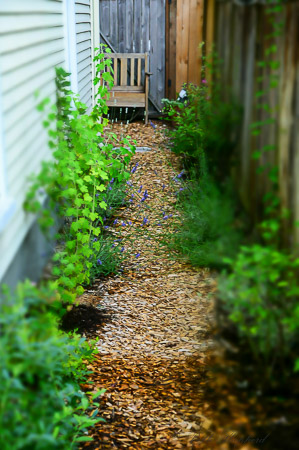
Side garden

Borage flowers

Poppy

My garden

Dahlia

My garden from above

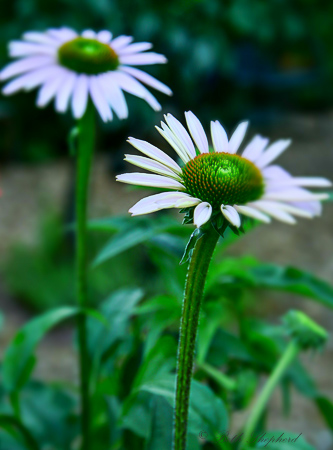
Coneflower

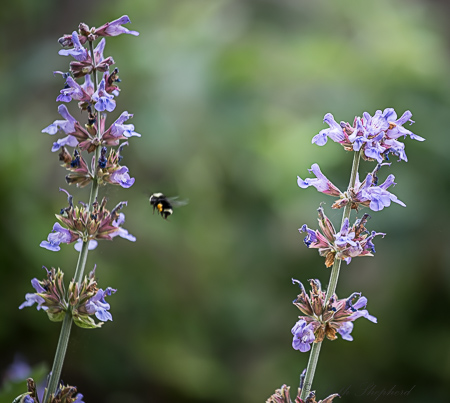
Bee and sage flowers

Back 40

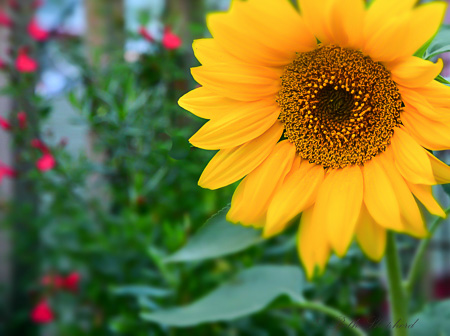
Sunflower

And if you want to read more about all things Pampers, follow me on Facebook, Twitter or RSS/email.

Take the road less traveled, Beth

Filed Under: Garden Tagged With: Garden

What’s the buzz: Bees in Jardin du Luxembourg

June 9, 2015 by Beth Shepherd

Some of the luckiest bees in the world make their residence in Paris’ exquisite Jardin du Luxembourg. Their homes (bee boxes), some of the most beautiful I’ve ever seen, are nestled in a corner of the Luxembourg gardens conveniently close to the meticulously cared-for fruit orchard. The bees pollinate these trees, many of which are named after senators, because the gardens surround Luxembourg Palace are currently home to the French senate, although the palace was originally built to serve as the royal residence of regent Marie de Medicis, mother of Louis XIII of France.

With such a zen spot to buzz around, an abundance of organically grown flowers and fruit trees (Paris is a pesticide-free zone), it’s no wonder these Parisian bees are extraordinarily healthy. There have been no signs of the well-publicized “colony collapse” plaguing bees around the world.  In the U.S. most commercial apiaries replace their queen at least once a year, whereas the queen bee of the Luxembourg Gardens lasts for 2-3 years!

Bees in Jardin du Luxembourg

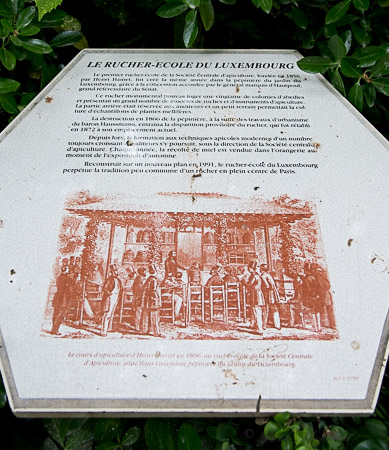
Jardin du Luxembourg has also been home to a beekeeping school, a permanent fixture in the garden since 1856, the same year the nursery was es when it was founded by Henri Hamet. In 1866, the garden was destroyed (along with much of the city) when Baron Hausmann commenced with his massive renovation of Paris. It was restored to its current location in 1872.

Le rucher-ecole du luxembourg

The current school, Rucher Ecole, is led by Jean Pauchon, who learned bees could thrive in Paris after temporarily storing a hive on the roof of the Opera House twenty years ago, where they collected an abundance of pollen to make honey. Pauchon’s classes include a beekeeping outfit (with a netted hat) and a smoker. Once a year, the honey harvest is sold at the honey festival, Fête du Miel, which takes place in September.

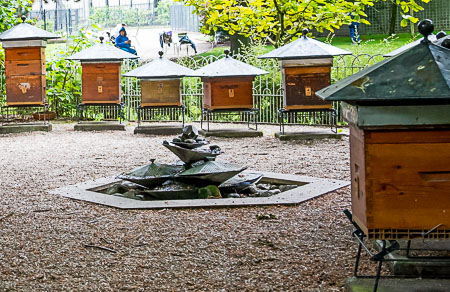
Bee houses Jardin du Luxembourg

If you visit, you’ll see a collection of gorgeous antique wood bee boxes, however the bees have moved to more contemporary housing, populating hives with copper roofs surrounding the gazebo. The bees even have their own personal (artistically designed) fountain, a necessity for their water consumption.

Beautiful bee boxes

Fountain Jardin du Luxembourg apiary

If you’re in Paris and want to check out the bees, or Jardin du Luxembourg–one of Paris’s most lovely gardens–you can, find the bees happily buzzing in their apiary near the rue de Fleuris entrance in the southwest corner of the park.

And if you want to read more about all things Pampers, follow me on Facebook, Twitter or RSS/email.

Take the road less traveled, Beth
Filed Under: Garden, Travel Tagged With: bees

Spring in my garden – a feast of color

May 15, 2015 by Beth Shepherd

Spring in my garden–a feast of color–and my favorite time of year. Every day I see something new that wasn’t there the day before, and a world that was filled with grays and browns is now flush with every hue in the rainbow. With my hands in the soil, surrounded by my beloved plants, I couldn’t be any happier.

The love of gardening is a seed that once sown never dies.

~ Gertrude Jekyll

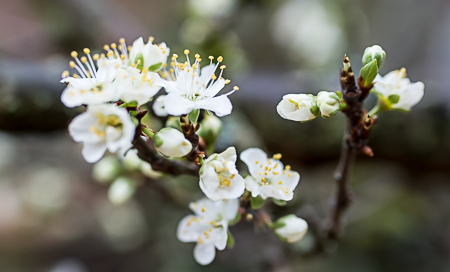
Plum blossomsPlum blossoms

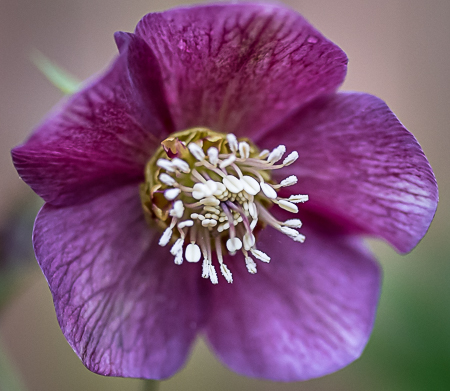
HelleboreHellebore

EuphorbiaEuphorbia

pierisPieris

HostaHosta

Bleeding heartBleeding Heart

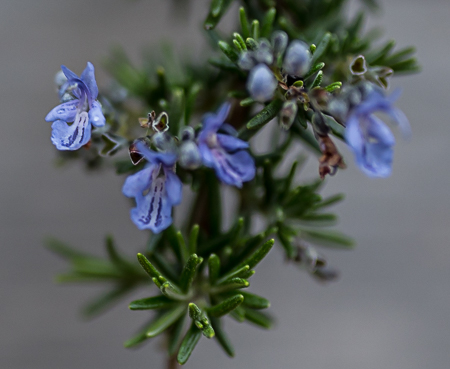
RosemaryRosemary

And if you want to read more about all things Pampers, follow me on Facebook, Twitter or RSS/email.

Take the road less traveled, Beth

Filed Under: Garden Tagged With: flowers, Garden

Earth Day 2015: Random acts of greenness

April 22, 2015 by Beth Shepherd

Earth Day 2015

Earth Day

Mother Earth faces a many challenges like climate change and species extinction. This is why, 45 years ago, Earth Day was created, to help activate the environmental movement worldwide, through a combination of education, public policy, and consumer campaigns.

There are so many ways to get involved and participate in random acts of greenness! When I looked through the list of ‘campaigns‘ mentioned on the Earth Day Network website, I realized our family does a number of the actions listed. You don’t have to wait for Earth Day–you can commit to protecting our beautiful Mother Earth all 365 days of the year! Here are a five ways you can go green every day:

  1. Reduce Energy Consumption
  2. Start Composting
  3. Stop Using Disposable Plastic
  4. Buy local produce
  5. End Junk Mail

This year, I decided to participate in one of the campaigns on Earth Day’s website: Create Art to Raise Awareness. Art Works For Change, along with Earth Day Network and Global Footprint Network, invite artists to submit a digital image of original artwork (all visual mediums are welcome) for an opportunity to be featured in their online exhibition, which will open on Earth Overshoot Day 2015  in August.

I submitted three photos and logged my ‘Act of Green,’ because–for me–there’s rarely a day that passes without me noticing something about the beauty of our world. It might be the colorful feathers on a bird, the uniquely shaped petals of a flower, or the majestic skyline views in the spectacular city where I live. When I’ve traveled, I always marvel at the mind-blowing beauty of our natural world: mountains, oceans, creatures in the water, in the air and on the land. Many of the shots that captured my eye recall natural beauty that I was lucky enough to encounter.

Yet sometimes, I am also saddened by the reality that–unless we do something NOW to protect our planet–some of the sights I’ve seen will disappear or be forever changed for future generations.

Mt Everest from Tibet

Mt. Everest, the tallest and most iconic mountain on earth, covered with immense glaciers. Unfortunately, like most mountains, Everest is melting. Glaciers in the Mt. Everest region have shrunk by 13 percent in the last 50 years and the snowline has shifted upward by 590 feet (180 meters),

And, this beautiful mountain is also littered with tons of trash: tents, sleeping bags, oxygen cylinders and even the corpses of climbers who never made it down remain. I was heartened to read, in a new move to fix their garbage problem, Nepalese tourism authorities said climbers must bring down 18 pounds of trash when they return.

Baja California whale

Whales. One of the most majestic creatures on the planet. Seven out of thirteen great whale species are vulnerable or endangered. Of course, whales are only one of many–too many–animals who might not be around for future generations.

endangered tropical plants

As a gardener I love plants, flowers and trees. They provide food, shelter, oxygen and beauty. Animals–including us humans–need them to survive. Sadly, like the creatures on our planet, much of our plant life is also in danger of disappearing. Over 20% of plants on earth face extinction.

I know photographs aren’t going to save the world. But awareness–and action–might. Earth Day! Commit a random act of greenness.

And if you want to read more about all things Pampers, follow me on Facebook, Twitter or RSS/email.

Take the road less traveled, Beth


Filed Under: Garden Tagged With: Baja California, Earth Day, Mt. Everest

Harbingers of Spring

February 27, 2015 by Beth Shepherd

Just when I feel I can’t take another day of dreary gray, I see them. Little sprigs of brilliant green poking out from the wet earth. Crocus! Spring is on its way. Although March 20, the official first day of spring, lies several weeks away, the signs that winter is moving on are everywhere (at least in Seattle!). A mere week later, my crocus are adorned with purple and white flower heads.

crocus in spring

purple white crocus

Hellebore too, tight purple and pink  buds cover the plants, waiting for just the right moment to open. Known as the Lenten rose, Helleborus Orientalis, begin blooming in February, and are true harbingers of spring. I love the intense color they bring to dark corners in the garden  where, weeks earlier, there was none.

Hellebore before budding

Purple hellebore

pink hellebore

My Virburnum Mariesii is filled with tiny flower buds. Soon they will flower, prolific and white, and my lovely shrub will look as though it were covered in snow. Nearby, delicate Epimedum–fairy wings–float in the air on stems so tiny you truly think they are flying.

Doulbe-file viburnum

Epimideum flower

I love this time of year when my garden is filled with magic. I am always in awe: How is it that each leaf, each bud, each flower knows exactly what it is meant to do? For me therein lies the wonder and the beauty of nature.

Each leaf,
each blade of grass
vies for attention.
Even weeds
carry tiny blossoms
to astonish us.

– Marianne Poloskey, Sunday in Spring

Me and house in reflecting ball

Take the road less traveled, Beth
Want to be in-the-know on all things Pampers? Follow me on Facebook, Twitter or RSS/email.

Filed Under: Garden Tagged With: spring

Five jaw-droppingly gorgeous gardens

February 25, 2015 by Beth Shepherd

Many of my readers know gardening is a passion of mine, so I’m sure it comes as no surprise that I love to explore gardens and parks when I travel. My ‘Garden Bucket List’ is is much longer than what I’ll be able to see in my lifetime, but as spring breathes new life into the flora of our world, I’d like to share five of the gorgeous gardens I’ve had the pleasure to visit.

Kauai’s Limahuli Garden and Preserve was breathtaking. It’s located at the end of the road (literally) on the north shore of Hawaii. As I toured the amazingly diverse gardens, I felt like I got a glimpse of what the Hawaiian islands looked like a long time ago. Dense greenery on the lower levels of the park are coupled with spectacular views of the ocean from the top of the hill. Limahuli is also filled with information about native Hawaiian plants and, sadly, invasive plants that are taking over tropical paradise. In the shadow of the Napali coast mountains, Limahuli is well worth a visit if you are on Kauai.

Limahuli Garden on Kauai

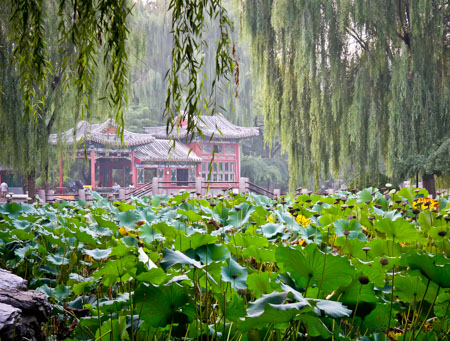
Ritan Park, my favorite park in Beijing was stunning, but in a different way than most of the other parks I saw there, like the Temple of Heaven or Beihai, which were so expansive it was hard to comprehend their size and grandeur. Ritan, with its stone boat cafe, masses of lily pads and weeping willow trees was intimate and accessible, the perfect spot to sit and meditate. Plus, it’s only a stone’s throw away from the Silk Market, if you’re in Beijing and need a break from the craziness. Such a contrast!

Ri Tan Park Beijing

Monet’s Giverny was one of the gardens on my bucket list. While the crowds were a bit overwhelming, I feel so fortunate I was finally able to visit when we were in France a few years ago. Throngs aside, the gardens are spectacularly beautiful. Monet’s house, too, was a festival of color. I loved the bright green window shutters adorning the outside of his home. And if his kitchen, bright-as-the-sun yellow–and I mean all yellow, every last thing–doesn’t perk you up, nothing will.

Monet Giverny France

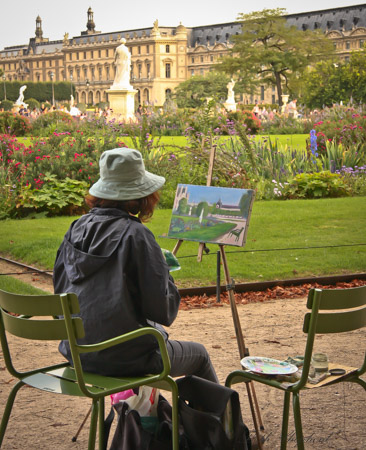
Of course, one cannot visit Paris without wandering through the Jardin des Tuileries. The gardens have a certain je ne sais quois that makes them feel oh-so-French. Whether you’re meandering along the grand promenade passing by flower gardens and manicured shrubbery, sitting at one of the cafes in the park sipping wine and nibbling French cheese, or watching the sunset cast orange hues on the fountains, the Tuileries are not to be missed.

Painting in the Tuileries Paris France

A trip to London would be remiss without a stroll through Kensington Gardens. Magnificent trees, arbors, flower beds…and a royal palace! So elegant and serene. I’ve seen pictures of the park fully decked out in its green-leafed glory, but even when the trees were bare in late March, Kensington was still lovely and peaceful, more so I thought than its famous next door neighbor, Hyde Park.

Arbor at Kensington Gardens London, England

Take the road less traveled, Beth

Want to be in-the-know on all things Pampers? Follow me on Facebook, Twitter or RSS/email.

Filed Under: Garden Tagged With: Garden

The scent of spring

January 20, 2015 by Beth Shepherd

What was that heady scent, I wondered, as I stepped out onto our back deck? And then I remembered: the Sarcococca confusa (also known as Sweetbox) I replanted at the base of our stairs. A gardener friend had encouraged me to plant it in a spot we’d walk by on a regular basis. She promised that just when I’d had enough of winter, I’d find my Sarcococca in bloom, and its intoxicating fragrance would whisper, “Spring is in the air.”

Sarcococca, the fist sign of spring

Most of the year, the Sarcococoa is not a noteworthy plant, except that it thrives in locations where other plants wither, namely shade. It is frequently overlooked which is many a garden’s loss, because how many plants are shade-loving, winter blooming and fragrant? I’m so glad I moved it. For the next few months, whenever I’m feeling those Seattle rainy day blues, all I have to do is open my back door and inhale! Spring is on its way.

Sarcococca confusa

Sweetly breathing , vernal air,
That with kind warmth doth repair
Winter’s ruins; from whose breast
All the gums and spice of the East
Borrow their perfumes; whose eye
Gilds the morn, and clears the sky.
~
  Thomas Carew,  1595 – 1645

 Take the road less traveled, Beth

Filed Under: Garden Tagged With: spring

Potato Fest 2014

October 24, 2014 by Beth Shepherd

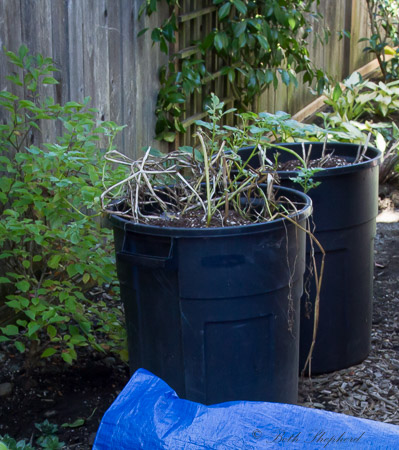
There’s nothing like a potato fresh from the garden, or garbage bin! Yes, that’s right, we grow our spuds inside a plastic garbage can. if you want to learn how to do this yourself, you can read a post I wrote a few years ago, here.

Potato crop

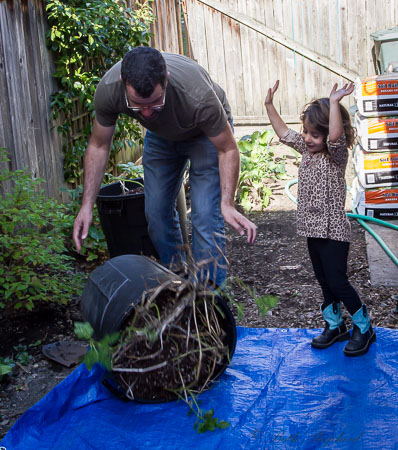
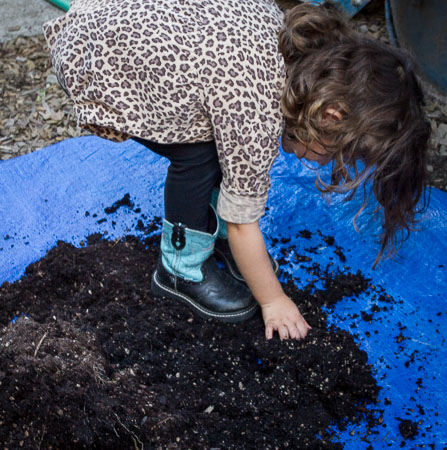
This year’s crop was not one of our finest, but that didn’t stop Little Bird from enjoying the annual fall “dumping.”  After a season of grown, the plants have died back which means it’s time to dump them out and scour the soil for potatoes (Note:You can reuse the soil in flower beds, just not in garden beds where other edibles are growing).

Two buckets of potatoes

Whoop. Whoop. There they go! This part always feels magical to me, because–unlike vegetables that grow above ground–you can’t see tubers growing, so you don’t know what kind of crop you’ve got until the can goes over.

Dumping the potatoes

We always dump our garbage bin onto a tarp. This way, it’s easy to sift through the soil, pick out the potatoes and then pour the soil back in the garbage bins for later use elsewhere in the garden.

Searching for potatoes

Found one! The potato treasure hunt is on.

Potatoes discovered

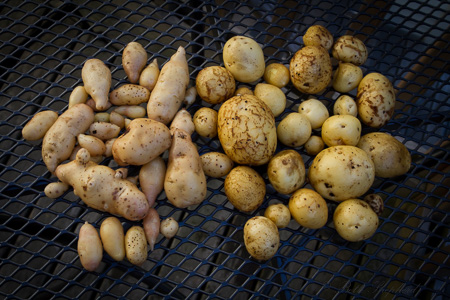
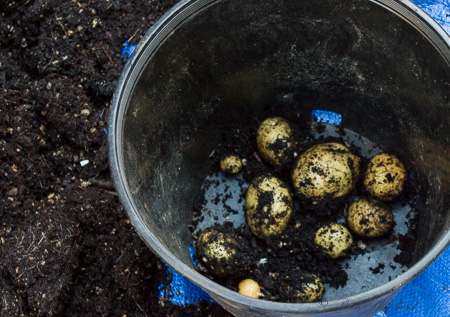
Into the bucket they go, one by one. I’ll brush them off and store them in a cool, dry place to harden them off a bit (assuming I have enough to do that, otherwise we just wash and eat them).

Potatoes in the bucket

Potatoes

And there goes potato harvest 2014. Until next spring…

Take the road less traveled, Beth

Filed Under: Garden Tagged With: potatoes

A is for apple

October 3, 2014 by Beth Shepherd

A is for apple, from our espaliered apple trees.

A is for apple

A is for apples on our espaliered trees

A is for apples

A is for apples in our kitchen window

Take the road less traveled, Beth

Filed Under: Garden Tagged With: apples

Espaliered apples!

September 24, 2014 by Beth Shepherd

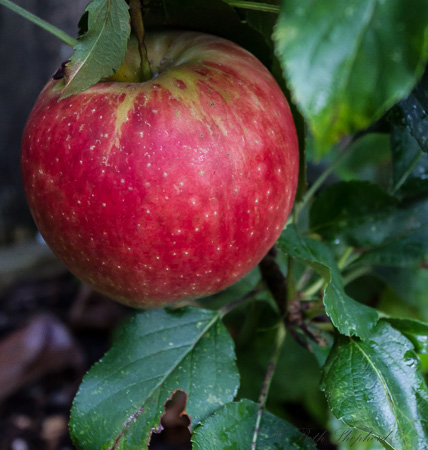
Apple on tree

One thing I really love about travel is visiting gardens. Traveling overseas, to Europe in particular, we saw spectacular gardens: formal gardens, enormous parks, kitchen gardens. Many of the gardens were very small and walled, just like our yard.  I felt inspired by these tiny jewels, and always came home with new ideas. One take-away for me was if you can’t grow out, grow up, and so I’ve tried to find a variety of plants that would cover the cedar walls that enclose our yard.

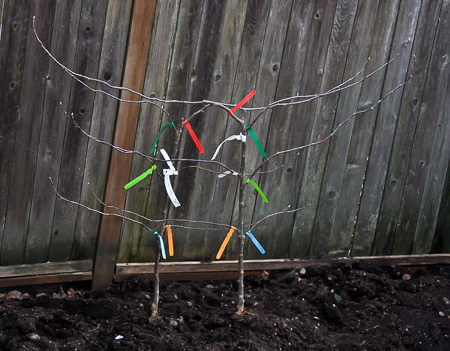
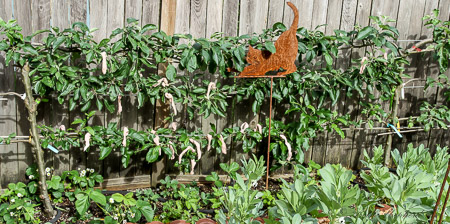
In 2010, we planted two espaliered apple trees. Espalier is a French word meaning “something to rest a shoulder on.” During the 17th Century, espalier initially referred only to the actual trellis or frame on which such a plant was trained to grow, but over time it has come to be used to describe both the practice and the plants themselves. Espalier technique started in Roman times. During the Middle Ages, Europeans refined the art of espalier. This practice was very popular in Europe for producing fruit inside the walls of a castle courtyard without interfering with open space. Wall were decorated by planting flattened trees near them. Vineyards have used the technique to train grapes for centuries.

Espalier apple treesBay trees in 2010

Over the past four years, since our trees were planted, they’ve grown. We’ve managed to get one or two apples, until this year. This is the our fourth season and boy do we have apples! Lots of delicious apples. Our trees have different apple varietals grafted to each horizontal branch (plants can be espaliered in all sorts of designs): Gravenstein, Macintosh, Braeburn, Fuji, Gala and Jonagold.


Apple trees 2011Espaliered apple trees 2011

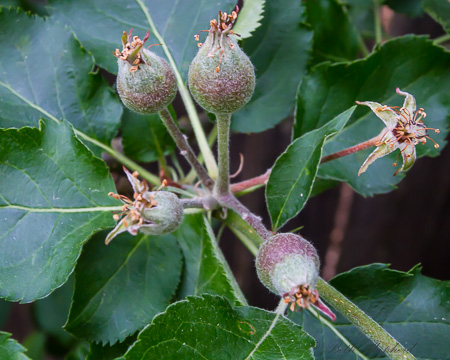
One thing I did differently this year was to cover the baby apples with a “sock,” just like the kind of “footies” some women wore inside their shoes. In previous years I thinned clusters (as I did this year), but this is the first time I tried the socks, which are supposed to help reduce damage by coddling moths, apple maggots and the like.

Apple cluster May 14Apple cluster

The clusters need to be thinned not long after the flowers drop and tiny apples emerge. It’s hard to do, because you have to winnow a cluster down to one fruit, and also make enough space between each fruit horizontally. But thinning the clusters helps the “chosen one” grow big and strong. As you thin each cluster, you look for any flaws in the fruit, such as spots, bug damage or poor formation. These are the first apples you should remove. Then, you try to pick the biggest (in relative terms), healthiest fruit…and put a sock on it.

One apple from the clusterSingle apple

Putting the socks on is labor intensive, and you have to be gentle with the fruit which requires patience. So don’t do it, like I did, when a rain shower is brewing (or in action). Each growing apple should also be about 4-5 inches from the next growing apple. This was supremely hard for me and I probably didn’t do the best job. Each time I thinned a cluster or took off a cluster that was too close to its neighbor, I worried that if the remaining apples didn’t make it, I’d be left empty-handed.

Apple sockApple sock

Putting the sock on the apple meant carefully tucking the budding apple into the open end of the sock, and then wrapping the base and tucking one end underneath. I got better as I went along, but I did lose a few “babies” along the way.

Tying on apple sockTying the apple sock

After all the clusters were thinned and the apples had their socks on, I was ready for some hard cider and a hand massage! I also felt proud and hopeful, though did worry that I should have put their socks on a couple weeks earlier because a number of the baby apples looked like someone/something had already discovered their petite deliciousness.

Apple with sock onApple with a sock on

Here are our apple trees thinned and socked. Aesthetically, it wasn’t as nice to look at (yes, it does look like our apple trees are covered with condoms…sorry mom) as in previous years when I went sock-free, but I really, really wanted to increase our odds of getting big, juicy edible  apples rather than apples that only serve as a pretty dwelling for the bugs.

Espalier apples with apple socksApple trees with socks

As spring turned to summer, our apples grew. And grew and grew and grew, until they were practically busting out of their socks. I could see that many of them had their imperfections–a blemish here, a small hole there where who-knows-what may have tried to take up residence–but hey, we had a sizable crop of our very own homegrown apples.

Apple in its sock ready to pickRipe apple peeking out of its apple sock

Of course, as the saying goes, the proof is in the pudding–or, in this case, the apple. In my lifetime I’ve seen plenty of fine looking apples that had very little flavor or a mealy texture. The verdict: We have several varieties of apples–grown in our own backyard-that taste phenomenal. Even Little Bird, who can be the pickiest of picky eaters, loves them. Let the eating commence!

Macintosh apple ready to eat

Take the road less traveled, Beth

Filed Under: Garden Tagged With: espaliered apples

  • « Previous Page
  • 1
  • 2
  • 3
  • 4
  • …
  • 9
  • Next Page »

Some might fend off a mid-life crisis by leaving the comforts of their corporate salary to jet off to a deserted island. Others might buy a Jaguar. I’ve chosen to dive head-long into my 50s and beyond by becoming a first-time parent. At any given moment you might find me holding a camera, a spade, a spatula or a suitcase. Or my little girl's hand. Adopted from Armenia, she puts the Pampers and Paklava into my life.

Subscribe to Blog via Email

Enter your email address to subscribe to this blog and receive notifications of new posts by email.

Recent Posts

  • Ghosts and goblins of Halloweens past
  • Raise a glass—or ten
  • No me without her: A life before motherhood
  • Leaving the orphanage with a priceless pair of tights
  • Rock of ages: Celebrating five years together as a family

Tags

366 Project Adoption anniversary Armenia autumn Bainbridge Island Baja Birds birthday blog cat cats chickadee China Christmas fall ferry flowers France Garden Gyumri Halloween Hawaii Holiday ice cream Kauai leaves London Mamas with Cameras Mexico Mother's Day Mt. Rainier New York orphanage Paris Puget Sound robin Seattle taxi Thanksgiving Tibet USCIS Valentine's Day wedding Yerevan

Categories

  • Adoption
  • Armenia
  • Family
  • Food
  • Friendship
  • Garden
  • Holiday
  • Miscellaneous
  • Paris
  • Photography
  • Recipes
  • Review
  • Seattle
  • Things to do with kids
  • Travel

Sites I like

  • The Wayfaring Voyager
  • Wanderlit
  • Wanderlust and Lipstick
follow us in feedly

Image Copyright

Unless specifically mentioned, all images on my blog are my own original photographs and, therefore, copyright protected (©Beth Shepherd). Feel free to use my images for non-commercial use so long as you provide me with the image credit. Likewise, if you pin my images to Pinterest, please mention me by name.

Copyright © 2026 · Pamperspaklava · WordPress Barista