Pampers and Paklava

  • Home
  • Photography
  • Travel
  • Food
  • Garden
  • Contact

Taking the ‘can’ out of Cannellini beans

September 11, 2013 by Beth Shepherd

Cannellini beans with olive oil, garlic and sage

Last Friday, while trawling my neighborhood farmers market for farm-fresh goodies, I spotted them: shriveled, damp looking bean pods, cream with rosy highlights. Cannellini shelling beans! Not a very attractive looking bean on the outside. But inside–heaven.

Cannellini beans themselves are white kidney-shaped beans, with a pale green to pale yellow pod that may be moist. Delicate bean flavor, not too dense. The shriveled pod indicates that the inside of these shelling beans are swollen and plump, full of rich bean flavor, and the dampness indicates the bean is still tender and ready to eat.

A shelling bean is any bean that is grown primarily for the edible seed inside. The pod is not eaten, because it is tough and stringy, unlike snap beans, which are eaten for the pod, with the bean inside barely developed. Most of the shelling bean crops are harvested when the pods and beans inside are dry, just before the pod shatters. After harvest, they are stored and sold throughout the year as dry beans. However, in late summer, some of these beans make it to the market in their fresh state – that is, when the edible seed is still moist, and can easily be bitten through. At this point the beans take only minutes to cook, not the hour or more needed for dried beans.

Fresh Cannellini beans

I think fresh shelling beans are one of the highlights of summer’s bounty, and I seek them out. Sometimes I grow them myself (favas!).  It is so simple to make them taste good–all the work is in getting them out of their shell. The shelling process, however, is an ideal time to keep your family and friends in the kitchen, sipping a glass of wine, and all shelling together. It goes quickly that way. Plus it’s a lot more fun.

Of course, you can always use Cannellini beans from a can. And I have. But–if you can find them fresh, why would you want to?

 Shelled Cannellini beans

How to cook ’em?

You will need to judge the time needed to cook the beans based on how mature they are. To do this, bite one of the shelled beans. If the bean is quite tender, if will need only about 5 minutes of cooking in boiling, salted water. If the bean offers resistance, you may need up to 20-25 minutes of cooking (which is how long I cooked mine). A pound of beans in the pod equals approximately 1 cup of shelled beans.

Where to get ’em?

I got mine from Rand at One Leaf Farm, my favorite farmers market veggie seller. Check out your neighborhood farmers market!

Simple Recipe for Cannellini Beans with Olive Oil, Garlic and Sage

Ingredients

  • Cannellini beans, shelled
  • Boiling, salted water
  • High quality extra-virgin olive oil
  • Course salt (Kosher or sea salt)
  • Chopped fresh sage (or herb of your choice), a few tablespoons
  • One or two (depending on how many beans you’re using) cloves of garlic, minced.

How to

  1. Shell your beans.
  2. Bring a pot of salted water to a rolling boil.
  3. Add shelled beans.
  4. Reduce heat to medium and cook for 5-25 minutes (I sampled a bean at 10 minutes and then cooked another 15).
  5. Drain beans through a strainer.
  6. Put the cooked beans in a bowl.
  7. Top with minced garlic, chopped sage (or other herb), and a healthy drizzle (1/4-1/3 cup, again, depending on how many beans you use).
  8. Give it a few stirs to blend it all together.

Seriously, that’s it! So simple. So delicious.

Optional add-ins might include:

  • a few tablespoons of freshly squeezed lemon juice
  • a generous sprinkle of shaved or grated Parmesan cheese
  • a handful of chopped Coppa, prosciutto or similar uncured meat

Cannellini beans with roasted corn tomato salad

We enjoyed our beans with a garden salad of tomatoes, roasted corn and basil…and a lovely bottle of crisp Sauvignon Blanc! And now I can’t wait to make more. Next year, Cannellini beans are definitely on my short list of veggies to grow in our garden.


Take the road less traveled, Beth

For more simple goodness, take a look at Wanderfood Wednesday!

Filed Under: Food Tagged With: canellini beans, Farmers Market, One Leaf Farm

Armenian feast in Amish country?

August 20, 2013 by Beth Shepherd

Armenian kebab

We recently spent a weekend in lovely Lancaster, Pennsylvania, attending a reunion for families with children adopted from Armenia. Who would think we would find an Armenia feast in the middle of the Amish countryside? But find a feast we did!

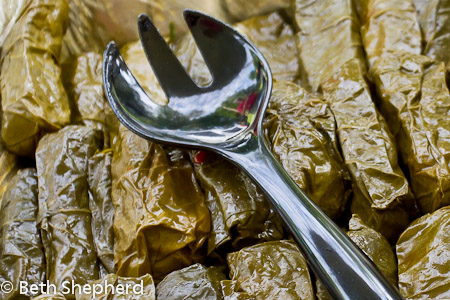
Armenian dolma

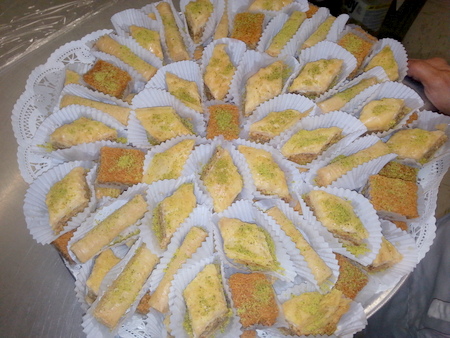
Armenian Delight from Broomall, Pennsylvania cooked up delicious dolma, kebab, tabouli, kufta and, of course, pakhlava. I ate every bite off my plate, got seconds, and reminisced about all the amazing food we enjoyed in Armenia.

Armenian tabouli

Pakhlava

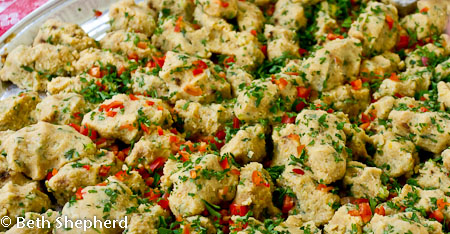
I’ve cooked a number of Armenian dishes, but have yet to try making kufteh at home. Not for long! Here’s a recipe for Vospov (Merjimek) Kufteh with thanks to Bev, Aunt Rose and the Armenian Memorial Church in Watertown, Massachusetts.

Armenian kufteh

Vospov (Merjimek) Kufteh

Ingredients

  • 1 cup split red lentils
  • 3 cups water
  • 1 tsp salt
  • 1tsp red pepper
  • 1 cup medium bulgur
  • 1/2 cup butter or margarine, melted
  • 1 medium onion chopped
  • 2 scallions, chopped
  • 1/2 sweet green pepper, chopped
  • 2 cups parsley, chopped
How to:
  1. Boil lentils 30 minutes in the water (will look pasty).
  2. Add salt ad red pepper and additional water, if needed and boil 2 minutes longer.
  3. Put bulgur in a large basin and pour lentils over it.  Mix, cover, and let cool one hour.
  4. Brown the onion in the melted butter or margarine add add to the bulgur/lentil mixture.
  5. When cool enough to handle, knead 5 minutes until well-blended.
  6. Mix in the chopped vegetables and add more salt and red pepper to taste.
  7. Shape into individual servings by squeezing a portion against the palm of your hand gently with your fingers.
  8. Serve while still warm.
Want more mouth-watering ideas? Check out Wanderfood Wednesday!

Filed Under: Food, Friendship Tagged With: Amish, Armenian, Armenian Delight, Bakhlava, Broomall, Dolma, kabab, kufteh, Lancaster, Pakhlava, recipe, reunion, tabouli

Soergel Orchards and Country Store in Wexford, PA

August 13, 2013 by Beth Shepherd

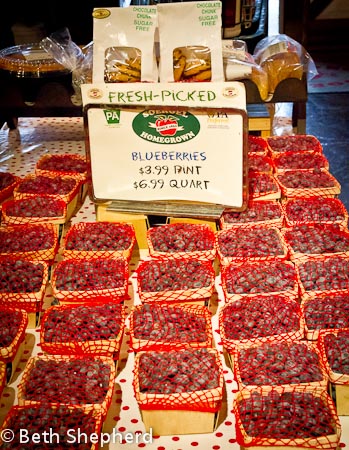
Blueberries at Soergel's Orchards

When Big Papa was a little boy, he would go with his family to Soergel’s roadside stand for fresh-picked fruits and vegetables. On several of our trips to visit his family in the Pittsburgh area, we’ve stopped at Soergel’s, even though its days of being a small roadside stand have long passed.

Soergel’s is over 150-years-old. In the mid-1850’s, John Conrad Soergel, a German immigrant settled on the spot where Soergel Orchards is now. He began planting apple trees and, for several decades, the apples were sold wholesale in town. John Soergel’s descendents continue to operate Soergel Orchards. When the business outgrew its original farm stand, a larger stand was built.  Eventually, in the early 1970s, the Soergel family felt it was time to expand their business further and built the market that exists today.

A bevy of surprises await little ones:

  • Goats, sheep, bunnies, chickens and one VERY large pig are in the out-buildings with feed available to purchase (25-cents a handful)
  • Pirate ship playground
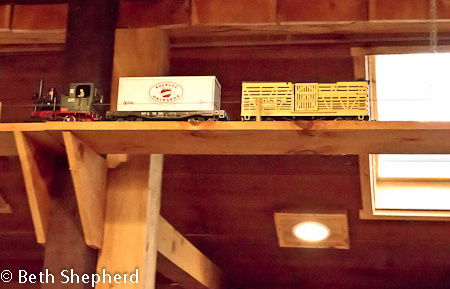
  • A cute electric train that circles the perimeter of the ceiling in the country store
  • Toy shop
  • Butterfly house ($2)
  • Firetruck rides

Feeding sheep at Soergel's Orchards

Making faces at the goats at Soergel's Orchards

Inside the country store you can find:

  • Ice cream parlor
  • Sandwich shop
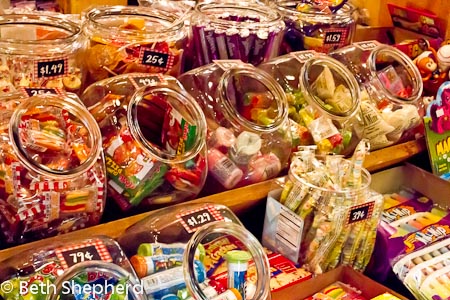
  • Dime store candy
  • Wine shop
  • Bakery
  • Deli
  • Oodles of fresh fruit and vegetables


 Inside the shop at Soergel's Orchards

Candy at Soergel's Orchards

Baby Bird loved feeding the goats, staring at the enormous pig, and, when we went inside to grab a sandwich for lunch, she couldn’t take her eyes off the miniature train that chugged in circles around the ceiling. If you find yourself north of Pittsburgh, Soergel’s is definitely a great place to take kids, and it’s a lot of fun for grown-ups too.

Tiny train inside shop at Soergel Orchard store

Take the road less traveled,

Beth

Filed Under: Family, Food, Garden, Travel Tagged With: candy, Ducks, fresh fruit and vegetables, goats, ice cream, PA, pig, Pittsburgh, sandwich shop, sheep, Soergel, Soergel's Orchards, Wexford, wine

Oui! You can make a French omelette

May 29, 2013 by Beth Shepherd

You can’t make an omelette without breaking an egg

~Dutch proverb

First omelet, French Country style

See the lovely omelette in the photo above? This omelette is Big Papa’s first, cooked on September 13, 2009, in Yerevan, Armenia.  He received a bit of coaching (moi) to help make his first attempt a success and, since that day, Big Papa has made his share of tasty omelettes.  Many people are intimidated by omelettes, but if you can make scrambled eggs, you can make an omelette.

I love omelettes. Always have. I will eat an omelette at any time of the day. On our trips to Paris, omelettes were on the top of my “must try” food list.

I’ve heard foodies claim that a good omelette is the mark of a great chef, but even amongst great chefs, there is some debate about what constitutes a good omelette (and even whether it should be spelled ‘omelet’ or ‘omelette’).  Should the omelette be allowed to brown (as in the French Country Omelette) or remain pure and yellow (French Classic Omelette)? Large curds or small? Add milk to the eggs or not? Just eggs, a bit of cheese or herbs—or—heartily stuffed with any number of fillings?

Answering these questions decides the fate of your omelette: French Country or French Classic.  Neither style is better or more authentic—it’s a matter of personal preference. A French Country Omelette is made of large curds; milk is added to the eggs; it’s not sinful to brown the omelet (or the butter); the omelette is folded into a half-moon; and, any number of fillings can be added. A country-style omelette is a rustic, manly omelette.

A French Classic Omelette, on the other hand, is daintily rolled and creamy textured. Milk is not added to the egg; the curds are small; the omelette mush NOT brown; the omelette is rolled; and, only a minimum of fillings (a sprinkling of herbs or a small amount of cheese) are added.

Want to try your hand at omelette making, French-style? Well then, let’s get started!

First of all, omelettes should always be cooked in a nonstick sauté pan. An omelette pan is the best choice, because of the rounded corners and shallow sloping edge curved, but any nonstick pan will do as long as it’s round and between six and ten inches in diameter. Also, you should always use a heat-resistant rubber spatula and, for making the French Classic Omelette, and a fork (metal, or plastic if you don’t want to scratch your nonstick pan).

French Country Omelette

Ingredients:

  • 3 large eggs
  • 2 tablespoons whole milk or cream
  • 2 tablespoons unsalted butter
  • Salt (preferably Kosher or sea salt) and ground pepper, to taste
  • Filling of your choice, optional (see below)

How to:

  1. Crack the eggs into a glass mixing bowl and beat them until they turn a pale yellow color.
  2. Heat a heavy-bottomed nonstick sauté pan over medium-low heat. Add the butter and let it melt and foam (it is okay, for this country-style omelet, if the butter browns).
  3. Add the milk to the eggs and season to taste with salt and white pepper. Then, grab your whisk and work up a sweat. Your objective is to beat as much air as possible into the eggs.
  4. When the butter in the pan is bubbling and hot enough to make a drop of water hiss pour in the eggs. Don’t stir! Let the eggs cook for up to a minute or until the bottom starts to set.
  5. With a heat-resistant rubber spatula, gently push one edge of the egg into the center of the pan, while tilting the pan to allow the still liquid egg to flow in underneath. Repeat with the other edges, until there’s no liquid left.
  6. Your eggs should now resemble a bright yellow pancake, which should easily slide around on the nonstick surface. If it sticks at all, loosen it with your spatula.
  7. If you’re adding any other ingredients, now’s the time to do it. Spoon your filling across the center of the egg in straight line.
  8. With your spatula, lift one edge of the egg and fold it across and over, so that the edges line up, and the omelette has a half-moon shape. Cook for another minute or so, but don’t overcook (in fact eggs will continue to cook a bit when you turn your burner off).
  9. Gently transfer the finished omelette to a plate. Garnish with chopped fresh herbs if desired.

Note: A slightly browned omelet is not frowned upon when making a French County Omelette. This is not the case with a Classic French Omelette.

Filling suggestions

There’s no limit to the number of fillings you can use with this basic omelette recipe. Some suggestions include:

  • Grated cheese
  • Sautéed mushrooms
  • Diced and sautéed onion
  • Chopped cooked bacon
  • Diced ham
  • Lox or smoked salmon

And now, on to the French Classic Omelette…

Pepin Classic French Omelet

French Classic Omelette

Ingredients:

  • 3 large eggs
  • 1 1/2 teaspoon unsalted butter
  • 1/2 tablespoon herbs, finely diced (the typical French omelet has four herbs: chervil, tarragon, chives and Italian parsley, and you can use any or all of these)
  • 1/4 tablespoon Italian parsley, finely diced
  • Pinch of Kosher salt or sea salt
  • 1 tablespoon Gruyére, finely shredded (optional)

How to:

  1. Beat eggs thoroughly with a fork or whisk.  Give it some moxie.
  2. Add herbs and sea salt. Beat until combined.
  3. In your omelette pan, over medium heat, melt unsalted butter, swirling the butter in the pan and wait until it foams (but doesn’t brown), and pour in the egg mixture.
  4. With your fork held flat (use plastic if you are concerned about scratching your nonstick pan), stir the eggs quickly (like you are scrambling them) as you shake the pan with your other hand. Do this some more. This will give you uniform, small curds. And this is how the delicateness of the classic omelette is born.
  5. When the egg mixture begins to set (but is still moist), use your fork to flatten the eggs a bit, and then angle the pan downward  and use your fork (or spatula) to fold the top (thinner) edge of the omelette inward toward the center of the omelette, enclosing the thick, moist center. If you’re adding cheese, place it in the center. Fold in the bottom part inward, and press the fold into place creating a round edge. You want a creamy center, not a raw center.
  6. Run your fork between the edge of the pan and the far edge of the omelette to loosen the omelette.  Then tap the handle gently where it joins the pan, to shake the omelette down lower in the pan and make it twist and lift onto itself. The lip of the omelette should rise above the edge of the pan. Fold this lip back toward the center of the omelette, meeting and overlapping the edge of the other lip.
  7. To plate, start by holding your serving plate, bang the underside of the pan against the counter (a chopping board is advisable) at the omelette end, so the omelette moves against the edge of the pan. Invert the omelette onto the plate. Press with the flat of the fork to shape the omelette into a point at each end.
  8. Serve right away!

And credit due to Jacques Pepin for the recipe. Voila! Classic French Omelette!

Want to ooh-la-la at more deliciousness? Check out Wanderfood Wednesday!

Filed Under: Food, Recipes Tagged With: Classic French Omelet, Classic French Omelette, eggs, French Country Omelet, French Country Omelette

Brandy and baby food

April 10, 2013 by Beth Shepherd

At the airport HeathrowOur five hour flight from Yerevan to London passed without a hitch. Baby Bird even fell asleep for a couple hours. I couldn’t believe our luck.

When we landed at Heathrow we knew a long layover awaited us. The airport was hot and sticky, and once we finished our requisite lunch of bangers and mash, we scratched our heads. Four hours left. What are a couple of tired, jet-lagged new parents to do?

“I heard there’s a play area here in the airport. Let’s see if we can find it.”

Find it we did and spent a relaxing hour watching Baby Bird delight in colorful toys the likes of which she’d probably never seen before. Watching her expressions, as she touched and discovered, was pure joy.

When we could see her energy was starting to wane, Big Papa strapped her into the Baby Bjorn and headed for the concourse. Back and forth he paced until she slumped, asleep. Sweat glistened on his neck and arms as he continued to walk, and walk for another 45 minutes to an hour. I’d catch them every lap or two, say hello and then off they went.

She woke up shortly before it was time to head for security and board our flight to Seattle. We were a few feet from the scanners when I saw the sign. No alcohol. I walked up to one of the security agents.

 “I see the sign says no alcohol. That doesn’t apply to duty free, right?”

“Yes, it does.”

I pleaded. “But it’s in a sealed duty free bag from our departure city?”

“Sorry, but as London is not your final destination, your duty free liquids will be confiscated.”

Now I was desperate. “What can we do? It’s a very expensive bottle of Armenian brandy.”

“Your only option would be to check it through.”

She was polite but stone-faced. My brandy and I would not be able to board this flight together. We either had to find a way to check it or drink a few shots before parting ways.

“We have to check it through,” I said emphatically to Big Papa. “I wonder if I could make it downstairs to the British Air desk and back through security in time for our flight.”

I could see the terrified look in his eyes.

“What if you don’t make it back?”

While I knew our main objective was to bring our baby home safe and sound, the thought of having to toss that bottle of brandy in the trash really irked me. I was stewing about this when I turned and saw a small British Air counter just feet before the security line, and then I had a brilliant (or at least I hoped) idea: we could check one of our carry-on bags and stow the brandy inside.

“Let’s shuffle a few things around, and put the brandy in one of our two carry-on bags,” I said eagerly.

Big Papa looked at me like I was nuts.

“Come on, we don’t need everything we’ve brought with us on this flight,” I asserted as I knelt down on the carpet, unzipped our two carry-on bags and started tossing diapers, second sets of clothes, magazines and sundry items this way and that. In a few minutes I’d managed to repack our bags with the “essentials” in one and the non-essentials in another—and the brandy tucked safely in the middle.

I walked up the ticket counter.

“Would it be possible to check this bag? We really don’t need it on our next flight.”

“Yes, absolutely,” she replied with her lovely British accent.

And there went the bag and our brandy. See you in Seattle.

Crazy as it might sound, I felt relieved. I smiled, feeling clever that we’d pulled it off and happy at the thought our future adoption milestones could be accompanied by a proper toast, with Armenian brandy.

And then came the moment, which I’d heard would come, when I had to taste the baby food we had with us in carry-on. “Squeezable” foods like baby food, feel into the LAGS (Liquids, Aerosols and Gels): If you can pump it, pour it, spread, smear, spray, spill or squeeze it, it is considered a LAG. But they were willing to bend the rules, if you taste a small amount right then and there.

So that’s exactly what I did. I opened three jars, put my finger in the jar and stuck it in my mouth. Down the hatch went a sampling of the baby food.  It wasn’t as horrible as I’d imagined (read: I didn’t gag), but I wouldn’t order any of them again if I saw them on the menu.

With the security check behind us, we headed to the gate. Only one ten-hour flight stood between us and home. All I could think about was how good it would feel to be in our own house and snug in our own bed, and how much I’d probably want a shot of that brandy.

Ararat Brandy

Want to toast to more great food and drink? Check out Wanderfood Wednesday!

Filed Under: Adoption, Food, Travel Tagged With: airport, Armenian Brandy, baby food, Heathrow, LAGS, London, security

Dreams of Ishkan fish

February 6, 2013 by Beth Shepherd

Cherkezi Dzour Gyumri Armenia restaurant troutWho would have guessed that in a small landlocked, mountainous country in the South Caucasus, you can find the most delicious fish? Not me. But you can, and that’s why I’ve been dreaming about eating fish, Ishkan fish.
Ishkan fish is a lake trout from Lake Sevan in Armenia.Lake Sevan was once the largest lake in the region, teeming with Ishkan trout, which was a species endemic to the lake. Unfortunately, during the era of Soviet control, the level of the lake was lowered, competitive species of fish were introduced (whitefish, goldfish and crayfish) and Lake Sevan trout were fished to near extinction (the “winter trout” sub-species no longer exists in the lake).

Today, farm-raised trout are released into the lake, and licenses are issued. The fee for each fish caught is U.S,  $ 25.00, but you can buy the same trout in Yerevan or Gyumri, the second largest city, for a fraction. And if you like fresh fish prepared skillfully on location, head to Gyumri and ask for directions to Cherkezi Dzor Fish Farm and Restaurant.

Cherkezi Dzour Gyumri Armenia restaurantCherkezi Dzor is located in a valley at the foot of the Red Fort. The fortress was built in the early 1800’s under the decree of Russian Tsar Nicholas I. The restaurant company owns and operates seven fish farms throughout Armenia and sells sturgeon along with fresh lake, river, and brook trout. And…Lake Sevan trout.

Although we visited Cherkezi Dzor on a cold day in March, I’ve heard the fish farm is lovely in May when the apple and pear trees bloom. For us, the restaurant was a warm and quiet respite. We ordered our fish, and while it was being prepared, wandered around the grounds, peering into pools teaming with fish, watching lavash being made in a tonir (deep, in-ground clay oven), until we headed back to the main building, and enjoyed our lunch.Gyumri Armenia tonir lavash

Big Papa and I ordered our trout wrapped in lavash, but I also wanted to try it poached the Armenian way, half steamed and half boiled. Our fish was delicious, the ambience at Cherkezi Dzor was rustic and homey, and the service was friendly and very competent. I can see why many people make the two-hour drive from Yerevan, the capital, just to enjoy skillfully prepared fresh trout or baked sturgeon, in a beautiful setting.

Cherkezi Dzour Gyumri Armenia restaurant

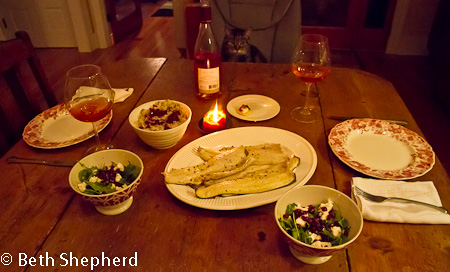
Sadly, Seattle is a long, long way from Lake Sevan. To satisfy my craving, we bought steelhead trout. Big Papa cooked it on the grill. We paired it with a salad and rice mixed with nuts, dried fruit and pomegranate seeds.

It was delicious. But it wasn’t Ishkan fish.

Steelhead trout before cooking

Grilled Steelhead Trout

Recipe makes 4 servings

Ingredients

  • Olive oil
  • 1 pound skinless steelhead trout fillets
  • 1/4 cup dry white wine
  • 2 1/2 tablespoons Dijon mustard
  • 1 tablespoon lemon juice
  • 1 teaspoon fresh thyme
  • Salt and pepper to season

Directions

  1. Lightly brush the trout with olive oil.
  2. Mix wine, Dijon mustard, lemon juice, and thyme in a bowl; spread over the fillets, letting some run underneath the fish.
  3. Season with salt and pepper.
  4. We cooked our trout outdoors on the grill for about ten minutes.
  5. You can also bake the trout in your oven. Preheat to 400 degrees. Use a baking dish, lightly coated with olive oil place the trout inside. Follow the remaining directions including cooking time (10-15 min.).
  6. Trout should flake easily.

Steelhead trout and Armenian New Year meal

Want to fish for more deliciousness? Check out Wanderfood Wednesday!

Filed Under: Food, Travel Tagged With: Gyumri, Ishkan fish, Lake Sevan, trout, Yerevan

I’d like a tall McDreamy

January 14, 2013 by Beth Shepherd

Patrick-Dempsey Dr. McDreamyHe used to be known for saving lives and now he’ll be known (at least in Seattle) for saving jobs. Yes, the rumors are true, Patrick Dempsey, aka Grey’s Anatomy Dr. McDreamy, bought Tully’s Coffee chain. Dempsey’s $9.15 million dollar offer, beat bidders such as Starbucks to take over the bankrupt coffee company (and prevailed following a week of uncertainty over the outcome). His group, Global Baristas, is hoping to breath some life into the business, build the brand, and help the Seattle economy. Dempsey says the Emerald City was very good to his career and he’d like to pay it forward.
I am already picturing Tully’s baristas decked out in green hospital scrubs, stethoscopes in hand as they check the heart rates of Seattle customers eager to get a–er–shot at having their–uh–mug in a photo alongside the new Tully’s owner.

In a coffee town where Starbucks dominates the horizon as far as the eye can see, some healthy competition might be just what the doctor ordered. As the actor said via his Twitter feed: “We met the green monster, looked her in the eye, and…SHE BLINKED! We got it! Thank you Seattle!”

Will I be lining up for a shot at fame and good coffee myself? Probably not. Hollywood glamor and excitement aside, I confess my favorite coffee shop, bar none, is home…especially when my own Mr. McDreamy, aka Big Papa, is pouring the shots.

Want a shot at more yummy food and drink? Check out Wanderfood Wednesday!

Filed Under: Food Tagged With: coffee, Dr. McDreamy, drinks, Patrick Dempsey, Starbucks, Tully's

Shepherd’s Pie, smoke alarms and holiday traditions

December 31, 2012 by Beth Shepherd

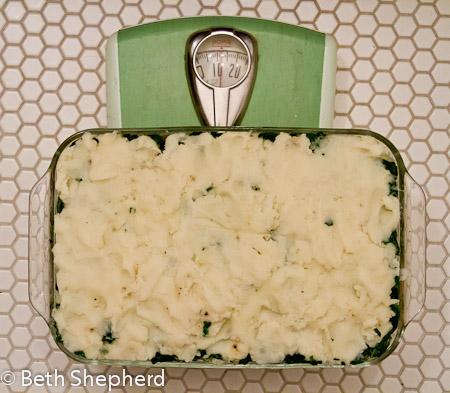
12 pound Shepherd's Pie

Center stage, weighing in at a whopping 12 pounds, is Shepherd’s Pie 2012. Our signature holiday dish is number eight in a line-up of Shepherd’s Pies we’ve made since we started dating in 2005.

Shepherd’s Pie–made the way it should be made–from scratch, with actual lamb shanks (86 the ground beef…come on people, we’re sheep herders) takes five hours to create (and several days to eat). We use every burner, and the oven, plus a small fleet of cookware.

By the time it’s all over, our kitchen is a mess, pans are stacked neck deep in the dish rack, and most of our windows have been flung wide open to stop the smoke alarm from going off (this year we set off the alarm a record five times).

“Is everything alright?” our neighbor hollered across the fence.

“YES,” we hollered back. “Just our annual tradition of making Shepherd’s Pie and testing our smoke alarm.”

And there, on the counter top, it sits, awaiting it’s final hour in the oven. One [very heavy] dish. Our dish. Shepherd’s Pie.

But despite the Herculean culinary effort required, the fuss, and the muss, I love our holiday tradition. What better way to knock-off the year than with one knockout dish?

Especially this year, because this year is a very special year. We added baby shepherd and became a flock.

So here’s goodbye to the year gone by and hello to the year ahead. And here’s to looking at you, kid.

Without tradition, art is a flock of sheep without a Shepherd.

~Winston Churchill

Filed Under: Family, Food Tagged With: 2012, Shepherd's Pie

Ho-Ho Hostess

November 27, 2012 by Beth Shepherd

Vintage Hostess Sno-balls signOh Hostess Sno-Balls, I knew thee well. Sugary chocolate cupcake infused with an angelic center of fluffy uber-sugary cream. In my youth, how I loved to peel off your puffy, pillowy outer marshmallow layer, and relish the crunchy, coconut goodness sprinkled on top.

Since the closure of all Hostess operations, you fade to a childhood memory. Sadly, now I can only buy you to the tune of $4.00 a Sno-Ball on Amazon.com  or bid for you on eBay. I weep.

With your passing, I also mourn the demise of [now] dearly departed Ho-Hos, Twinkies, Ding Dongs, Cupcakes and Donettes. But in an ode to your past, I share a bit of [historic] information on how you, dear Sno-Ball, were made:

And how lucky am I, sweet Sno-Ball, that whilst tearing off the back of our home during a remodel three years ago we found a reminder of the sweet treat I once knew, an historical artifact [circa 1940s?] tucked into the ancient [circa 1898] walls of our house. How fitting it is that you once insulated both the home I now live in…and my belly.

Wanna Ho-Ho-Ho-Ho at more deliciousness? Check out Wanderfood Wednesday!

Filed Under: Food Tagged With: Hostess, Hostess Sno-Balls, Sno-Balls

When you wish upon a star

November 21, 2012 by Beth Shepherd

Sitting by the lakeThis morning I read Baby Bird a new book, Olivia and the Fairy Princess. She loves the original Olivia and I’d heard great reports about this book too. In this book, Olivia is having an identity crisis. There are too many ruffled, sparkly princesses around. She wants to do more than just fit in. She wants to stand out. At the end of the story, as Olivia lies in bed unable to sleep, she starts imagining who she could be.

I read aloud to my daughter:

Maybe I could be a nurse and devote myself to the sick and elderly. I could use my brothers to practice bandaging and various other treatments.

Then I turned the page and continued:

Or maybe adopt orphans from all over the world.

I stopped, took a deep breath, and finished reading the book.

As the day went along I found that I couldn’t stop thinking about this one sentence.  I had a something else in mind to post today, but now I feel compelled to write about this.

There are many fairy tales with an adoptee in the storyline: Cinderella, Snow White, Pinocchio, and Bambi; the list goes on and on. And, as we all know, there is always a happy ending with the protagonist fulfilling his or her dreams, securing a warm home (if not a castle), finding true love, everlasting happiness, and being accepted as part of a healthy, loving family.

When you wish upon a star
Makes no difference who you are
Anything your heart desires
Will come to you

If your heart is in your dream
No request is too extreme
When you wish upon a star
As dreamers do

Fate is kind
She brings to those who love
The sweet fulfillment of
Their secret longing


Like a bolt out of the blue
Fate steps in and sees you through
When you wish upon a star
Your dreams come true

But the truth is that life—for many– is quite unlike the Disney fantasy. It does make a difference who you are, anything your heart desires may not come to you, and fate is frequently unkind. And there are millions of people, not just orphans, who are unable to find a place to lay their head at night, a meal to fill their belly, and family and friends to love and care for them.

Sometimes, I feel selfish that we chose to shower time, money and attention on making a difference for one, when there are so many in need.  It was truly heartbreaking to spend a great deal of time in several orphanages, and see children whose lives are never going to be filled with the opportunities our daughter will have.

For whatever challenges I’ve had or might face, my life is indeed blessed. I live in a beautiful city, inside a cute house with a lovely garden filled with color and nature. Each night I fall asleep in my own bed beside my wonderful husband. While I have lost several friends and family members who were dear to me, I have many incredible friends who sustain me and a family who loves me. I am healthy and fit and eat delicious meals on most nights. I’m able to indulge my interests in photography, gardening, cooking, and writing. I have been able to fulfill some of my dreams: to travel, to marry and to become a mom.

I am one lucky girl.

Happy Thanksgiving to my family, my friends and those of you who faithfully read my blog.

To Big Papa: There are no words to really say how deeply grateful I am to share my life with you.

To Baby Bird: May this, your first Thanksgiving, be the foundation for a life with many more.


For each new morning with its light, for rest and shelter of the night, for health and food, for love and friends, for everything Thy goodness sends.

~Ralph Waldo Emerson

Filed Under: Family, Food, Friendship, Garden, Holiday, Travel Tagged With: Olivia and the Fairy Princesses, orphans, Thanksgiving

  • « Previous Page
  • 1
  • 2
  • 3
  • 4
  • 5
  • 6
  • …
  • 13
  • Next Page »

Some might fend off a mid-life crisis by leaving the comforts of their corporate salary to jet off to a deserted island. Others might buy a Jaguar. I’ve chosen to dive head-long into my 50s and beyond by becoming a first-time parent. At any given moment you might find me holding a camera, a spade, a spatula or a suitcase. Or my little girl's hand. Adopted from Armenia, she puts the Pampers and Paklava into my life.

Subscribe to Blog via Email

Enter your email address to subscribe to this blog and receive notifications of new posts by email.

Recent Posts

  • Ghosts and goblins of Halloweens past
  • Raise a glass—or ten
  • No me without her: A life before motherhood
  • Leaving the orphanage with a priceless pair of tights
  • Rock of ages: Celebrating five years together as a family

Tags

366 Project Adoption anniversary Armenia autumn Bainbridge Island Baja Birds birthday blog cat cats chickadee China Christmas fall ferry flowers France Garden Gyumri Halloween Hawaii Holiday ice cream Kauai leaves London Mamas with Cameras Mexico Mother's Day Mt. Rainier New York orphanage Paris Puget Sound robin Seattle taxi Thanksgiving Tibet USCIS Valentine's Day wedding Yerevan

Categories

  • Adoption
  • Armenia
  • Family
  • Food
  • Friendship
  • Garden
  • Holiday
  • Miscellaneous
  • Paris
  • Photography
  • Recipes
  • Review
  • Seattle
  • Things to do with kids
  • Travel

Sites I like

  • The Wayfaring Voyager
  • Wanderlit
  • Wanderlust and Lipstick
follow us in feedly

Image Copyright

Unless specifically mentioned, all images on my blog are my own original photographs and, therefore, copyright protected (©Beth Shepherd). Feel free to use my images for non-commercial use so long as you provide me with the image credit. Likewise, if you pin my images to Pinterest, please mention me by name.

Copyright © 2026 · Pamperspaklava · WordPress Barista