Pampers and Paklava

  • Home
  • Photography
  • Travel
  • Food
  • Garden
  • Contact

Oui! You can make a French omelette

May 29, 2013 by Beth Shepherd

You can’t make an omelette without breaking an egg

~Dutch proverb

First omelet, French Country style

See the lovely omelette in the photo above? This omelette is Big Papa’s first, cooked on September 13, 2009, in Yerevan, Armenia.  He received a bit of coaching (moi) to help make his first attempt a success and, since that day, Big Papa has made his share of tasty omelettes.  Many people are intimidated by omelettes, but if you can make scrambled eggs, you can make an omelette.

I love omelettes. Always have. I will eat an omelette at any time of the day. On our trips to Paris, omelettes were on the top of my “must try” food list.

I’ve heard foodies claim that a good omelette is the mark of a great chef, but even amongst great chefs, there is some debate about what constitutes a good omelette (and even whether it should be spelled ‘omelet’ or ‘omelette’).  Should the omelette be allowed to brown (as in the French Country Omelette) or remain pure and yellow (French Classic Omelette)? Large curds or small? Add milk to the eggs or not? Just eggs, a bit of cheese or herbs—or—heartily stuffed with any number of fillings?

Answering these questions decides the fate of your omelette: French Country or French Classic.  Neither style is better or more authentic—it’s a matter of personal preference. A French Country Omelette is made of large curds; milk is added to the eggs; it’s not sinful to brown the omelet (or the butter); the omelette is folded into a half-moon; and, any number of fillings can be added. A country-style omelette is a rustic, manly omelette.

A French Classic Omelette, on the other hand, is daintily rolled and creamy textured. Milk is not added to the egg; the curds are small; the omelette mush NOT brown; the omelette is rolled; and, only a minimum of fillings (a sprinkling of herbs or a small amount of cheese) are added.

Want to try your hand at omelette making, French-style? Well then, let’s get started!

First of all, omelettes should always be cooked in a nonstick sauté pan. An omelette pan is the best choice, because of the rounded corners and shallow sloping edge curved, but any nonstick pan will do as long as it’s round and between six and ten inches in diameter. Also, you should always use a heat-resistant rubber spatula and, for making the French Classic Omelette, and a fork (metal, or plastic if you don’t want to scratch your nonstick pan).

French Country Omelette

Ingredients:

  • 3 large eggs
  • 2 tablespoons whole milk or cream
  • 2 tablespoons unsalted butter
  • Salt (preferably Kosher or sea salt) and ground pepper, to taste
  • Filling of your choice, optional (see below)

How to:

  1. Crack the eggs into a glass mixing bowl and beat them until they turn a pale yellow color.
  2. Heat a heavy-bottomed nonstick sauté pan over medium-low heat. Add the butter and let it melt and foam (it is okay, for this country-style omelet, if the butter browns).
  3. Add the milk to the eggs and season to taste with salt and white pepper. Then, grab your whisk and work up a sweat. Your objective is to beat as much air as possible into the eggs.
  4. When the butter in the pan is bubbling and hot enough to make a drop of water hiss pour in the eggs. Don’t stir! Let the eggs cook for up to a minute or until the bottom starts to set.
  5. With a heat-resistant rubber spatula, gently push one edge of the egg into the center of the pan, while tilting the pan to allow the still liquid egg to flow in underneath. Repeat with the other edges, until there’s no liquid left.
  6. Your eggs should now resemble a bright yellow pancake, which should easily slide around on the nonstick surface. If it sticks at all, loosen it with your spatula.
  7. If you’re adding any other ingredients, now’s the time to do it. Spoon your filling across the center of the egg in straight line.
  8. With your spatula, lift one edge of the egg and fold it across and over, so that the edges line up, and the omelette has a half-moon shape. Cook for another minute or so, but don’t overcook (in fact eggs will continue to cook a bit when you turn your burner off).
  9. Gently transfer the finished omelette to a plate. Garnish with chopped fresh herbs if desired.

Note: A slightly browned omelet is not frowned upon when making a French County Omelette. This is not the case with a Classic French Omelette.

Filling suggestions

There’s no limit to the number of fillings you can use with this basic omelette recipe. Some suggestions include:

  • Grated cheese
  • Sautéed mushrooms
  • Diced and sautéed onion
  • Chopped cooked bacon
  • Diced ham
  • Lox or smoked salmon

And now, on to the French Classic Omelette…

Pepin Classic French Omelet

French Classic Omelette

Ingredients:

  • 3 large eggs
  • 1 1/2 teaspoon unsalted butter
  • 1/2 tablespoon herbs, finely diced (the typical French omelet has four herbs: chervil, tarragon, chives and Italian parsley, and you can use any or all of these)
  • 1/4 tablespoon Italian parsley, finely diced
  • Pinch of Kosher salt or sea salt
  • 1 tablespoon Gruyére, finely shredded (optional)

How to:

  1. Beat eggs thoroughly with a fork or whisk.  Give it some moxie.
  2. Add herbs and sea salt. Beat until combined.
  3. In your omelette pan, over medium heat, melt unsalted butter, swirling the butter in the pan and wait until it foams (but doesn’t brown), and pour in the egg mixture.
  4. With your fork held flat (use plastic if you are concerned about scratching your nonstick pan), stir the eggs quickly (like you are scrambling them) as you shake the pan with your other hand. Do this some more. This will give you uniform, small curds. And this is how the delicateness of the classic omelette is born.
  5. When the egg mixture begins to set (but is still moist), use your fork to flatten the eggs a bit, and then angle the pan downward  and use your fork (or spatula) to fold the top (thinner) edge of the omelette inward toward the center of the omelette, enclosing the thick, moist center. If you’re adding cheese, place it in the center. Fold in the bottom part inward, and press the fold into place creating a round edge. You want a creamy center, not a raw center.
  6. Run your fork between the edge of the pan and the far edge of the omelette to loosen the omelette.  Then tap the handle gently where it joins the pan, to shake the omelette down lower in the pan and make it twist and lift onto itself. The lip of the omelette should rise above the edge of the pan. Fold this lip back toward the center of the omelette, meeting and overlapping the edge of the other lip.
  7. To plate, start by holding your serving plate, bang the underside of the pan against the counter (a chopping board is advisable) at the omelette end, so the omelette moves against the edge of the pan. Invert the omelette onto the plate. Press with the flat of the fork to shape the omelette into a point at each end.
  8. Serve right away!

And credit due to Jacques Pepin for the recipe. Voila! Classic French Omelette!

Want to ooh-la-la at more deliciousness? Check out Wanderfood Wednesday!
Filed Under: Food, Recipes Tagged With: Classic French Omelet, Classic French Omelette, eggs, French Country Omelet, French Country Omelette

Gluten-free Banana Macadamia Nut Bread Recipe

May 22, 2013 by Beth Shepherd

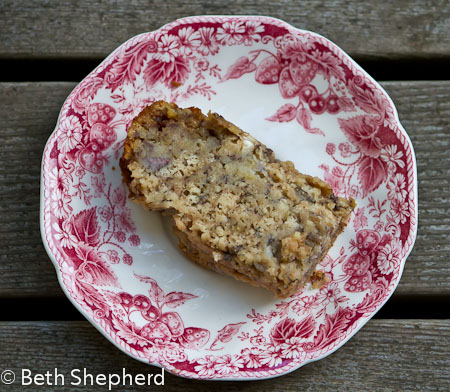
Gluten-free Banana Macadamia Nut BreadA few months ago, Big Papa ventured into gluten-free land. He did not go willingly –it took a number of years, at least seven trips to the emergency room (he has a rare allergic reaction to a combination of wheat and exertion which can result in anaphylaxis), and some clever insistence on the part of his wife (me) to convince him to at least give it a try.

After his last ER trip, I decided it was time to experiment with gluten-free products, starting with cereal, bread and pasta. My own memories of gluten-free forays (friends who couldn’t eat wheat) did not leave a pleasant taste in my mouth. I remember rice pastas that were gummy and mealy textured, and dry, flavorless bread.

I brought home several boxes of granola cereals, four different sliced breads, a package of dried pasta and fresh Manini’s gluten-free pasta.  Big Papa found several cereal options; that was an easy switch. Udi’s bread and bagels are great for sandwiches and snacks, and Udi’s thin pizza crusts are now a “regular” item in our dinner rotation.

Maninis Gluten Free Multiuso Multipurpose Flour MixWe both gave the dry pasta a “meh” rating (though gluten-free pasta made from quinoa flour was the tastiest). Then we tried Maninis fresh pasta. Wow! I actually made a pasta dish, using Maninis Gluten Free Lemon-Thyme Linguini and did not tell Big Papa it was gluten-free. He couldn’t tell the difference and neither could I. Thanks must be given to the Pacific Northwest because we are blessed to live in a place where we have so many gluten-free options (and the only place Maninis fresh past is sold).
So when I discovered Maninis Multiuso Multi-purpose flour at PCC (which you can buy online!), my culinary light bulb flashed on, and along with it the answer for the five overripe bananas on our counter: Gluten-free Banana Bread. I searched recipes on the internet, found one that looked good, and tweaked it a bit to make it mine. The tweaking involved swapping out pedestrian walnuts for creamy, rich Hawaiian Macadamia Nuts (a souvenir from a trip to Hawaii).

Wow again! Gluten-free banana bread made with Maninis flour was moist and delicious, really delicious. If someone put a blindfold on me, gave me one slice of wheat-based banana bread and one slice of this gluten-free banana bread, I would be hard-pressed to know which was which.

Gluten-free cooking is new to me, but after my inaugural baking success, I’d say there’s a strong likelihood there will be more to come.  Make this recipe and I promise you’ll find it hard not to eat the entire loaf!

Take the road less traveled,

Beth

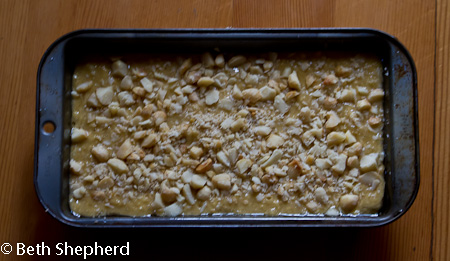
Gluten-free Banana Macadamia Nut Bread before cooking

Gluten-free Banana Macadamia Bread

Prep: 20 min. Bake: 45 min. (plus cooling time)

Yield: Two loaves

Ingredients

  • 2 cups Maninis Multiuso Multipurpose Flour Mix (or any other gluten-free all-purpose baking flour)
  • 1 teaspoon baking soda
  • 1/4 teaspoon salt
  • 4 eggs
  • 2 cups mashed ripe bananas (4-5 medium)
  • 1 cup sugar
  • 1/2 cup unsweetened applesauce
  • 1/3 cup canola oil
  • 1 teaspoon vanilla extract
  • 1/2 cup chopped Macadamia nuts (any nut: walnuts, hazelnuts, almonds, etc. could be substituted here, or no nuts at all if that’s how you roll)

Directions

  1. In a large bowl, combine the flour, baking soda and salt. In a small bowl, whisk the eggs, bananas, sugar, applesauce, oil and vanilla. Stir into dry ingredients just until moistened.
  2. Transfer to two 8-in. x 4-in. loaf pans coated with cooking spray (or rubbed with some oil). Sprinkle with Macadamia nuts. Bake at 350° for 45-55 minutes or until a toothpick inserted near the center comes out clean (found it was moist and needed more time, but check at 45 minutes and then cook for 10 minute increments).
  3. Cool for 10 minutes before removing from pans to wire racks.


Want to broaden your culinary horizons? Check out Wanderfood Wednesday!


Filed Under: Recipes Tagged With: Banana bread, Gluten-free, Hawaii, Macadamia nuts, Maninis Gluten Free, Udi's

Emerald City Pesto Recipe: Mint, Pistachio and Lime

May 15, 2013 by Beth Shepherd

Mint in the gardenOutside my window, the world is a sea of green. They don’t call Seattle the Emerald City for nothing!  And inside my kitchen, freshly snipped mint waits for its symphony partners: pistachio and lime. This green trio is perfectly accompanied by–just about anything: drizzled over roasted vegetables; mixed into pasta, rice, or tabouli; plopped on top of potatoes; spread on a sandwich; or, slathered inside an omelet loaded with fresh garden peas.

Fresh mintEmerald City Pesto

Ingredients

  • 1 cup mint leaves
  • 1/3 cup roasted, salted, shelled pistachios
  • 1 small clove garlic, peeled
  • 1/4 teaspoon salt
  • 1/4 cup extra virgin olive oil
  • juice of 1/4 lime

How to

Put the mint leaves, pistachios, garlic and salt into a small food processor or into a mortar. Process or crush until coarsely ground. In a steady stream, add the oil and lime juice until the consistency is of your liking.  Yep, that’s all there is to it.

Take the road less traveled,

Beth

Want to put more green in your life? Check out Wanderfood Wednesday!

Filed Under: Garden, Recipes Tagged With: Emerald City, lime, mint, pesto, pistachio

Peppermint Ice Cream Recipe

December 18, 2012 by Beth Shepherd

Peppermint stick ice creamWhen I was growing up, Friendly’s Ice Cream was the bomb. Friendly’s was a great place to meet friends, hang out and eat ice cream. I always ordered one of two flavors: Peppermint Stick or Coffee, although I did not drink coffee until I was 30 so my preference for the flavor at such a young age is something of a mystery to me. But I digress.

Over the years I’ve eaten—and made– a lot of ice cream, and in the past twenty years I’ve had more than my fair share of coffee and espresso (living in Seattle certainly helped with that habit), but somehow Peppermint Stick or Coffee faded from my ice cream rotation. That is until I bought a pint of Peppermint Chip ice cream from Old School Frozen Custard (If I’m not making my own, Old School is my go-to frozen treat). Little bits of red and green crushed peppermint lingered on my tongue with every creamy, mouth-refreshing spoonful. Take me away, to the endless days of summer in my youth, Friendly’s, and Peppermint Stick or Coffee ice cream.

And that’s when the idea occurred to me. Why not make Peppermint Affagato. Affagato means “drowned” which is exactly what happens when ice cream and espresso get friendly…Italian style.

Peppermint Ice Cream
The Perfect Scoop by David Lebovitz

Ingredients

  • 2-1/2 cups heavy whipping cream
  • 1-1/2 cups milk (whole)
  • 8 egg yolks
  • 3/4 cup sugar
  • 1/4 tsp salt
  • 2 tsp peppermint extract
  • 1/2 cup peppermint candy, crushed (mixing red and green peppermint adds a nice holiday touch)

How to make the ice cream

  1. Heat the milk, sugar, and salt in a saucepan until sugar and salt are dissolved (don’t let boil).
  2. Set the cream in a bowl nested in a larger bowl of ice.
  3. Place a sieve on top of the bowl with the cream. In another bowl, whisk the egg yolks.
  4. Slowly pour in the warm milk mixture while whisking constantly (take care not to cook the eggs – this is why you temper them with the warm milk slowly). Pour the contents back into your saucepan.
  5. Heat the mixture over medium flame and stir constantly with a spoon or spatula. It’s good to scrape the bottom and corners of the pan so you don’t get uneven cooking. Do this for about 5-7 minutes until the mixture coats the back of the spoon.
  6. Pour the custard through the sieve into the cream. Stir to cool over ice and then chill thoroughly in the refrigerator.
  7. Once mixture is chilled, add peppermint extract to your desired taste.
  8. Freeze in your ice cream machine according to the manufacturer’s instructions. After the ice cream is done in the machine, stir in your candy and then store in an airtight container and freeze.

Lavazza espresso

How to make Affagato

Place a scoop of peppermint ice cream in bowl or coffee cup. Pour a shot of espresso (or a few tablespoons of good strong coffee) over the ice cream.

Peppermint affagato

Want to get friendly with more deliciousness? Check out Wanderfood Wedneseday!

Filed Under: Recipes Tagged With: Affagato, coffee, David Lebovitz, Friendly's Ice Cream, Old School Frozen Custard, Peppermint Stick

Fresh Mint Chocolate Chip Ice Cream Recipe

September 19, 2012 by Beth Shepherd

mint

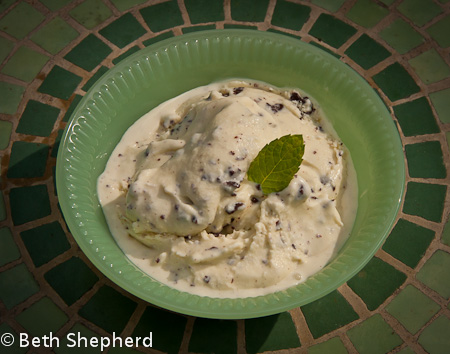
When I was a little girl, my two favorite flavors of ice cream were coffee (I was destined for Seattle) and mint chocolate chip. So when I asked our cousins which flavor ice cream they’d like me to make for an upcoming Dad and son birthday party (yes, both born on the same date), I was tickled when the reply was “anything mint.”

Now let me clarify: I am not talking fake, green, creme de menthe ice cream, but rather the REAL thing with fresh mint, which we happen to have growing in a mint box on our back deck (mint can take over a garden in the blink of an eye so I always corral it in a planter box). There’s nothing like mint chocolate chip ice cream made with fresh mint. Zingy and refreshing ice cream with”chocolate chips” made from Seattle’s own Theo’s Ultimate Dark Chocolate bar. Don’t say I didn’t warn you if you can’t stop at one scoop.

Fresh Mint Chocolate Chip Ice Cream

Fresh Mint Chocolate Chip Ice Cream

Credit to David Lebovitz for the recipe

Mint Chip Ice Cream

Makes about 1 quart (1l)

The bright taste of fresh mint is marvelous with the little bits of bittersweet chocolate. If you are unsure of the quantity of mint leaves, weigh them to the get the exact amount. I just stuck a few mint springs in my rooftop garden box and within a week, they took root and are thriving nicely. It’s not enough to make a batch of mint ice cream quite yet, so for now, I’m buying my mint at the market. Depending on where you shop, you might want to buy two bunches, to make sure you have enough.

Ingredients:

  • 1 cup (250 ml) whole milk
  • 3/4 cup (150 gr) sugar
  • 2 cups (500 ml) heavy cream
  • pinch of salt
  • 2 cups packed (80 gr) fresh mint leaves
  • 5 large egg yolks
  • For the chocolate chips:
  • 5 ounces (140 gr) bittersweet or semisweet chocolate, chopped

How to:1. In a medium saucepan, warm the milk, sugar, 1 cup (250 ml) heavy cream, salt, and mint.

2. Once the mixture is hot and steaming, remove from heat, cover, and let stand for an hour to infuse the mint flavor.

3. Remove the mint with a strainer, then press down with a spatula firmly to extract as much mint flavor and color as possible. (You can also use well-washed hands to do it as well, making sure the mixture isn’t too hot to safely handle.) Once the flavor is squeezed out, discard the mint.

4. Pour the remaining heavy cream into a large bowl and set the strainer over the top.

5. Rewarm the infused milk. In a separate bowl, whisk together the egg yolks, then slowly pour some of the warm mint mixture into the yolks, whisking constantly, then scrape the warmed yolks back into the saucepan.

6. Cook the custard, stirring constantly with a heatproof spatula, until the mixture thickens and coats the spatula. If using an instant read thermometer, it should read around 170ºF (77ºC).

7. Immediately strain the mixture into the cream, then stir the mixture over an ice bath until cool.

8. Refrigerate the mixture thoroughly, preferably overnight, then freeze it in your ice cream maker according to the manufacturer’s instructions.

9. While the mixture is freezing, melt the chocolate in a small bowl over a pot of simmering water, or in a microwave oven on low power, stirring until smooth. One tip: When you melt the chocolate, make sure the bowl is clean and dry; any moisture or water will cause the chocolate to seize and harden. Place a storage container in the freezer.

10. When the ice cream in the machine is ready, scribble some of the chocolate into the container, then add a layer of the just-churned ice cream to the container. Scribble melted chocolate over the top of the ice cream, then quickly stir it in, breaking up the chocolate into irregular pieces. Continue layering the ice cream, scribbling more chocolate and stirring as you go.

When finished, cover and freeze until firm.

Want more freshness in your meals? Check out Wanderfood Wednesday!

Filed Under: Recipes Tagged With: ice cream, mint, Mint Chocolate Chip, Theo Chocolate

Life is like an onion: Onion Tart Recipe

September 5, 2012 by Beth Shepherd

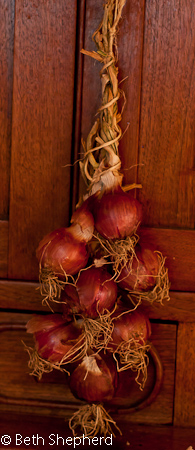
Braided onions

Life is like an onion. You peel it off one layer at a time, and sometimes you weep.

~Carl Sandburg

Tears of gratitude rolled down my cheek when, last week, I came home to find a strand of braided  red-wing onions hanging from my front door. Thank you Rand and One Leaf Farm: thank you for the onions, for your kindness, and for your friendship.

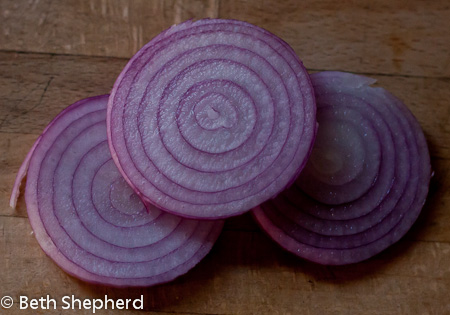
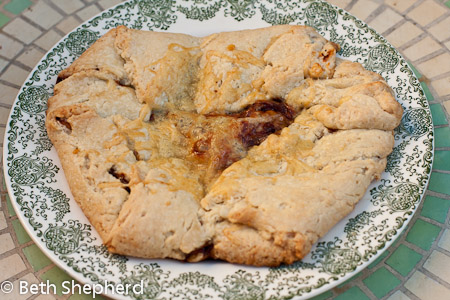
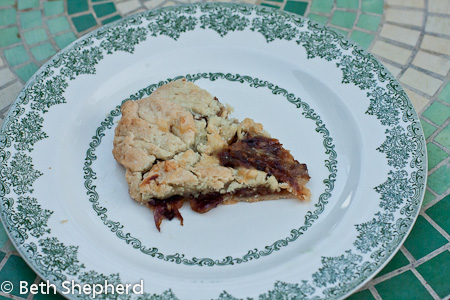
A few tears rolled down my cheeks as I sliced these purple beauties and readied them for their next adventure: Rustic Onion Tart. I’ve caramelized onions before but this is my first attempt at featuring them as the headliner in a tart. If you’ve got the time, making crust from scratch, is a fine (and tasty) way to go. Caramelizing onions also takes a bit of patience too, but offers delicious rewards. And if you decide to take the easy road and purchase a pie crust, I promise not to tell a soul.

This is one delicious tart. Glass of rose, sitting on the deck, sunshine on our shoulders. You’d almost think it was finally summer in Seattle.

Red onions

Rustic Onion Tart

Serves 4.

Ingredients

  • 1 Pâte Brisée (tart dough) for one 10-inch tart or 1 packaged, pie crust (Trader Joe’s has them in their frozen section, two rolled up that you thaw and unroll)
  • 3 medium sized red onions
  • 2 Tbsp olive oil
  • 1 Tbsp butter
  • Salt
  • 1 teaspoon balsamic vinegar
  • 3/4 cup (not packed) roughly grated Gruyère Swiss cheese (I used Emmental)

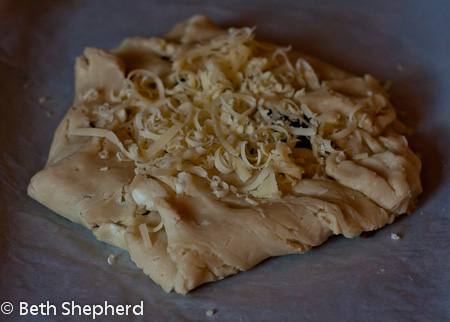
Rustic onion tart before cooking

How to

If you are making a crust from scratch, prepare the dough and let it chill in the refrigerator while you are cooking the onions.

Peel and slice the onions.

Heat olive oil and butter in a large, heavy-bottomed sauté pan on medium heat. Once the butter has melted, add the onions and sprinkle a little salt over them. Cook onions, stirring occasionally, for 10 minutes, until onions have softened and are translucent. Reduce heat to medium low and cook for an additional 40 minutes, stirring occasionally, until the onions are well browned. Add balsamic vinegar and cook for 10 minutes more, until onions are completely caramelized. Remove from heat.

Preheat the oven to 450°F. Remove the dough from the refrigerator and let stand for 5 minutes before rolling it out. Roll out the dough on a lightly floured surface to a 10-inch diameter. Remove the crust dough to a cookie sheet lined with parchment paper.

Place all but a couple tablespoons of the cheese in the center of the dough. Spread to within 1 1/2 inches from the edges. Add the caramelized onions, layering them on top of the cheese. Fold the edges of the crust dough over so that a small circle of onion is still showing in the centre of the tart. Sprinkle the remaining cheese over the top of the tart.

Place in the oven on the middle rack. Bake for 10 minutes at 450°F. Reduce the heat to 350°F and bake for an additional 20-25 minutes, until the crust is golden brown. Remove from oven and let sit for 10 minutes before serving.

Rustic onion tart

Want to weep at more deliciousness? Check out Wanderfood Wednesday!

Slice of Rustic onion tart

Filed Under: Recipes Tagged With: One Leaf Farms, onion tart, Rand Rasheed

Visualize whirled peas: Pea-mint risotto recipe

July 18, 2012 by Beth Shepherd

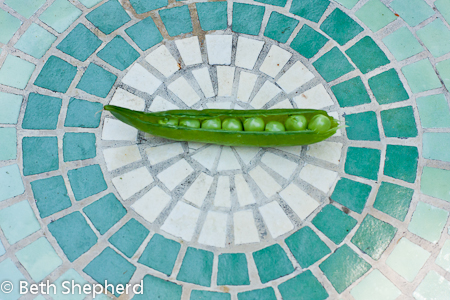
Pea pod

Peas are plentiful at the Urban Cabin. And so is mint.Visualize all that gorgeous greenness in a bowl and you have pea-mint risotto, the perfect summer meal for Seattle, aka the Emerald City, a green-filled city if there every was one.

A lovely local fume blanc (thank you Facelli Winery!) to sip on, and herbed goat cheese stuffed squash blossoms (my recipe linked here) on top. Mmm….fresh, minty, delicious. Green.

Pea-mint risotto

Facelli Winery fume blancIngredients

  • 1 tablespoon extra-virgin oil
  • 1 large garlic clove, halved
  • 1 medium-sized Walla Walla onion (or sweet onion), minced
  • 1-1/2 cups arborio rice (~10 ounces)
  • 4-1/2 cups stock (I used turkey stock that I’d frozen at Christmas), chicken or vegetable, warmed
  • Salt and ground pepper
  • 3 cups peas (I used freshly shelled English peas, but you can use one 16-ounce bag of frozen peas, thawed)
  • 1/2 cup grated Parmesan cheese
  • 1 cup finely shredded mint leaves
  • splash or three of dry sherry (optional)

How to:

Heat stock on the stove. Then, in a large saucepan, heat the oil. Add the garlic, Walla Walla onions, cover and cook moderately over low heat until softened (about 3 minutes). Add the arborio rice and stir over moderately low heat until the grains are slightly translucent (about 2 minutes). Add 1 cup of the warmed stock and cook, stirring, until nearly absorbed. Continue adding stock, about 1 cup at a time, stirring until the stock is absorbed before adding more. Cook, stirring until the rice is al dente and suspended in a thick, creamy liquid (about 15-20 minutes total). Season with salt and pepper; discard the garlic halves. Add the peas and until just heated through (I added a couple splashes of fino sherry at this point). Stir in the Parmesan cheese and mint. Serve.

Pea-mint risotto

Want to visualize more deliciousness? Check out Wanderfood Wednesday!

Filed Under: Garden, Recipes Tagged With: Facelli Winery, fume blanc, mint, peas, whirled peas

Fruit Leather Recipe

June 20, 2012 by Beth Shepherd

Fruit leather rolls in ArmeniaWhen I was a little girl, one of my favorite snacks was fruit roll or fruit leather. I loved to fold it every which way and nibble away, savoring the intense fruity sweetness.

So imagine my delight—on my trips to Armenia—when I discovered Armenian fruit leather, enormous swaths of color, made with farm-fresh apricots or Cornelian cherries.  One fruit roll lasted for several days. In fact, the fruit rolls in Armenia were so large Big Papa and I would joke about our fruit “blanket.”

Fruit leathers may have been originally created in the Middle East when people discovered that they could preserve fruit by pureeing, cooking, and drying it. Armenians and Persians were among those to start the tradition of cooking fruit leathers in the home. Their recipes called for placing the purees in muslin sheets, hung outside during  dry, sunny weather, and then sprayed with water so the dried leather could be easily peeled from the muslin when completely dry.

I’ve had my eyes on all the luscious fresh strawberries popping up in stores and at our local farmers markets.  The sun is shining today. It’s officially the first day of summer…let’s roll!

Armenian fruit leather

Strawberry Fruit Leather

Special equipment: You will need a non-stick silicon baking mat (I’ve seen recipes using plastic wrap or aluminum foil, but getting the fruit leather off them can be a challenge).

Fruit leather has a 5- to 7-hour baking time, so plan accordingly.

Ingredients

  • 1 1/2 pounds strawberries, washed and hulled
  • 1/3 cup granulated sugar
  • Pinch fine salt
  • 2 teaspoons freshly squeezed lemon juice

How to:

Heat the oven to 170°F and arrange a rack in the middle. Line a rimmed baking sheet with a silicone baking mat and place it on a flat work surface; set aside.

Set a fine-mesh strainer over a medium saucepan; set aside.

Place the strawberries, sugar, and salt in a blender and blend on high speed until you’ve got a very smooth purée, about 1 minute. Pour the mixture through the strainer into the saucepan and, using a rubber spatula, scrape against the inside surface of the strainer to push the purée through until only mostly seeds remain. Remove the strainer and discard the seeds.

Place the saucepan over medium heat and cook, stirring occasionally with a rubber spatula and scraping the sides and bottom of the pan, until the mixture starts to bubble around the edges. Reduce the heat to medium low and simmer, stirring occasionally and scraping the sides and bottom of the pan, until the mixture thickens slightly and reduces to about 1 3/4 to 2 cups, about 15 to 20 minutes. Remove the pan from the heat and stir in the lemon juice. Transfer the mixture to a heatproof container with a spout or return it to the cleaned and dried blender pitcher.

Slowly pour the mixture onto the baking mat, tracing the inside of the colored border to create a rectangle. (If your baking mat has no border, leave a 1-inch border from the edge.)

Pour the remaining mixture within the borders of the rectangle in a zigzag pattern (do not pour it all into the middle of the baking mat). Using the rubber spatula, push the mixture to cover any empty parts within the rectangle (the surface will not be even).

Keeping the baking sheet on the work surface, grasp the edges of the sheet—pressing against the exposed border of the baking mat with your thumbs—and gently shake back and forth to even out the surface of the mixture, rotating the baking sheet and shaking as necessary.

Place in the oven and bake until the surface of the fruit leather is slightly sticky to the touch but, when pressed in several different places, a finger does not leave an indentation, about 5 to 7 hours. Remove the baking sheet from the oven, place on a wire rack, and let cool completely.

Set aside a 16-inch-long sheet of waxed or parchment paper. Starting at one short edge of the cooled fruit leather, pull it up from the baking mat and transfer it to the paper. Using clean kitchen scissors, cut through the fruit leather and paper to form the desired-size strips, shapes, or pieces and then roll them up, paper and all (to prevent sticking). Store in an airtight container for up to 3 weeks.

Want more sweetness in your life? Check out Wanderfood Wednesday!

Filed Under: Recipes, Travel Tagged With: apricot, Cornelian cherry, fruit leather, fruit roll

Bangers and mash with Walla Walla gravy recipe

May 23, 2012 by Beth Shepherd

Bangers and mashWhen I first met Big Papa, I was having a crown put on one of my teeth. As I bemoaned my inability to eat much of anything toothier than mush, he assured me, “Chewing is overrated.” That’s when I found out mashed potatoes rate as one of Big Papa’s favorite dishes. Sausages easily make it into his top five. So this March, when our travels to Armenia included a couple days in London on the way over, I knew that if we ate nothing else, we’d eat bangers and mash.

Bangers and mash are quintessential British pub food, eaten in homes for centuries but first served up in English pubs around WWI as a cheap and filling lunchtime meal for the working class. “Bangers,” sausages, and “mash,” potatoes are served up with a healthy slathering of rich onion gravy.

Bangers take their name from the sound sausages can emit when fried. Modern sausages apparently don’t make the loud “bang” sausages pre-WWII did when they were overheated because today’s meats are generally made with less water.

We tried bangers and mash at several London locales and they did not disappoint. How could they really? Bangers and mash, with a good pint of ale alongside, are comfort food at its finest.

Here’s my northwest take on onion gravy, made using succulent Walla Walla sweet onions. Paired with some locally grown potatoes and homemade sausage (one of the latest “it” foodie items easily found in Seattle), and our recent spate of gray days and drizzle, blimey if it doesn’t feel like jolly old England.


Caramelized Walla Walla Onion Gravy
Ingredients

  • 3 cups thinly sliced Walla Walla onions (or other Vidalia-type sweet onion)
  • 2 tablespoons butter
  • 1 tablespoon light brown sugar
  • 1 teaspoon garlic
  • 1 teaspoon thyme leaves (fresh if possible)
  • 2 tablespoons cognac (optional)
  • 1 cup beef or chicken stock
  • salt and pepper


How to:

  1. In a small saucepan set over medium heat, add the butter.
  2. Once melted, add the onions and sugar to the pan and saute, stirring occasionally until wilted and well caramelized, about 18 to 20 minutes.
  3. Add the garlic and thyme to the pan and saute until fragrant, about 30 seconds.
  4. Add the flour to the pan and stir to make a roux, about 2 to 3 minutes.
  5. De-glaze the pan with the cognac and once nearly evaporated, 1 minute, add the chicken stock.
  6. Bring to a boil and reduce heat to a simmer.
  7. Simmer the gravy for 15 minutes and season with the salt and pepper.

Want more bang in your week? Check out Wanderfood Wednesday!

Filed Under: Recipes Tagged With: bangers and mash, British, England, London, pint, potatoes, sausages, sweet honion, Walla Walla onions

Armenian yogurt soup recipe

May 16, 2012 by Beth Shepherd

Spas Armenian yogurt soup, tahnaboor“I’ll have the spas,” is what I frequently said when we went out for lunch in Armenia. Spas (spahs) is a creamy, tart, filling and soup served warm in the winter and chilled during summer months.

This soup, sometimes called tahnabour or madzoon abour, is classic Armenian cuisine. It’s made with yogurt and wheat grain (dzedzadz is the name of the Armenian grain) and seasoned with mint or cilantro. In a mountainous country with harsh winters, most rural homes keep their cupboards well-stocked with dried buttermilk and grains.  Making spas makes sense—it’s an ancient comfort food.

When I visited Armenia this March, snow was still on the ground and temperatures dipped well below freezing. Spas was the perfect belly warmer for a cold day. And, I have also enjoyed chilled spas at the height of Armenian summer, when the cool yogurt and refreshing mint are the perfect pairing for hot, dry days.

There is an Armenian saying: Lentil soups are for fasting days and yogurt soups are for feasting days. All I can say is that I did a lot of feasting when I was in Armenia, because I [heart] spas.


Spas (yogurt soup with grains and herbs)

*Note: I have seen several recipe variations. Some use parsley, others use cilantro. Most also incorporate mint. Egg or wheat is necessary if the soup is hot; it keeps the yogurt from curdling.  You can also serve this soup chilled.


Ingredients

  • 2/3 cup hulled wheat (farro, wheat berries or pearl barley can be used as a substitute if you can’t find hulled wheat)
  • 3 cups yogurt (Greek-style yogurt is best)
  • 3 cups water or chicken broth
  • 1 egg* Do not use in the cold version of the soup
  • 2T flour
  • ½ tsp salt
  • 4T butter
  • 1 T mint (chopped)
  • 1/3 T parsley or cilantro (chopped)

How to:

Cook wheat in 4 cups of water or broth until tender. Blend yogurt, water, egg and flour with a beater. Cook until it boils, stirring constantly with a wooden spoon. Add salt, cooked wheat and remove from heat.  Saute onion in butter. Add mint and parsley. Combine with soup. Simmer five minutes.


Want to dip your spoon into more deliciousness? Check out Wanderfood Wednesday!


Filed Under: Recipes Tagged With: dzedzadz, mint, pearl barley, spas, tahnaboor, tahnapoor, Wanderfood Wednesday, yogurt soup

  • « Previous Page
  • 1
  • 2
  • 3
  • 4
  • 5
  • 6
  • Next Page »

Some might fend off a mid-life crisis by leaving the comforts of their corporate salary to jet off to a deserted island. Others might buy a Jaguar. I’ve chosen to dive head-long into my 50s and beyond by becoming a first-time parent. At any given moment you might find me holding a camera, a spade, a spatula or a suitcase. Or my little girl's hand. Adopted from Armenia, she puts the Pampers and Paklava into my life.

Subscribe to Blog via Email

Enter your email address to subscribe to this blog and receive notifications of new posts by email.

Recent Posts

  • Ghosts and goblins of Halloweens past
  • Raise a glass—or ten
  • No me without her: A life before motherhood
  • Leaving the orphanage with a priceless pair of tights
  • Rock of ages: Celebrating five years together as a family

Tags

366 Project Adoption anniversary Armenia autumn Bainbridge Island Baja Birds birthday blog cat cats chickadee China Christmas fall ferry flowers France Garden Gyumri Halloween Hawaii Holiday ice cream Kauai leaves London Mamas with Cameras Mexico Mother's Day Mt. Rainier New York orphanage Paris Puget Sound robin Seattle taxi Thanksgiving Tibet USCIS Valentine's Day wedding Yerevan

Categories

  • Adoption
  • Armenia
  • Family
  • Food
  • Friendship
  • Garden
  • Holiday
  • Miscellaneous
  • Paris
  • Photography
  • Recipes
  • Review
  • Seattle
  • Things to do with kids
  • Travel

Sites I like

  • The Wayfaring Voyager
  • Wanderlit
  • Wanderlust and Lipstick
follow us in feedly

Image Copyright

Unless specifically mentioned, all images on my blog are my own original photographs and, therefore, copyright protected (©Beth Shepherd). Feel free to use my images for non-commercial use so long as you provide me with the image credit. Likewise, if you pin my images to Pinterest, please mention me by name.

Copyright © 2026 · Pamperspaklava · WordPress Barista