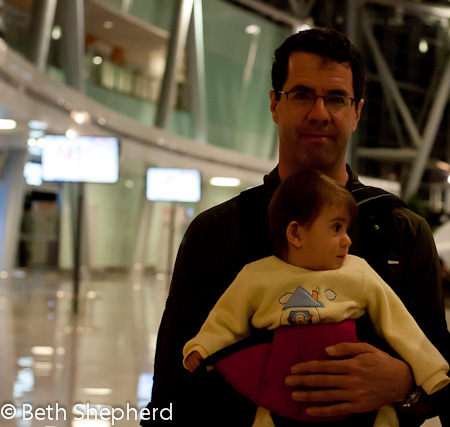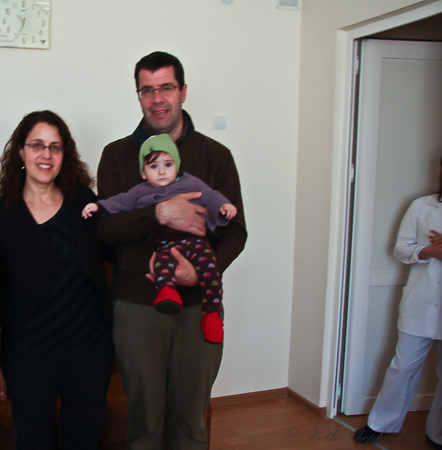
 I will always be grateful for the care our daughter received, during the first year of her life, as a child in an orphanage. Whenever I talk with her about the nannies who watched over her, I make sure she knows they did the best they could. I’ve told her they changed her diaper, bathed her, made sure she was fed and put her to bed. But when she asks me if they read her stories or played with her, I tell her that they had a lot of babies to care for and, even if they wanted to, they couldn’t give her the kind of love and attention she gets from her mama and dada.
After we came home, and especially in the two years that have followed, I’ve come to understand how much I underestimated the impact of life in an orphanage. I thought–and people told me (even people who are deeply involved in the world of adoption)– “She won’t remember those first months in institutionalized care.” I believed, because she was so young, her transition would be relatively easy. I knew to expect that the first 3-6 months might be difficult, everything would be new to her (smells, sounds, tastes, sleep), but we’d have smooth sailing after that.
Then, when she started walking, I noticed she would approach strangers, climb into their laps or take their hands at the playground and walk off. At first I thought, “What a friendly child I have,” and indeed she is. As months passed, however, I felt more and more uneasy as I began to realize some of these behaviors weren’t helping her attach to our family, and even put her at risk.
 It’s true: she will not remember spending her first year in an orphanage. She will only know the nannies who cared for her from the stories and pictures we share with her. She might learn their names, but she will not have any memories of them as “real people.” However, I now firmly believe that her experience of living in an orphanage is deeply imbedded in her psyche.
No matter how good orphanage care may be, it is not a healthy substitute for being part of a family. Our daughter did not experience the security of knowing the same person would meet her needs, or even that her needs would be met at all. It makes sense now, she might be reluctant to trust her parents won’t leave her, because all she knew was a constant rotation of caregivers, all of whom “disappeared” when we took her out of the orphanage. And it also makes sense that her brain would tell her it’s “in her best interest” to be really nice to that stranger who just smiled at her in the park, because that woman might be her next mama.
We have come a long way, literally and figuratively, in the past two years. When I look back on March 24, the day she left the orphanage, I remember feeling excited, terrified and filled with hope about our future as a family. I still feel excited (and sometimes terrified, though thankfully less often) and filled with hope for our family and the years together that lie ahead. At the same time, I am now much more cognizant that her life didn’t start with us. She carries within her the experience of life with three families: the family of her birth, her orphanage family, and now us.

Take the road less traveled, Beth

 Each Tuesday, Baby Bird and I have a standing appointment with Miss. K. Miss K. helps us overcome challenges Baby Bird has faced after spending the first year of her life in an orphanage.
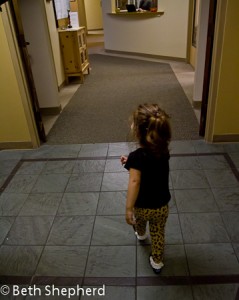 During our early visits, she would open one of the double glass-paned doors and search, sweeping her tiny hand over each shelf. Occasionally there was a piece of paper or a pen, and she would try to take it.
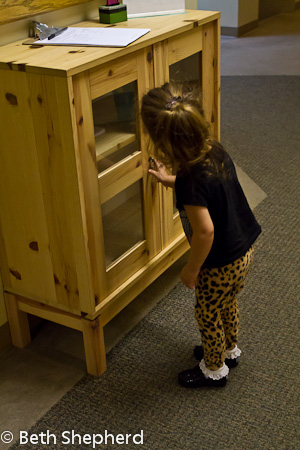 Months later, she opened the cabinet and lo and behold–stickers. Baby Bird reached inside and took the sheet of farm animal stickers off the shelf.
 While I know she enjoys the gifts, her interest in them doesn’t seem to last as long as her interest in the Magic Cabinet itself. Her delight lies in the quest more than the acquisition. She was just as curious about the cabinet, before there were gifts, as she is now.
 I truly enjoy watching her excitement from simply looking inside. I love her curiosity, is what she says.
















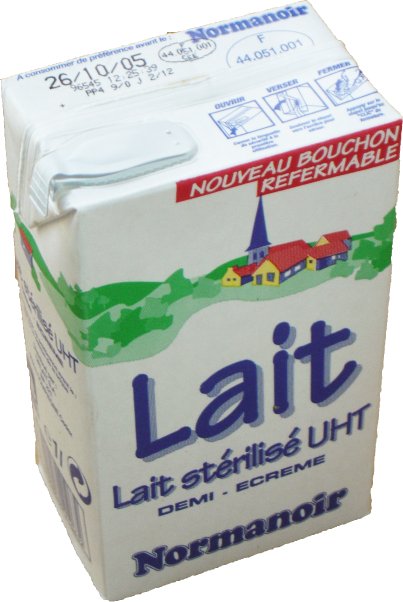 My junior year in college, I spent a semester in Amsterdam. In the six months I lived there, I was able to speak (and understand) more Dutch than I ever managed with French, even though I had studied it for two years. Being immersed in the culture, seeing and hearing the same words and sounds every day, fostered a much quicker acquisition of the language. This is one of the reasons why I enrolled our daughter in French school: I wanted her to have the opportunity to learn another language, and begin as soon as possible.






 Our five hour flight from Yerevan to London passed without a hitch. Baby Bird even fell asleep for a couple hours. I couldn’t believe our luck.
 We set our alarm for 3:30 a.m. and awoke, bleary-eyed, to what would be the start of a very long day. A full, luminous moon was the only light in the pitch black sky. Two floors below us, Tumanyan Street, lay silent: no horns blaring, no cacophony of people passing below on the sidewalk. It felt as though all of Yerevan was asleep, except for us.
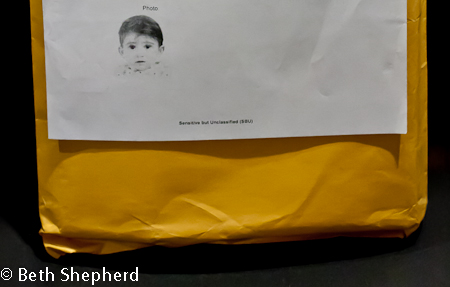 When our agency’s attorney arrived, he handed us a large manila envelope. THE envelope we’d heard so much about during our four year adoption journey, the envelope from the U.S. Embassy in Yerevan containing all the adoption documents U.S. Immigration would need to process our daughter as a new U.S. citizen. We were told do not open this envelope under any circumstances, do not let it out of our hands, and do not let anyone else open it until it is safely in the hands of a U.S. Immigration officer.