Pampers and Paklava

  • Home
  • Photography
  • Travel
  • Food
  • Garden
  • Contact

My Father’s Sauerkraut Recipe

January 25, 2012 by Beth Shepherd

sauerkrautMy father passed away early Sunday morning. When I shared the news with family and friends, each person I spoke to, talked about my father’s pickles and sauerkraut. Dad was the king of kraut.

Memories of making kraut with my Dad, growing up in Fayetteville, New York, go back as far as I can remember.  My sister and I would help him in his workshop, which was located in the unfinished portion of our basement. In this magical and mysterious spot, lay a treasure trove of wonders: my father’s darkroom, the oak barrel where he made wine, his myriad tools, and all the accoutrement necessary to make pickles and sauerkraut, the way his parents made it in the “old world,” without heat and without vinegar.

We would ball our fat little hands into fists and pound down the grated cabbage into an earthenware crock to release the juices. My eyes would survey the old shelves lining the walls, where Mason jars of green and gold gems stood like a line of soldiers, as they waited for their fermentation period to end.

When they were ready, my father would fetch a jar and, with some effort, unscrew the lid. The pickles and kraut would bubble and hiss before we scooped them out to enjoy with just about any meal my mother prepared. From my father’s perspective pickles and kraut paired with everything!

Dad also delighted in sharing his homemade delicacies. Jars upon jars found their way to the homes of relative and friends. Pickles and kraut were his “signature dishes.” Plus, my father loved to barter. I recall many times when he would use his pickled goods as currency to get a little of this and a little of that.

Even after he suffered a stroke, some 40 years ago, my father continued making pickles and kraut. When we moved him from Florida out to Seattle, and into an assisted living facility, he kept right on making them. In fact, Dave, one of the cooks even scored a few cabbages and spent a couple hours with my father, grating the cabbage and putting it into jars.

Tasting Dad’s wares was also a test of friendship. If you liked his pickles and kraut, he liked you. I think it was all of five minutes into their first meeting, that my father offered Big Papa a sampling of his goodies. I held my breath, hoping it was a “good batch.” Thankfully, it was.

There are a lot of things I will miss about my father. Many of my greatest passions in life come from him: gardening, photography, love of birds and nature. I will most certainly miss his pickles and kraut. Big Papa and I make them, but somehow, ours never seem quite as good as those my Dad made.

Abe’s Kraut

To make sauerkraut at home, you will need:

  • large crock, glass, enamel or food-safe container
  • Five pounds of firm, fresh green cabbage (about 2 heads)
  • Food processor, madoline or cabbage shredder
  • kosher salt
  • a plate or something to cover kraut in crock/container
  • something heavy to weight down the plate
  • wooden spoon (do not use aluminum utensils in kraut making!)

Here’s how:

Shred five pounds of firm, fresh green cabbage (about two heads) in a food processor (you can also use a mandolin and I used the large cabbage grater that my Dad made). It will need to be done in batches. Dump each batch into a large bowl (or a crock if this is what you will ultimately use to ferment the cabbage) as you go, sprinkling with a total of three generous tablespoons of kosher salt, and mix it all together well. You can use a little more or a little less cabbage; just be sure to use a scant two teaspoons of kosher salt per pound of cabbage.

Pack the cabbage and any juices it has released into a crock a little at a time, pressing the cabbage down tightly with your fist as you go. If you don’t have a crock, you can use a food-safe plastic bucket; just be sure you have at least five inches of clearance above the cabbage to allow for foaming/bubbling during fermentation.

Place a clean plate over the cabbage that fits fairly snugly within the opening of the crock or bucket. Place a clean container of water (a large Mason jar works well—it should weigh a minimum of five pounds) on the plate to weight down the cabbage, and throw a clean towel over the top of the crock to keep out any dust.

Check back frequently during the first day to be sure the cabbage is releasing enough juices (the salt will pull water from the cabbage to create brine). Press on the plate/weight if necessary, and/or add more weight if the liquid doesn’t start to cover the top of the cabbage. After about six to eight hours, there should be at least an inch of juice/brine above the plate. If there isn’t, you can top off your cabbage with cooled brine composed of one and a half tablespoons of kosher salt per quart of water.

Store the crock in a spot with a temperature around 70 degrees Fahrenheit—not colder than 65 degrees or hotter than 75 degrees (a basement is ideal). Check it every few days, skimming any scum off the top. The fermentation will cause natural bubbles and foam to form and that’s okay. Rinse the plate and weight off well each time before putting them back. Keep an eye on the brine level; you may have to add more if it’s evaporating. Keep a good inch of brine above the plate as the fermentation proceeds…this is important to prevent unwanted bacteria from forming and the sauerkraut from spoiling!

Start tasting the cabbage after about a week, and ferment it to the level of sourness you like, which will take anywhere from one to four weeks. Some people prefer the milder cabbage-y taste of young kraut, while others like a more fermented flavor.

When the cabbage is fermented to your liking, transfer it and its brine to clean jars, again pressing the kraut down tightly in the jar so the juice rises above. Leave about a half inch of head space, and refrigerate. Your sauerkraut should last a few months refrigerated under brine.

Variation: Add a teaspoon or two of caraway seed for a tasty variation on your kraut. My father used to do this on occasion with a batch or two, and I quite liked it.
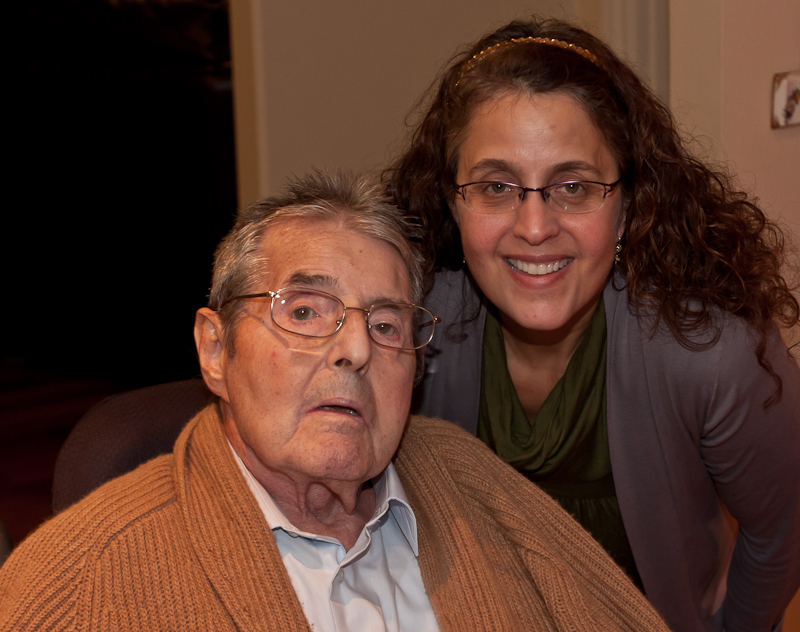
Beth and Abe
In memory of my father, Abe: March, 1924-January 22, 2012.

I know you’re up there making kraut like they’ve never tasted before!


Want more old-school flavor? Check out Wanderfood Wednesday.
Filed Under: Recipes Tagged With: dad, Fayetteville, kraut, pickles, sauerkraut

Forty years of friendship

December 20, 2009 by Beth Shepherd

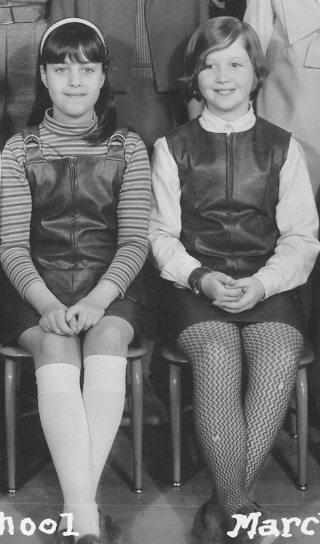
March 20, 1969. Backs straight in our au courant “pleather” mini-jumper dresses, Dee and I sat side by side for our fourth grade class photo. On December 20, 2008, thirty-nine years and nine months to the day this picture was taken, she died.  We’d been friends for nearly forty-three years, since 1966 when Dee and her family moved into the house across the street from our house in Fayetteville, New York.

Dee-and-meWhen I look at this picture, I can barely remember myself as a young girl. The years have melted away. Back in the days when we wore our pleather dresses, summers were endless. Now it seems summer, much less a lifetime, passes in the blink of an eye. My father often told me that the older you get, the quicker time goes.

I don’t recall thinking much about dying when I was in fourth grade. I’m sure questions came up if I saw a dead robin in our yard, but until I was twelve I hadn’t been touched by illness and death in such a personal and profound way.

Two years after this picture was taken, when I was in sixth grade, my father had a major paralyzing stroke and my sister had her first of two cancers, a brain tumor. For me, their illnesses were the beginning of my realization that good health can be tenuous and life may be fleeting. They both lived, but while they were hospitalized, I heard many stories of those who did not.

The lump in Dee’s breast appeared shortly before her fortieth birthday. Cancer. For her it was the beginning of a difficult ten-year journey. My sister beat cancer twice so I held strong in my belief that Dee would overcome cancer too. I wanted the best for her and prayed for her health and complete recovery. Selfishly, I couldn’t imagine her not being around.

I cheered every bit of good news, every PET scan with hopeful results. For any step in a negative direction, I tried to offer words of encouragement.  When she reached her seven year mark as a survivor, I was elated. A few months later, the cancer was back.

It wasn’t until the year before Dee died that I began to let it in. That Christmas she sent a package containing all the Christmas ornaments I’d given her over the years with a note, “I would like it if you would add these ornaments to your collection. They have hung on our trees for many years.” I wanted to put them back in the box and return them to her. Accepting her gift felt like an acknowledgment that time was running out for my friend.

Today is the one year anniversary of Dee’s death. I think about her all the time, sometimes with sadness that she passed too soon and at other times with gratefulness that I was able to enjoy a friendship that spanned four decades.

I take some comfort in knowing that Dee was in the arms of her husband when she died. Their marriage was the source of tremendous strength and joy for Dee. Two of her sisters were also there. She was surrounded by love and, from what they’ve told me, she wasn’t in pain.

Beth and DeeStill, I miss her. Loss is one of life’s most difficult lessons and I struggle with accepting its presence.

I will never have another friendship quite like the friendship I had with Dee. There is no other close friendship I have as an adult, which goes back as far. Dee knew my family and she knew about their illnesses and our struggles. She knew the decades of twists and turns in my dating history that led finally to a wonderful man and a happy marriage with Big Papa. She knew that I loved a good yard sale as much as I loved a trip to the farmer’s market.

Dee knew me in such a way that I didn’t have to explain myself. And, despite much of what she knew of my failings, she was still my friend through thick and thin. Sometimes, I marvel that she stuck by me during the many years I made poor choices in partners and sought paths where I was not true to myself. She held steadfast in her support of me, her friend, believing I would find my way.

There are days when hearing her voice on the other end of the phone would mean the world to me. She always knew how to find the words to soothe, and I’d feel listened to and understood. She managed to keep in touch with her large network of family and close friends, and was the glue between us, keeping us updated on each other’s lives. She remembered our birthdays and anniversaries, and she had the uncanny ability to pick out just the right gift.

In this season of giving, I warmly remember our friendship. There is no finer gift than the heart of a loved one or the hand of a friend.

May the road rise up to meet you
May the wind be always at your back
May the warm rays of sun fall upon your home
And may the hand of a friend always be near.

~Irish blessing

In loving memory of my friend, Dee Wood Schaubroeck. October 5, 1958-December 20, 2008.

Filed Under: Family, Friendship Tagged With: breast cancer, death, Fayetteville, Friendship

There’s no place like home

October 26, 2009 by Beth Shepherd

Down the lane
Rain pounds on the windshield of our rental car as we drive up the gravel road in Ingomar, Pennsylvania, just north by twenty minutes from Pittsburgh. The temperature outside is unseasonably cold and we hear that several inches of snow had fallen the week before our visit. Today the skies are gray, and trees still cling to their colors, with hues of brown, rust, yellow and burgundy coated the rolling hillsides.

Big Papa and I are on our “Tour of the moms” trip. We plan to spend six days visiting our childhood homesteads and haunts, three days in Pittsburgh where he grew up followed by three days in Syracuse where I grew up. Both our mothers still live in the cities of our birth.

Turning left onto Wilvan Lane, we quickly spot the Cape Cod-styled house, now painted a soft yellow. Wilvan Lane is tiny with just a handful of homes sharing the intimate road named after two of the families who lived on it, the Wilsons and the Vandervorts. Big Papa moved to this house when he was four years old and his parents lived there until his father passed away and his mother moved into a retirement community. Since that time, it’s had two owners.

Wilvan LaneNext door sits a grand old stone house where Tom, Joel’s closest friend and the best man at our wedding, grew up. For Big Papa, a couple decades of adventures and mischief went down in the lanes and yards surrounding those homes.

We pull up to the house, just we’ve done the past couple times we’ve visited Pittsburgh. As we hop out of the car to take a few pictures, a woman opens the front door and calls out to us. “Are you interested in my house?” “Yes!” said Big Papa. “I grew up here.”

“Come on in. I’ll show you around.” Walking up to the back entrance, our tour guide introduces herself. Melissa has owned Big Papa’s former digs for several years now.  She enthusiastically guides us through the house pointing to lovely original oak wood floors, heretofore unknown to Big Papa who lived with wall-to-wall carpet during his years in the house.

Big Papa shares stories from days gone by and Melissa describes what she’s done to the home since becoming its owner. We pass the laundry chute where Big Papa would toss his stuffed bear for a quick ride down to the basement. Traveling through the living room we reach the far end of the house, where there is a bedroom, a small bath, a sitting room and a porch that is now a sunroom. As we poke our heads into the bathroom, we see a handrail against the wall. Melissa says, “I think an old man, who was ill, lived here alone for awhile.” Big Papa responds, “That was my father, but he wasn’t alone.” “He’d had a stroke and my mother put in the rail and moved him down here from their upstairs bedroom so he could get around more easily.”

Next we head upstairs, where there are three bedrooms. Big Papa had to walk through his parent’s bedroom to reach his own, tucked into the rafters in a corner of the second floor. We turn the clear glass door knob and the door sticks a bit before we give it a good shove to open it. “The door stuck just like that when I was a kid,” Big Papa recalls. Looking inside we see a spacious room painted bright yellow. “I painted the room yellow, when I was in high school,” he recollects. “It’s a different shade now, but how funny that it was yellow thirty years ago and still is to this day.”

Our last stop on the tour is the basement. Big Papa’s father lay claim to this space and piled it high and deep with tools, wood, a darkroom and project upon project. As we chat, I hear Big Papa catch his breath. “My father’s workbench. I can’t believe that it’s still here.”  We run our fingers along the weathered wood with its shiny patina from years of use. “I never could see much of the bench with all the stuff piled on top of it,” Big Papa tells us.

I wanted to reach out and hold Big Papa close. I know he is thinking about his dad, long passed. I’m sure he can almost hear small feet running down the stairs to see what mysteries might be uncovered in the busy basement workshop. He probably smells faint traces of developer wafting from the side of the basement where the darkroom once stood, and remembers how pungent aromas from fresh cut wood lingered in the nooks and crannies.

Big Papa told me that once, as a child, he secretly “cleaned” the basement work area as a birthday present for his dad. Tidying up the messy space seemed like a good idea at the time, until his father arrived home. A look of displeasure crossed his face. He didn’t yell at Big Papa but sternly told him to ask the next time he considered tackling a similar venture.

Leaving Pittsburgh for Syracuse three days later, we fly over a beautiful patchwork of fall color. Farms dot the landscape and small towns sit side by side with verdant woodland. I think to myself how lucky we both were to grow up in such a spectacular setting. I also muse about how different it is to go home versus to be home.

Yellow houses
We arrive in Fayetteville, New York, a small village twenty minutes southeast from Syracuse. Another yellow house, my childhood home, comes into view as we walk up Highbridge Street from the Craftsman Inn where we’re staying. Fifty years later, my mother still resides in the house I called home for the first eighteen years of my life. It’s a small ranch-style home, built in the 1950s when new suburbs sprung up across the U.S.

Across the street is the large gray house where my close friend Dee lived, along with her ten siblings. I can feel my heart wince a bit as we pass by. Ten years ago, Dee’s parents moved to a townhome a few miles away and Dee died last Christmas. Time changes all things.

Highbridge StreetThat I grew up in a yellow house, Big Papa’s boyhood home is now yellow and our home in Seattle, the Urban Cabin, is also yellow is a fascinating coincidence not lost on me. Four decades passed before Big Papa and I crossed paths. While we found each other on the west coast, our shared roots are in the east. Both our fathers had a woodshop and a darkroom in the basement and both were paralyzed by strokes. Big Papa has a sister, as do I, both of whom suffered from illness as children. My sister had cancer twice and, as a young teen, Big Papa’s sister began her lifelong struggle with mental health issues. We have many, many differences between us but there are an equal number of ways in which we are kindred spirits, our experiences cut from similar cloth.

My mother greets us at the door and before we are ushered into the house, we take a walk through the yard. Although I grew up on a very busy street, our property backed up to a sizable protected wooded area with two streams. My father was an avid gardener and part of our lot was filled with every edible plant imaginable. A compost pile still collects leaves in the farthest corner of the back yard, and I remember how my steps would quicken as I carried the remains of our meal out to toss in the compost. What danger I imagined lurked there, I do not recall. I am often surprised I felt scared to be alone surrounded by the trees in our back lot since it was also a place of great discovery. My father found milk glass dishes left by early settlers and ancient arrowheads, once used by Iroquois Indians who first walked the land.

As we walk and talk with my mother, we hear the sound of Limestone Creek gurgling in the background. Birds fly freely in the sanctuary established before my parents bought the house. No one will ever be able to build in these protected woodlands. I know my love of nature and plants comes from this magical place.

Back inside, my mother tasks us with going through belongings saved over my lifetime. Over the next three days, we uncover photos, trinkets, artwork and letters that fill boxes stored in our attic and closets of the house.

A flood of memories, some happy and others painful are brought to life as we pick through dusty relics lovingly stored by my mother. The members of my family are all ‘savers,’ with me being the least inclined of the foursome. Later, as we walk back to our room at the inn, Big Papa and I talk about the psychic weight entrenched in generations of memorabilia. What to keep and use, what to keep but store, and what to toss? We are the caretakers for our own treasures, those of parents and all the generations before. My father’s artwork alone would cover every inch of wall space in our house if I put them all up. What of my own creations? How do we show respect for what has passed and honor the present without drowning in stuff?

Should we successfully adopt, will my child cherish the twelve years of classroom photos, taken from Kindergarten on? Or will he relinquish them to the trash bin? Surely if his style leans mid-century modern, he won’t see the charm in our oak kitchen table or the dresser hand-painted by Big Papa’s father. Will he feel burdened, as I did, to haul something comparable to my father’s unwieldy darkroom enlarger for decades from apartment to apartment until I finally, with a mountain of guilt, dispatched it to the dumpster behind my building before shacking up with Big Papa?

We leave before dawn on the morning of the seventh day of our journey across the country. I feel heavy, loaded down with the gravity of memories from conflicted relationships, roads taken and not taken. While we can always return to the places of our youth, we are no longer young when we do so.

These four walls

A sense of place grounds us to the land we hail from and to the places we’ve laid our head. Familiar colors, scents and sounds are imbedded deeply in our souls, whether gentle rolling wheat fields, wide open plains or lush forests.

Traveling back to a place, the memories we conjure are at times pure poetry and in other moments wounds rubbed raw. No matter how far we roam, the stories from our childhood and the places we’ve called home become a part of our internal landscape.

I still recall the promise of an east coast spring when the first crocus pokes its brave head through the frost-covered ground in our yard. Walking past lilacs in bloom, I smell the sweet fragrance and can almost feel myself cradling the overflowing bunches against my chest, just as I’d done with the branches cut from the bush outside my childhood porch. Each fall, I thrill at the sight of rich red maple trees and remember the hillsides of central New York, covered with their vibrancy.

Even though decades have passed, and the scenery outside my window has changed, I will always carry with me, a piece of the places I’ve called home. No one will ever be able to completely take away the east coast from the girl.

Urban CabinUpon our return to Seattle, the taxi drops us off in front of the Urban Cabin, looking as chipper as it did when we left it. Our steps are sure and swift, and we bound up the front stairs until we reach the front door. Simultaneously, we both let out a great sigh of relief. Back walls torn off for our remodel and lives crammed temporarily into 450 square feet notwithstanding, our little yellow house never looked more beautiful. Tonight we will lie down side by side in our bed. Maggie, the cat, will curl up next to us and purr contentedly. I know, almost instinctively, which fir board will creak when I rise in the morning and place my feet on the floor. These four walls are rooted steadfast in our bones. We are home, our home.

Filed Under: Family, Travel Tagged With: arrowheads, Craftsman Inn, Fayetteville, Ingomar, Iroqouis, Limestone Creek, milk glass, New York, Pennsylvania, Pittsburgh, Syracuse

Some might fend off a mid-life crisis by leaving the comforts of their corporate salary to jet off to a deserted island. Others might buy a Jaguar. I’ve chosen to dive head-long into my 50s and beyond by becoming a first-time parent. At any given moment you might find me holding a camera, a spade, a spatula or a suitcase. Or my little girl's hand. Adopted from Armenia, she puts the Pampers and Paklava into my life.

Subscribe to Blog via Email

Enter your email address to subscribe to this blog and receive notifications of new posts by email.

Recent Posts

  • Ghosts and goblins of Halloweens past
  • Raise a glass—or ten
  • No me without her: A life before motherhood
  • Leaving the orphanage with a priceless pair of tights
  • Rock of ages: Celebrating five years together as a family

Tags

366 Project Adoption anniversary Armenia autumn Bainbridge Island Baja Birds birthday blog cat cats chickadee China Christmas fall ferry flowers France Garden Gyumri Halloween Hawaii Holiday ice cream Kauai leaves London Mamas with Cameras Mexico Mother's Day Mt. Rainier New York orphanage Paris Puget Sound robin Seattle taxi Thanksgiving Tibet USCIS Valentine's Day wedding Yerevan

Categories

  • Adoption
  • Armenia
  • Family
  • Food
  • Friendship
  • Garden
  • Holiday
  • Miscellaneous
  • Paris
  • Photography
  • Recipes
  • Review
  • Seattle
  • Things to do with kids
  • Travel

Sites I like

  • The Wayfaring Voyager
  • Wanderlit
  • Wanderlust and Lipstick
follow us in feedly

Image Copyright

Unless specifically mentioned, all images on my blog are my own original photographs and, therefore, copyright protected (©Beth Shepherd). Feel free to use my images for non-commercial use so long as you provide me with the image credit. Likewise, if you pin my images to Pinterest, please mention me by name.

Copyright © 2026 · Pamperspaklava · WordPress Barista