I spend a lot of time watching the birds in our yard. And, I spend a lot of time taking their pictures.
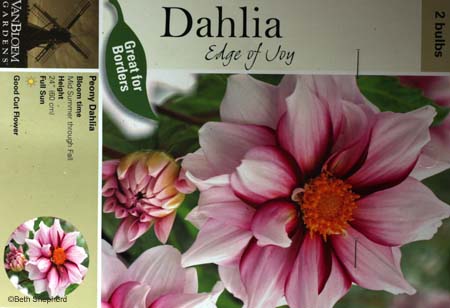
Edge of Joy
Spring, the season of hope, has finally arrived at the Urban Cabin. As a gardener, spring is my favorite time of the year. Birds add new twigs to their nests while they await their first brood of chicks. Tiny chartreuse buds are popping out on branches and, everywhere you look, trees are dressed in pink and white tutus.
Each spring my soul feels renewed. No matter the trials I may be facing, somewhere in the garden a new flower is ready to bloom. I water it with care and fertilize with love anticipating the day when tender green shoots will push themselves above the dewy soil.
This spring, as I tuck new flower bulbs into our garden, I am thinking of one special child who may be far away but will always have a place in my heart. I stop and pause, remembering a time when I held her tiny body against my own as we shared the warmth of the sun. Those days were pure bliss and for a few moments, I was on the edge of joy.
Eat like a bird
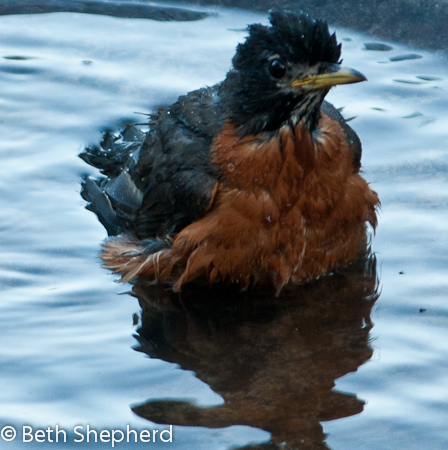
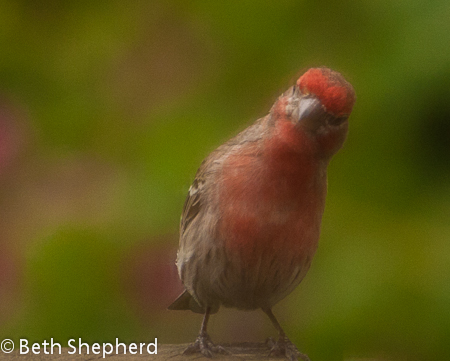
Mmmm. Nothing like a little Nyer thistle mixed with some sunflower chips, and millet to wet my appetite. Well, at least nothing like it, if I’m Mr. Finch. Rosy the robin starts her morning nibbling with a few tasty earthworms. Groovy grubs crawling on the ground look dang delightful to Freddy Flicker. And we all know that Mrs. Hummer has a sweet tooth and heads straight for the Scarlet Runner Beans after sidling up to the hummingbird feeder for an appetizer of sugar water.
Yes, I know it’s Wanderfood Wednesday and a post on birdie buffet qualifies oh-so-tangentially, but what can I say? My feathered friends are feasting happily these days and the Urban Cabin just became an official ‘Certified Wildlife Habitat,™’ so I was in the mood to sing the praises of all we’ve done to put food on “the table” for the denizens who frequent our yard.
Our back-forty is tiny, but what it lacks in size it makes up for mightily in food, both for us human folks and for those who fly, crawl and scamper inside its fenced walls. On the fruit front, Big Papa and I are lucky to host three Greengage plum trees (that are enormously prolific), one small apple tree (that doesn’t really produce much), two baby espaliered apple trees, two figs, three blueberry bushes, one huckleberry, one lingonberry, and a bunch of strawberry plants that substitute for ground cover along our east fence line. Veggie-wise, we’ve now got four raised beds filled with green stuff (struggling with our abysmal spring but planted nonetheless) plus two raised herb beds.
We’re still working on getting our yard back to 100% after the remodel, but slowly and surely plant and animal life is enjoying our garden once again. Cape Fuchsia bloom day-glow pink in one corner, assorted beans start their skyward climb up trellises and brilliant purple salvia beckon.
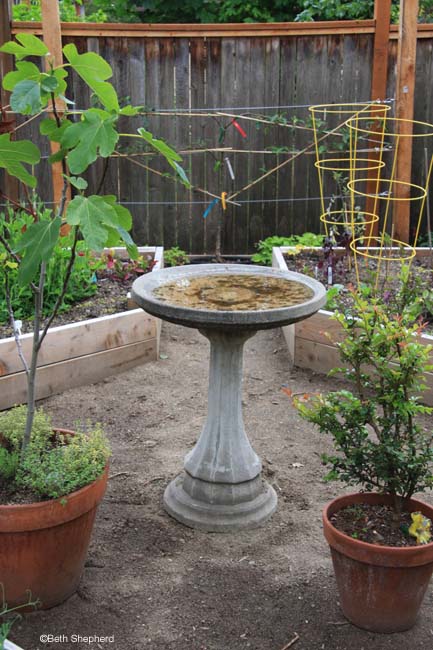
Besides the fruit trees, plants and flowers, “our” birds can find cover in two gigantic Poplars, (amazingly enough in our pipsqueak urban location) and a scattering of fluffy shrubs. They can take up long-term residence in two bird houses. Three birdbaths pepper the property so there’s always a spot for them to spruce up and preen.
I’d heard about National Wildlife Federation’s ‘Certified Wildlife Habitat™ for some time and finally decided to hop on to their website and find out exactly what would be required to register the Urban Cabin in their program. It’s quite simple, really. All you need to do is provide elements from each of the following areas in your yard:
Food sources : native plants, seeds, fruits, nuts, berries, nectar- Water sources: Birdbath, pond, water garden, stream
- Places for cover : thicket, rock pile, birdhouse
- Places to raise young: dense shrubs, vegetation, nesting box, pond
- Sustainable gardening: mulch, compost, rain garden, chemical-free fertilizer
As the NWF site says, “you don’t need a 20-acre farm to create a garden that attracts wildlife and helps restore habitat in commercial and residential areas. By providing food, water, cover and a place for wildlife to raise their young, and by incorporating sustainable gardening practices, you not only help wildlife, but you also qualify to become an official Certified Wildlife Habitat™.”
Alright then, let’s find out how the Urban Cabin stacks up:
- Provide food for wildlife: Several mature trees and an assortment of nectar, berries, and seeds that many species of wildlife require to survive and thrive. Plus, we have a few supplemental feeders.
- Supply water for wildlife: Bird baths and one rain chain.
- Create cover for wildlife: Shrubs and nesting boxes offer places to hide in order to feel safe from people, predators and inclement weather.
- Offer a place for wildlife to raise their young: One Mason bee box, two birdhouses and bushes where butterflies and moths can lay their eggs.
- Sustainable gardening: Composter, mulch, minimal chemicals and virtually no “turfgrass.”
Check, check, check, and check. Big Papa and I submitted our application. The Urban cabin will soon take its place alongside thousands of wildlife enthusiasts across the country who have turned their yards and gardens into Certified Wildlife Habitat™. How cool is that?
Of course the birdies couldn’t give a tweet about any of this. All that matters to them is that the “all you can eat” Urban Cabin Bar and Grill remains open and no one cries fowl at the feeder.
A little birdie told me
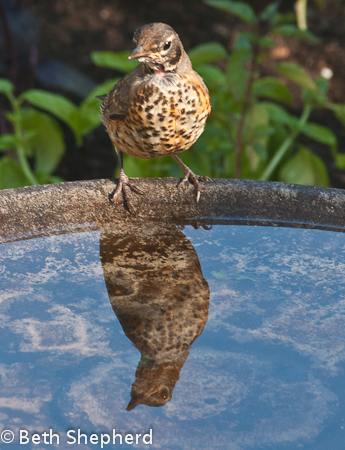
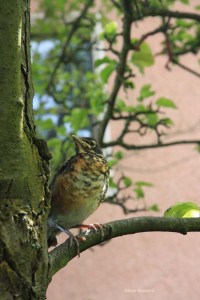
Last weekend we watched local family drama play out in our backyard. Three robin chicks were leaving the nest. The first thing that clued us in was all the commotion in the trees, tweeting, chirping, squawking and the flurry of wings. Soon, we spied two chicks in our plum tree. Shortly afterwards, we saw chick number three hopping around on the ground near our fence.
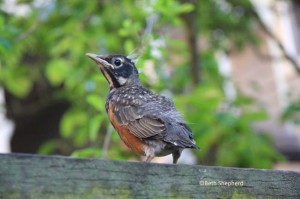
The chicks were impossibly cute, round little balls of speckled feathers, bits of fluff still hanging on. No necks to speak of, just a big yellow beak that periodically opened as wide as the Grand Canyon to accept worms, berries and grubs Mama and Papa stuffed down their hungry gullets.

One chick found his way to the fencepost and we caught him doing deep knee bends, squatting down and then up on his spindly bird legs, as if to say, “I’ll be darned, look how these things work.” For the most part they sat, in relative safety, under the cover of foliage on the trees, just taking it all in.
Mama and Papa robin, on the other hand were as hard working as any two birds with a family of fledglings could be, racing through the sky this way and that to find food for their youngins,’ while fending off the cadre of cackling crows. They would team up in a moment’s notice and dive bomb the crows to keep them at bay. We were both pretty impressed that Papa robin pulled equal weight in the “kitchen.” Each parent took turns keeping watch on the rooftops surrounding our yard as the other went in search of snacks.
Big Papa and I were tuckered out from the flurry of activity after a couple hours. Later in the day when we ventured back out to check on our little flock, we saw that two of the three chicks were gone, hopefully off to greener pastures. One of the three chicks was still nestled into the crook of a branch on our apple tree.
Mama and Papa robin continued to keep an eye on him and feed him, but we were a bit worried when he was still there the next morning. Special needs chick? Our neighbor thought he was the runt and that his failure to “fly the coop” didn’t bode well for his future. We kept our fingers crossed that he just needed a bit more time to get himself together.

Monday morning he was still in the tree. Big Papa managed to catch a glimpse of him during a test flight from the tree to a ledge on the nearby apartment building. A few hours later, he was back in the tree. Wings, legs, and feet all seemed intact and in working order. Maybe he just liked our little oasis and was reluctant to strike out on his own. When I returned later in the afternoon, he was gone. I guess he was just a late bloomer, something I understand. The plum tree seems a bit lonelier without him and our backyard is certainly quieter.
I think about our own brood of one, who we’ll bring to nest with us in the Urban Cabin. When he fledges, I’ll be on the verge of seventy. Right now, from where we sit, the distance from the branch to the ledge seems impossibly far away. It’s hard to imagine a kiddo running around the house, much less leaving the roost a couple decades down the road. Still, like our backyard buddies, that day will come when he stretches his wings and takes flight.