Pampers and Paklava

  • Home
  • Photography
  • Travel
  • Food
  • Garden
  • Contact

Pakhlava Recipe

July 22, 2009 by Beth Shepherd

Three cups of nuts, a cup and a half of butter, layers of flakey pastry, and enough sugar for an entire village, that’s Pakhlava. This weekend, Big Papa and I went to a shindig at “the other Beth’s,” aka Beth Whitman, the Wanderlust and Lipstick travel Diva! I thought it fitting to bring along some homemade Pakhlava. Plus, if I’m going to become a Mama to an Armenian child, I need to practice my Pakhlava technique.

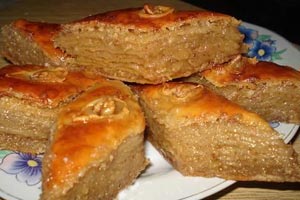
Plate of PakhlavaIn a previous post (You say Baklava and I say Pakhlava), I wrote a bit about the history of Baklava (the dessert and my own experience with it). I also touched on approach various countries take when baking this delectable pastry. Walnuts, pistachios, or almonds? Honey and sugar, or just sugar? Cinnamon or Cardamom?

Over the years, I’ve made a few variations on the them, but in this period of my life there’s no question. It’s Armenian Pakhlava all the way.

Pakhlava

Ingredients
1 pound (25) prepared Filo or Phyllo* dough sheets (approx. 13″ x 17″)
3 cups chopped walnuts
1 cup finely chopped almonds 1/2 cup sugar
1 Tablespoon cinnamon
1 orange peel, grated
1-1/2 cup clarified butter**

Syrup
2 cups sugar
1-1/2 cups water
4 oz. honey***
1-1/2 Tablespoon lemon juice

Preparation
1. Mix nuts, sugar, cinnamon, orange peel for filling.
2. Butter bottom and sides of a 13″ x 9″ x 2″ baking pan.
3. Cut sheets of Filo in half to fit the pan.
4. Place 10 cut sheets of Filo in the bottom of the pan, lightly brushing each layer with melted butter.
5. Sprinkle 1/3 of nut mixture on top of sheets.
6. Repeat with next 10 sheets and nuts until you have 30 layers of Filo and three of nuts
7. Place about 20 layers of Filo on top, lightly buttering each.
8. Using a sharp knife, cut through dough lengthwise and then diagonally about 1 1/2 to 2″ apart to make diamond shapes and pour a little melted butter on each diamond. Sprinkle lightly with water to prevent curling of top layers.
9. Bake for 15 minutes at 350° F.
10. Pour any remaining butter over dough and continue baking 25-30 minutes until it is golden brown in color. It is very important not to undercook the pastry.
11. While Pakhlava is baking, prepare syrup.
12. Place sugar, water and honey in a large pot and stir over medium heat until sugar has dissolved. Add lemon juice. Bring to a boil and continue to boil for 15 minutes.
13. Cool to lukewarm.
14. When dough is finished baking, spoon syrup evenly over Pakhlava. Let Pakhlava set for several hours. Cut into serving portions.

Notes
* Filo/Phyllo Dough: Paper thin prepared strudel-like dough used for flaky pastries such like Pakhlava. Filo is sold fresh or frozen, approximately 22 – 35 sheets to the pound box, depending on size and thickness.25 sheets are needed for this recipe. Frozen Filo dough is available in 1 lb boxes at most supermarkets in the freezer section. When using frozen Filo, it is important to slowly thaw the dough overnight in the refrigerator and then let it come to room temperature (unopened) for two hours before using. Filo dough dries quickly in the heat of the kitchen. Work with one sheet at a time, keeping the rest covered with a lightly dampened cloth.

**Clarified butter is used frying and making pastries. It is better than ordinary butter because it does not burn as easily. Pastries made with clarified butter will retain their freshness longer.

***The Greeks use honey in their syrup Armenian do not. Instead increase sugar to 2-1/4 cups.Homemade Pakhlava

Clarified Butter

You can also find clarified butter or Ghee, pre-made, in specialty grocery stores
Yield: 3 cups

Ingredients
2 lbs. unsalted butter

Preparation
1. Place 2 lbs. butter in a heavy saucepan. Melt over low heat.
2. Skim off foam with a spoon as it rises.
3. Simmer until the milky residue in the bottom of the pan begins to lightly brown (do not burn!)
4. Carefully pour off the clear butter into a container, leaving the residue at the bottom.
5. Cover and refrigerate.

Note
You can make this ahead and have it on hand. It will keep well for weeks in the refrigerator.
Filed Under: Food Tagged With: Baklava, Beth Whitman, clarified butter, cooking, Filo, Ghee, Pakhlava, pastry, Phyllo, recipe, Wanderlust and Lipstick

You say Baklava and I say Pakhlava

April 27, 2009 by Beth Shepherd

It was 1980. I was twenty and studying abroad in Amsterdam. Most of my fellow students were headed to the south of France for spring break. I had other plans.

My destination was Greece. I traveled by train through Germany, Austria, what was at the time Yugoslavia, before entering eastern Greece at Thessaloniki. I eventually made my way south to Athens, through the Peloponnese peninsula before taking a ferry to the island of Crete. It was decidedly adventurous undertaking for a young, single, and solo, female traveler.

I had read about Matala, a small village in southern Crete on the Mediterranean. Matala was famous for the artificial caves, carved into the rocks. These caves were first inhabited during the prehistoric period. Tombs found in the caves date from Greek, Roman and Early Christian times. During the 70’s the caves were hosting an international hippie community. Hippie chick that I was, this sounded like the ideal place to spend spring break.

Matala did not disappoint. I enjoyed several glorious days camping on the beach below the caves, where I connected with two women, traveling from Sweden. We spent our days soaking up the sunshine at Red Beach, the most famous nude beach on Crete and our nights dining at the cafes drinking Ouzo while feasting on Moussaka, Dolmades and Baklava.

Ah, Baklava. Flaky, nutty, buttery layers of syrupy goodness. Baklava consists of 30 or more sheets of phyllo dough brushed with lots of butter, and layered with finely chopped pistachios, walnuts, and/or almonds. After baking, simple syrup of honey or sugar, rose water and lemon juice (sometimes spiced with cinnamon, cardamom, cloves) is poured over the pastry and allowed to soak in.

Pakhlava

Twenty-eight years later, when my husband and I began exploring international adoption, our discovery of Armenian cuisine was a contributing factor to our decision to adopt from this country. Yoghurt, hummus, lamb, Shish Kebab, mint, stuffed grape leaves – we enjoyed them all. Along with Baklava, which in Armenia is, called Pakhlava.

History of Pakhlava

The exact origin of Pakhlava or Baklava is a bit of a mystery. Many ethnic groups, whose ancestry goes back to the Asia Minor or the Mediterranean, lay claim as the creators of this dessert. And their claims are all partially accurate since the origins of Baklava predate the many shifts that have occurred over the centuries with boundaries and borders of countries in these regions.

Around the 8th century, B.C., the Assyrians were the first people who layered chopped nuts between thin layers of thin bread dough, added honey and baked it in their primitive wood burning ovens. Historically baklava was considered a food for the rich until mid-19th century, as the earliest versions were baked only on special occasions.

Greek seamen and merchants traveling east to Mesopotamia soon discovered the delights of Baklava. They brought the recipe to Athens. Armenians, whose lands were located on ancient Spice and Silk routes, added cinnamon and cloves, Arabs introduced rose-water and cardamom. Each nation and region put their individual stamp on this delicious pastry.

From their table to our table

Paklava will most certainly be a welcome visitor at our dinner table. I am excited to share this treat, along with many Armenian culinary traditions, with our child. I believe it’s important to explore the rich histories of our ancestors as well as create new traditions that celebrate our uniqueness as a family.

Above my stove, is a magnet that reads, “She didn’t always follow the recipe.” I’d say it’s a good bet that I too, like those who preceded me, will find ways to make this dish my own. I might incorporate hazelnuts to celebrate our lives as Northwesterners, or add local lavender honey. Whatever the variation, it’s safe to say that Pakhlava is at our table to stay.

Filed Under: Adoption, Food Tagged With: Baklava, Crete, Greece, Matala, Ouzo, Pakhlava, Red Beach

Some might fend off a mid-life crisis by leaving the comforts of their corporate salary to jet off to a deserted island. Others might buy a Jaguar. I’ve chosen to dive head-long into my 50s and beyond by becoming a first-time parent. At any given moment you might find me holding a camera, a spade, a spatula or a suitcase. Or my little girl's hand. Adopted from Armenia, she puts the Pampers and Paklava into my life.

Subscribe to Blog via Email

Enter your email address to subscribe to this blog and receive notifications of new posts by email.

Recent Posts

  • Ghosts and goblins of Halloweens past
  • Raise a glass—or ten
  • No me without her: A life before motherhood
  • Leaving the orphanage with a priceless pair of tights
  • Rock of ages: Celebrating five years together as a family

Tags

366 Project Adoption anniversary Armenia autumn Bainbridge Island Baja Birds birthday blog cat cats chickadee China Christmas fall ferry flowers France Garden Gyumri Halloween Hawaii Holiday ice cream Kauai leaves London Mamas with Cameras Mexico Mother's Day Mt. Rainier New York orphanage Paris Puget Sound robin Seattle taxi Thanksgiving Tibet USCIS Valentine's Day wedding Yerevan

Categories

  • Adoption
  • Armenia
  • Family
  • Food
  • Friendship
  • Garden
  • Holiday
  • Miscellaneous
  • Paris
  • Photography
  • Recipes
  • Review
  • Seattle
  • Things to do with kids
  • Travel

Sites I like

  • The Wayfaring Voyager
  • Wanderlit
  • Wanderlust and Lipstick
follow us in feedly

Image Copyright

Unless specifically mentioned, all images on my blog are my own original photographs and, therefore, copyright protected (©Beth Shepherd). Feel free to use my images for non-commercial use so long as you provide me with the image credit. Likewise, if you pin my images to Pinterest, please mention me by name.

Copyright © 2026 · Pamperspaklava · WordPress Barista